









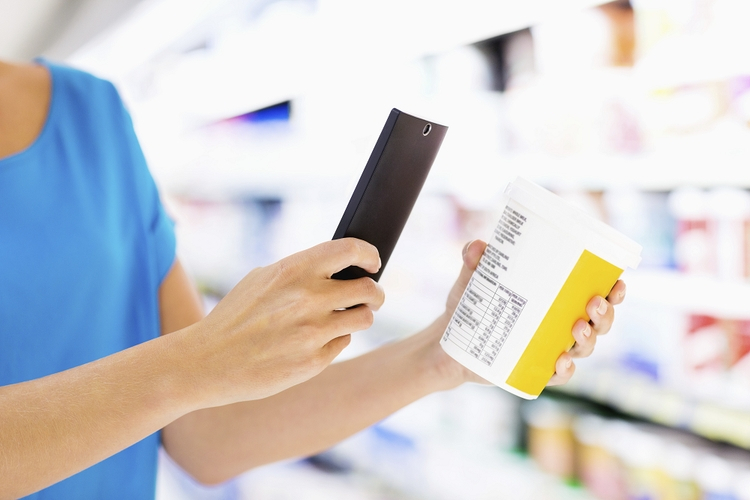
Reliable and credible data from the GS1 Poland eProdukty product database supports the Polish Asisto application, which helps visually impaired consumers recognize products.
Asisto is a personal assistant in the form of a mobile application tailored for use by the visually impaired. Thanks to artificial intelligence algorithms, the application accurately locates and identifies products on store shelves. The solution uses the latest image interpretation models, eliminating the need for a third party during shopping and reducing the level of social exclusion for these individuals.
– We came up with the idea when we accidentally met our blind friend in a supermarket. He was shopping with his disabled friend who uses a wheelchair. After talking, we learned that one of the biggest problems for blind people is carrying out daily duties, such as grocery shopping. Our friend does it three or four times a week and needs the help of a sighted person to guide him to a specific shelf and point out a given product. The conversation convinced us that such an application has a chance to realistically influence the standard of living for people with perception disorders – says Adam Stelmaszyk, a student at the Faculty of Computing and Telecommunications at the Poznan University of Technology, co-creator of the application.
The Asisto application helps fight the social exclusion of disabled people through technology. Its authors emphasize that the main premise of the project was to improve the shopping experience of blind people and enable them to shop independently and safely.
– In our solution, we were primarily guided by the principle that the process should not require the involvement of any third parties. Regardless of whether it is a close friend, a store employee, or a random volunteer, people with disabilities may feel embarrassed in such a situation. Our idea uses the latest technological progress, which has created new possibilities in the field of automated object recognition in photos over the last few years. With its help, we are redefining the consumer area to better include blind or visually impaired people in society – comments Mikołaj Sienkiewicz, a computer science student at the Faculty of Computing and Telecommunications at the Poznan University of Technology, one of the creators of the application.
Creating an application based on image recognition required “training” an artificial intelligence algorithm. It works on a similar principle to the eye of a sighted person – it learns to recognize the characteristic features of a product based on provided images. Developing the application therefore required collecting a very large amount of professional product photos. The application uses the GS1 Poland eProdukty product database, which contains information on over 30 million products.
– On the eProdukty platform, we collect data on products to ensure a consistent omnichannel shopping experience for consumers. We also want them to be sure that they are buying original and safe goods, guaranteed by the GTIN number from GS1 – comments Magdalena Krasoń-Wałęsiak, e-commerce manager at GS1 Poland.
The cooperation between the global organization GS1 and creative students is proof that cross-sectoral solutions bring many benefits by drawing on different experiences. It also confirms that a sustainable economy is based on reliable data.
– The very idea of barcodes is a socially responsible concept. It provides a guarantee of product originality, which can even determine a person’s life and health, as is the case with protection against counterfeit medicines. Data regarding the products themselves, but also their footprint throughout the supply chain, are the basis for sustainable development. In an era of high consumer awareness and the increasing role of the circular economy, information about a product may soon be more important than the product itself, so by helping to collect data, GS1 plays an incredibly important and responsible role – claims Marta Szymborska, communications and CSR manager at GS1 Poland.
The application is being developed thanks to a grant from the “Accessibility Generator” Social Innovation Incubator, which supports innovative solutions in the field of accessibility in Poland. The team is looking for help in collecting data using smartphones and the AsistoV application. The latest version of the application is available in the Google Play store. More information can be found at https://asisto.pl.