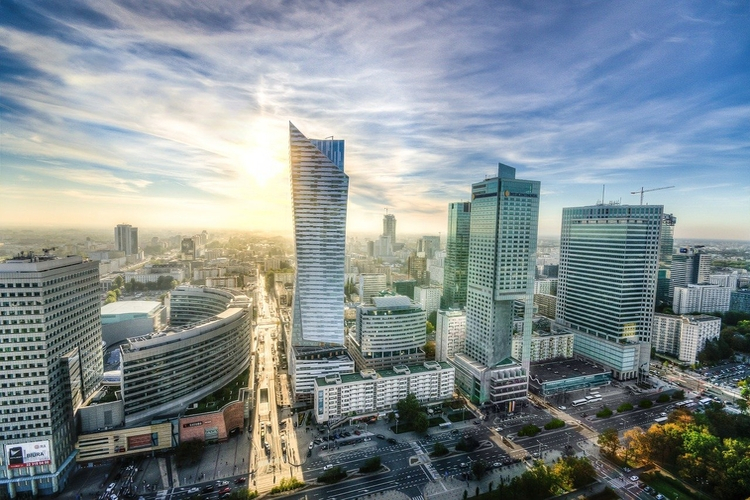
The capital of Poland is one of the oldest and most mature warehouse markets in the country. The region’s warehouse sector continues to evolve, offering tenants various options for space and location.
Over the last decade, the Warsaw warehouse market has changed significantly. The main trend has been the displacement of warehouse and production facilities outside the city center, and even beyond its borders. Post-industrial areas in Wola or Praga Południe have been converted into office buildings and residential estates, completely changing the character of these districts. Nevertheless, at the end of the first half of the year, total warehouse stock in Warsaw amounted to nearly 665,000 sqm, which represents a 7% year-on-year increase. This was determined by the location.
– Warsaw has the largest communication infrastructure among all warehouse markets in Poland. For years, the city has benefited from an excellent network of roads and highways, rail connections, and the cargo terminal at Chopin Airport. The location also benefits from logistically well-developed suburbs, which successfully absorb part of the strong demand for warehouse space, as well as a very large pool of qualified employees – says Anna Peczela, Senior Industrial & Logistic Consultant at AXI IMMO.
Companies looking for space to rent most often choose facilities or warehouse halls located near exit roads from the city, mainly in the Okęcie, Żerań, and Targówek Przemysłowy areas. A slightly smaller logistics base is located in Ursus and Ursynów near the airport. High land acquisition costs in Warsaw contributed to lower supply in the first six months of 2020, which amounted to only 9,000 sqm. During this period, 71,000 sqm were under construction. More than 1/3 of these are speculative investments. Most of this space is being built in the areas of Okęcie, Ursynów, Annopol, and Targówek.
Investment in last-mile logistics
Warsaw, as the oldest and most mature market, was the first to start investing in the construction of warehouses dedicated to the logistics service of the so-called last mile.
– The Warsaw warehouse market concentrated in the city had to face changing trends. On one hand, with the relocation of warehouse areas outside the central zones of the city, and on the other, with increased demand shown by companies serving the e-commerce industry and those that need a location in the city, close to the consumer. Adapting to new conditions forced developers to change their existing policy regarding the space provided and increasingly look for “brownfield” investments, i.e., already built-up areas. Changes in shopping trends have caused not only smaller entities but also large logistics and distribution companies to become interested in urban warehouses – says Anna Peczela.
Structure of the warehouse market in Warsaw
– In the first six months of 2020, gross demand on the urban warehouse market in Warsaw amounted to 87,000 sqm, and one of the larger transactions was the signing of a lease agreement for 21,000 sqm of space by a company from the Data Center sector. This shows that not only goods can be stored in halls, but also data placed on servers, which need specialized warehouse space – emphasizes Anna Peczela.
Those interested in the Warsaw market also include active logistics tenants, courier companies, online stores, and the FMCG industry. Strong demand generated by tenants, combined with limited new supply, caused the vacancy rate to fall from 8.6% at the end of the first quarter of 2020 to 6% at the end of June 2020. Rental rates during this period remained at the level of 4.80-5.25 EUR/sqm, similar to previous quarters of 2019. Recent years have brought dynamic development of large logistics centers located about 30-40 km from the center of Warsaw, intended to serve the e-commerce sector. There was also a greater demand for smaller warehouses located 10-15 km from the center and Small Business Unit facilities located within the city.
– It is precisely thanks to SBU-type facilities that Warsaw successfully implements the strategy of the so-called last-mile logistics model, which uses halls located within the city’s administrative boundaries, allowing for the organization of distribution, a showroom area, and a representative company headquarters in one place – concludes the AXI IMMO expert.
Source: AXI IMMO
Read also about the warehouse space market:
– Demand for warehouse space is growing
– Cushman & Wakefield Report – Marketbeat Poland – Q2 2020
– The warehouse and industrial real estate market surprises again
We write more about last-mile logistics in the magazine Logistyka 5/2020.
The e-edition of the magazine is available in our offer!