Finding a compromise between the economic and ecological aspects of human activity is one of the main trends currently prevailing in logistics. We asked Paweł Sapek from Prologis about the ecological solutions used in logistics facilities*.
Izabela Wielicka: What has the greatest impact on the development of eco-logistics? The awareness of entrepreneurs, consumers? Or is it perhaps forced by legislation?
Paweł Sapek: One of the main reasons why ecological solutions in logistics are becoming increasingly popular is that they have simply started to pay off. With the popularization of sustainable technologies, their implementation is becoming more and more cost-effective. As a result, the application of solutions in the field of sustainable construction and the use of RES currently translates into real savings for tenants – and this is clearly visible in lower operating costs. The influence of international funds, for which environmental certificates are a determinant of property value in Poland, is also significant. An important stimulus for the industry is also the changing perspective of tenants, who attach increasing importance to conducting business in a sustainable and environmentally friendly manner. The issue of responsible management of natural resources with minimized operating costs will therefore become more important year by year. Every year, goods worth $2.2 trillion flow through our distribution centers, which accounts for almost 2.5% of global GDP. The wider the scale of operations, the greater the responsibility – we are aware of our role in the global economy, which is why we work to minimize our impact on the planet. Sustainability has always been in our DNA, and we strive for excellence in environmental management and social responsibility, i.e., ESG. For many years, we have been recognized as one of the most sustainable companies in the real estate market.
I.W.: A lot is being done in the transport industry to reduce carbon dioxide emissions into the atmosphere. Intermodal transport, using more ecological rail, is growing. We are witnessing the coming era of electromobility. We know a little less about what ecological solutions are used in logistics facilities. What are the ecological standards for warehouses?
P.S.: In the case of logistics real estate, one of the market benchmarks is BREEAM – a system for assessing buildings and infrastructure projects in terms of their environmental impact. As the most sustainable company in the logistics real estate industry in the world, according to the Global 100 ranking, we subject every new Prologis building in Central Europe to BREEAM accreditation. So far, we have built over 40 warehouses in the CE region that have received a BREEAM rating, including being the first developers to receive the highest possible rating – Outstanding – for the Prologis Park Prague-Rudna building, and last year it was joined by a warehouse in Park Prague-Airport in the Czech Republic. From the customers’ point of view, it is important that certified buildings mean real savings in operating costs, because BREEAM criteria require solutions assuming, among other things, the lowest possible utility consumption. All our warehouses are also equipped with a smart metering system for remote monitoring of utility consumption. The application allows customers to monitor electricity, water, and gas consumption, as well as take temperature and humidity measurements in their warehouses from every corner of the world, which allows for even more responsible management of natural resources. It is worth remembering that, given the current adaptability of buildings, many modern, green solutions such as photovoltaics or LED lighting can be implemented in standard, already existing facilities.
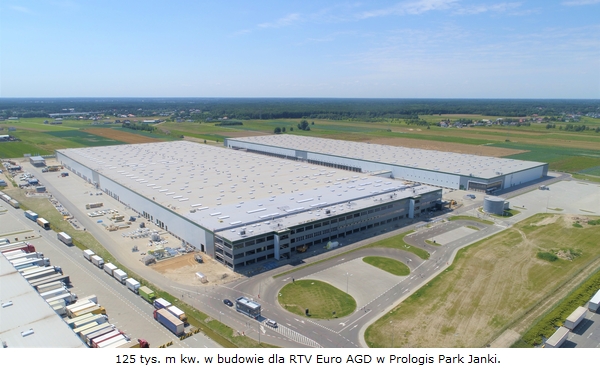
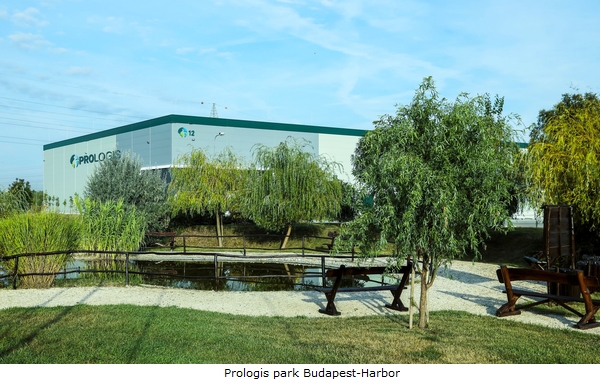
An example of a Polish investment in which we combined the need for maximum operational efficiency with a simultaneous reduction in environmental impact is Prologis Park Janki. Near Warsaw, we are building one of the largest distribution centers in Europe, with an area of 125,000 sq m, for the owner of the RTV Euro AGD brand. Together with the client, we opted for a number of sustainable construction solutions, such as energy-efficient LED lighting, large daylight illumination, walls with increased thermal insulation, ergonomically designed offices, and a smart metering system that helps control the level of natural resource consumption. The park also features a photovoltaic installation, street lamps powered by hybrid solar and wind energy, a rainwater recovery system, and CO2-absorbing concrete paving stones. For the convenience of employees, but also to promote low-emission transport, a bus stop, bicycle shelters, and electric vehicle charging stations are being built directly next to the warehouse buildings. We are also creating a green relaxation zone in the park with space for rest and recreation for employees. Similar green areas – with places for barbecues, picnics, sports, and with special plantings, birdhouses, and insect hotels – are already successfully operating in our other parks in the region, for example in Prologis Park Budapest – Harbor in Hungary.
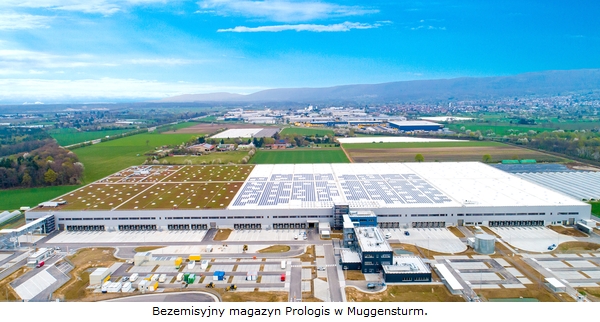
The pursuit of minimizing the ecological footprint, which will be combined with operational savings, is an important trend that we, as a developer, are developing and popularizing. One of the examples of breakthrough investments in this area is our tailor-made building for L’Oreal in Muggensturm, Germany. It is a completely carbon-neutral facility, equipped with a photovoltaic installation, a green roof, and a water recovery system. The energy supplied to the facility comes exclusively from renewable sources: sun, wind, and hydroelectric power plants.
I.W.: Ecology is often associated with luxury. Ecological goods are more expensive. There is therefore an opinion that environmental protection is a higher good, but it is not economical. Can ecology in logistics really pay off?
P.S.: It definitely already pays off. Let’s look at electricity expenses, which are currently one of the largest components of operating costs in warehouses. The answer to rising energy prices and higher electricity bills resulting from the increasing degree of warehouse space utilization is energy-efficient LED lighting systems. Our estimates indicate that it is 60-80% more energy-efficient than other technologies, such as fluorescent lighting. In the case of LEDs, we also have greater consistency in luminance levels and color temperature, which improves employee well-being as well as work efficiency and safety. To popularize this solution, we introduced a special LED program as part of the Prologis Essentials Marketplace platform. Thanks to this, our customers can replace their existing system with intelligent LED lighting with a built-in motion and time-of-day response function on favorable financial terms. Another way to achieve concrete electricity savings is the use of photovoltaics. In this area, we also support our customers by offering the SolarSmart service in some European countries, which allows them to benefit from energy generated directly in the building and contributes to reducing their carbon footprint. In our Hamburg warehouse alone, the solar installation, which generates 650 MWh per year, generates 293 tons of CO2 savings during that time. The fact that the solution is profitable is proven by the numbers – so far, over a hundred of our customers have taken advantage of the opportunity to install solar panels in their buildings, which gives a gigantic value of 212 megawatts of generating capacity.
I.W.: Logistics is driven by e-commerce. Its already fast pace of development was additionally boosted by the coronavirus epidemic. Prologis looked at the issue of sustainable development in the online retail sector and published the report “E-commerce and logistics real estate: the benefits of sustainable development”. What conclusions did this research bring?
P.S.: This study was the first analysis conducted by the Prologis Research Department regarding the potential that e-commerce has in shaping sustainable trade. The research teams, using statistical modeling, analyzed the carbon footprint in individual trade models. The calculation showed that e-commerce is more sustainable than trade in traditional retail outlets. The main factor affecting the environment is transport, and the consolidation of deliveries makes e-commerce more efficient in this regard. Combining multiple deliveries within a repeatable route allows for reducing the carbon footprint of transport by over 50% – measured in kilograms of carbon dioxide equivalent – compared to the amount of emissions produced by consumer vehicles during individual shopping trips. Currently, the supply chain allows for the maximum shortening of the distance between the operational center and end consumers thanks to Last Touch facilities and urban distribution centers. Every reduction in the distance traveled by vehicles has an impact on reducing carbon dioxide emissions, and at the same time on lowering operating costs. If we add to this the faster pace of implementing electric vehicles by logistics companies compared to individual customers, then online shopping really influences the reduction of CO2 emissions compared to shopping in stationary stores. Although e-commerce requires more packaging, this does not change the fact that this sales model is more beneficial in terms of transport savings. Replacing many shopping trips with direct home deliveries is a more beneficial solution, even taking into account the higher percentage of returned products. It is estimated that thanks to online shopping, retail trade reduces its negative overall environmental impact by about 15%.
I.W.: Prologis describes itself as a leader in environmental protection and social responsibility. What specific pro-ecological achievements has Prologis managed to obtain?
P.S.: As a global company, we try to develop standards on our own, which I hope will be a stimulus for change for the entire industry in this regard. Among other things, as the first company in the real estate industry from the S&P 100 index, we achieved carbon neutrality of our operations, we also extended our commitment to reducing carbon dioxide emissions throughout the building’s life cycle to all of Europe, and in cooperation with Cool Earth, we protect rainforests. Our pro-ecological projects and activities are measurable and translate directly into a number of benefits for customers, including financial ones, which is why we analyze and report them annually as part of ESG (Environmental, Social and Governance) standards. This allows us to constantly raise the bar and set new goals. When the power of our solar installations exceeded – a year and a half ahead of schedule – the original goal of 200 MW by 2020, we set a new one – 400 MW of green energy by 2025.
An important element of our strategy is also social sustainability. In Central Europe, the Parklife program helps us realize this idea, thanks to which our logistics parks are much more than just buildings. We focus on the needs of employees and try to offer them a friendly workspace – from numerous transport amenities to green areas for rest and recreation within the park. By building a favorable work environment, we can simultaneously provide added value to our customers.
I.W.: Thank you very much for the conversation.
 |
Paweł Sapek Senior Vice President, Regional Head CE & Country Manager Prologis Paweł Sapek, as Senior Vice President and Regional Head for the Central Europe region, is responsible for the entire company portfolio in the region (Poland, Czech Republic, Slovakia, and Hungary) with a total area of 4.2 million square meters. In addition, he manages the Polish branch of Prologis and directly supervises operations in Hungary. Paweł Sapek oversees the company’s investment and operational activities throughout the country, including the implementation of business strategy, identification of investment opportunities, new investments, and customer acquisition.
|
We write more about trends in eco-logistics in the Logistyka magazine 4/2020.
The e-edition of the magazine is available in our offer!