The answer to this somewhat provocative question is, contrary to appearances, simple. On one hand, we are dealing with visionary concepts whose full implementation depends on many factors, while on the other, we can speak of a kind of mission, which is the pursuit of sustainable development in transport. In both cases, we must be aware that these are extremely expensive, complex, and long-term undertakings. It is no wonder, then, that in such situations, the optimism of enthusiasts contrasts with the skepticism of pessimists.
From the point of view of classifying transport branches, the issue in question falls into the area of pipeline transport, referring to solutions that have been functioning for many years in the field of oil, gas, and liquid transmission. However, the use of an underground pipeline system for the transport of, for example, general cargo, undoubtedly represents a new quality in logistics and testifies to its almost inexhaustible potential for innovation. Moreover, all such solutions are an example of a new approach to meeting EU requirements regarding the reduction of greenhouse gas emissions. They can also be an antidote to transport problems such as congestion, which urban agglomerations are struggling with.
CargoCap, or the urban logistics of the future
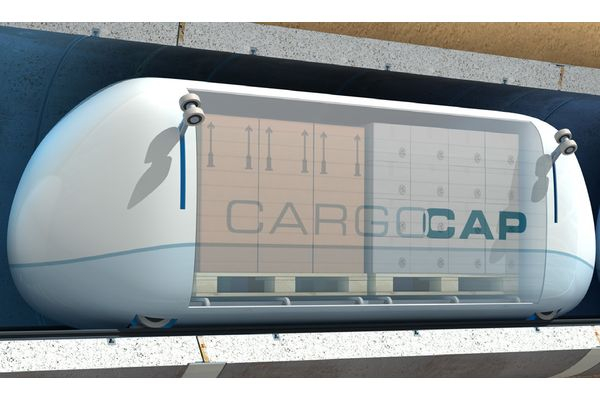
CargoCap – a system of electric freight capsules moving in a tunnel located 6 m underground – is a very original solution that is the result of a research project carried out between 1998 and 2002 by a team of scientists from the Ruhr University Bochum (RUB) under the direction of Prof. Dietrich Stein. In recent years, a special 1:2 scale model line was built to conduct ground-level tests of the capsule.
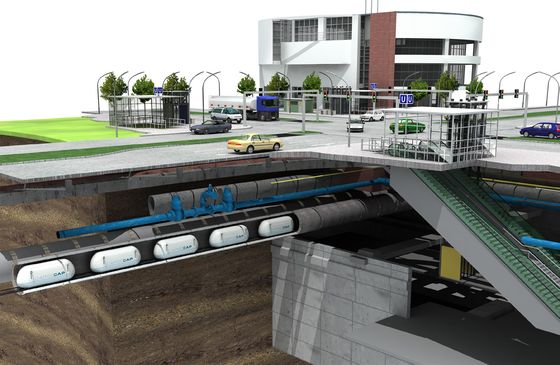 Photo 1. Visualization of the CargoCap system
In the context of seeking alternative solutions to traditional transport, Stein’s idea fits perfectly into the area of urban logistics and is an interesting attempt to solve the “last mile” problem. The goal of the CargoCap system creators was an alternative connection between logistics centers (GVZ), located outside the city, and urban hubs (urban consolidation centers), from where goods would be delivered to recipients (e.g., shops) by electric vehicles and city bikes. In the original plans, an 8-kilometer section between the center of Bergisch Gladbach and a logistics center located by the A4 motorway was chosen as a “testing ground.” However, improving urban logistics is not the only area of application for CargoCap. From the point of view of manufacturing companies, an important advantage of the system is also the possibility of its use in internal transport, where transport capsules can run between a transshipment station and a production plant. In this case, the designers provided an option for reverse flows (for the removal of waste or empty containers). So far, the project – as a comprehensive logistics system – has not been realized. The launch of the entire system in the center of Bergisch Gladbach was scheduled for 2021, which, however, seems unlikely, as work on the feasibility study is still ongoing. This ambitious undertaking is an example of a rather paradoxical situation – developing a concept and constructing a functioning, extremely innovative vehicle and an entire logistics system is not the only challenge. The next step is to overcome administrative barriers, convince local authorities and residents, and reconcile the conflicting interests of various groups. Nevertheless, the idea itself is not utopian, and in the context of growing interest in urban logistics and pressure to implement eco-friendly solutions, it will be realized, if not in the place of the planned application, then in other locations. One should therefore hope that the realization of these ambitious plans will only be a matter of time.
People overground, cargo underground
The slogan of the Swiss consortium Cargo Sous Terrain (CST) seems like a rather unusual, but from the point of view of eco-logistics and urban logistics, a rational proposal. Compared to the previous solution, the functionality of CST is similar, but the scale and possibilities of using underground transport stimulate the imagination, if only for the reason that, ultimately, the tunnel in which specially designed autonomous vehicles will move is intended to be 450 km long and connect several cities. According to the plans, in the first stage of the project, a 70 km long section is to be put into operation. Along its route, there will be 10 hubs (automatic loading and unloading stations), from where cargo will be picked up by operators. According to Rhenus Logistics experts, the transshipment capacity of intermediate stations (loading and unloading) along the route is as much as 1550 pallets/h. The vehicle itself can carry loads placed on two pallets up to 2.4 m high. From the point of view of the functionality of the entire system, its creators have taken on an even greater challenge than the designers of CargoCap – they have also provided for an additional form of delivery, which is to be a cable car running in the tunnel for transporting smaller loads, such as letters or parcels, moving at a speed of 60 km/h.
Unlike the German CargoCap, the preparation of design work involved the need to create a new legal framework for this unprecedented infrastructure and logistics undertaking. Recent announcements from the CST consortium indicate that the draft law on underground freight transport will be submitted to the Federal Assembly (parliament) this autumn. Reading press reports and the opinions of some politicians, one can have mixed feelings about the success of the project; in the opinion of some, the entire undertaking is too visionary, structurally daunting, and therefore extremely expensive (3.5 billion CHF). From a historical perspective, however, it must be admitted that the Swiss have unquestionable experience in carrying out tunnel construction investments, as exemplified by the Gotthard Tunnel.
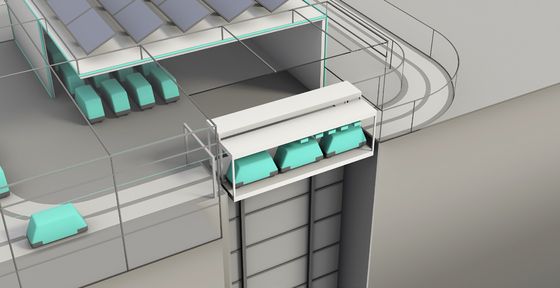 Photo 2. Visualization of the Cargo Sous Terrain system (loading and unloading station)
The importance of the project in question is evidenced, among other things, by the fact that its first foreign partner was the Californian Hyperloop One (now Virgin Hyperloop). 31 entities are already participating in the project, including companies representing the IT and logistics sectors (e.g., SAP, Rhenus Logistics, SBB Cargo, as well as Swiss Post). Retail chains also have high hopes for the venture, if only because such giants as Migros and Coop have become involved in its implementation. The good news from recent weeks is that, despite the pandemic, work related to the preparation of the project has continued. Moreover, at the beginning of June this year, the consortium acquired further investors. The completion of the entire project is planned for 2031. The Swiss, at least the project’s enthusiasts, have high hopes for it. If the expected reduction of truck traffic on roads by as much as 40 percent by 2045 is taken as a measure of potential success, the benefits seem to be tangible.
Underground transport in… a hospital
Austrian Graz is known for its ecological approach to transport, if only thanks to the presence of the Cargo-Tram freight tram on the streets of this city (which we wrote about in issue 5/2019 of “Logistyka”) and, of course, one of the most important logistics centers in Europe, which is the Cargo Center Graz (CCG). An even more unusual example of a solution serving the city and its residents, however, is the use of electric vehicles in the basement of the University Hospital (Medical Center Graz). Unlike the first two – nevertheless – futuristic projects using alternative types of transport, the “freight metro” under the hospital has been successfully operating – and here is an interesting fact – for over a dozen years (construction of the system, which was launched in 2004, began in 1999). The implementation of the project was certainly favored by circumstances related to the existing underground infrastructure. For this purpose, a tunnel located under the hospital, which was excavated at the beginning of the 20th century, was used and adapted for the purposes of modern transport. The loads transported underground are medical tools, bedding, medicines, and meals necessary for the hospital’s operation. The functionality of the solution is not limited only to making deliveries to individual transshipment points – the system also works in the opposite direction – 2800 tons of waste are removed from the clinic area annually, which is the majority of the 3600 tons of waste generated by the facility. Only electric vehicles are used for transport, and there is also an underground freight station in the tunnel. The project of the Austrian designers is not only an interesting example of the successful implementation of a vision of transport of the future, but also – in a broader sense – a unique example of hospital logistics in operation.
An optimistic conclusion
The described solutions resemble the original Hyperloop, although in terms of, for example, speed of movement, none of them can compare with that system. That was probably not the point for the creators of CargoCap and Cargo Sous Terrain. The idea of the described undertakings is to carry out deliveries using underground transport technology over relatively short distances, at a speed allowing for the realization of transshipment and loading functions and the integration of nodal points with elements of surface infrastructure (collection points). Their common feature is that they are not limited to using transport for “point A to point B” delivery functions, but are an element of an innovative, extremely extensive logistics system. Their success will revolutionize not only transport itself in a technological sense, but will also change the current approach to new forms of delivery.
The article comes from the magazine Logistyka 4/2020.
We also wrote about the transport of the future in the magazine Logistyka 5/2019.
The e-edition of the magazine is available in our offer!