









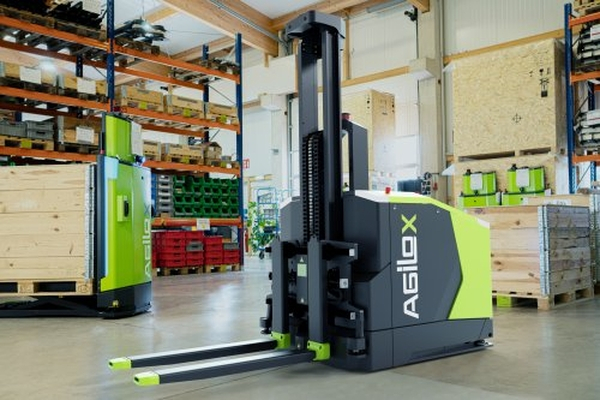
AGILOX has introduced an autonomous, omnidirectional counterbalanced forklift that operates based on swarm intelligence. The vehicle marks the beginning of the new “OCF” series and the company’s expansion into new areas.
– The OCF is a logical addition to our product portfolio. It opens up opportunities in warehousing and order picking technology. This creates a large market where IGV vehicles can demonstrate their advantages over both AGVs and manually operated forklifts – said Eng. Franz Humer, co-founder and CEO of AGILOX.
Small and lightweight AGILOX IGVs organize their routes according to decentralized swarm intelligence principles, making them significantly more flexible than traditional AGVs. Furthermore, programming or “teaching” the vehicles becomes much easier, while central software for maintenance, updates, etc., becomes obsolete. This innovation reduces operating costs.
The previous ONE series vehicles are equipped with a scissor lift that acts as a load transfer device – transporting the load within the vehicle’s footprint. The new OCF (Omnidirectional Counterbalanced Forklift) series vehicle is designed as a counterbalanced forklift. Consequently, it can carry pallets, lattice boxes, and other load carriers weighing up to 1500 kg, transport them to their destination, and place them at heights of up to 1600 mm.
The intelligent and efficient IGV concept from AGILOX is finding new areas of application. While ONE vehicles are primarily used for material delivery in production, the OCF enables the execution of classic intralogistics tasks in inbound and outbound goods handling, order picking, and warehousing, as well as in production – provided that transport is carried out on pallets.
Like the ONE, the OCF also utilizes an omnidirectional drive concept. This allows it to drive sideways through narrow aisles, turn on the spot, and maneuver in tight spaces. The same lithium-ion (LiFePO4) battery technology ensures fast charging and long operation – just three minutes of charging is enough for up to an hour of work.
IGV fleets can be connected to customer software systems, such as LVR, ERP, WMS, MES, etc., using an open API. An optional IO box allows for the integration of external infrastructure, such as sliding gates and stationary conveyors, into the intelligent control system. An analytics module provides the user with all relevant operational data and KPIs.
A major advantage is also the combination of ONE and OCF operations in a “swarm”. While smaller vehicles provide material delivery to assembly stations or use e-Kanban racks, the OCF can take over pallet transport using the same control system and WiFi infrastructure.
The OCF pilot series has already been successfully tested in Vorchdorf, Austria. Serial production will begin soon, and the first OCF vehicles will reach customers in the first quarter of 2021.
Source: AGILOX