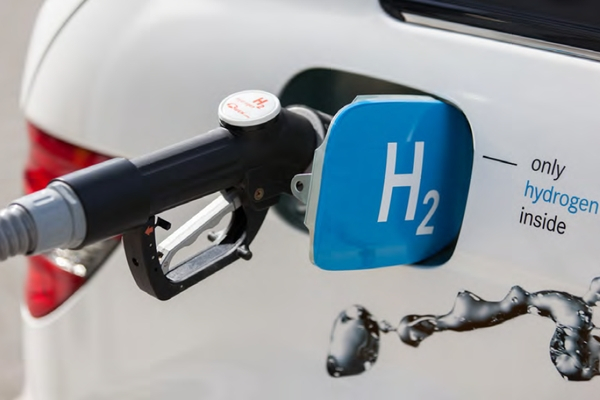
In 2021, the first hydrogen station will be built in Poland. PGNiG will invest in it. The tender for its design and construction was won by Górnośląski Zakład Obsługi Gazownictwa Sp. z o.o. (GZOG), which will build the station in a consortium with the Scottish company Pure Energy Center. Marek Pinkas, the GZOG vice-president responsible for the project, talks about the advantages, strengths, and weaknesses of hydrogen, as well as its future in the fuel industry.
Urszula Dziewit-Gontowska: Will we be driving on hydrogen in the future?
Marek Pinkas: Yes, but to put it precisely: we will be driving on electricity, which we will draw from hydrogen fuel cells. Because hydrogen is not a fuel in the dictionary sense of the word, but an energy carrier. I think that the automotive industry and the industry in general will develop in the direction of increasing the use of hydrogen. This is signaled quite clearly by China, which is shifting subsidies from electric cars to hydrogen ones. A condition for the success of the idea of using hydrogen in transport is the use of renewable energy sources for its production. After all, we are considering the topic of zero-emission fuels.
U.G.: Will we also be sailing and flying on hydrogen?
M.P.: The entire transport sector can benefit from hydrogen. Besides, space rockets were already using hydrogen fuel during the Apollo missions. In a few months, 14 hydrogen-powered passenger train sets will enter the tracks of Lower Saxony in Germany. The year-and-a-half-long tests yielded very promising results. Maritime transport will probably breathe a sigh of relief, because hydrogen can solve the problem of heavily smoking ships entering ports and will protect shipowners from severe financial penalties. If we invest in converting boilers and burners to H2, then steel production and boiler rooms can also draw energy from hydrogen. Hydrogen cells are already used on a fairly large scale in forklifts, for example in companies like Amazon or Walmart. The first companies in Poland are also already using them. I think that the range of possibilities for using hydrogen for energy production will systematically expand.
 U.G.: Where does this huge surge of interest in hydrogen come from?
M.P.: In the context of global environmental requirements for CO2 reduction and the development of renewable energy sources (RES), hydrogen can be the answer to very serious challenges: energy storage and distribution. We have quite a lot of clean technologies in Europe: onshore and offshore wind turbines, underwater floats, photovoltaics, biogas, geothermal energy. RES are already producing so much energy that there is sometimes too much of it. On May 1, 2018, in Germany, so much electricity was produced from clean sources that the surplus had to be exported (for a surcharge!). Coal, gas, and nuclear power plants could have been turned off, but for technical and safety reasons, it was not possible. This confirms the potential of RES, but both wind turbines and solar panels do not always produce energy when it is needed. And for now, there are no good methods for large-scale energy storage. It turns out that underinvested power grids across Europe cannot cope with sudden waves of surplus power, hence, to save the entire grid, it must be partially turned off. Countries then pass this power around like a hot potato. The solution to the energy storage problem is, for example, pumped-storage power plants (they account for 99% of the world’s energy storage), where, using excess electricity, water is pumped into higher-located reservoirs, and in times of energy shortage, water is released into lower-located reservoirs. Giant metal or concrete blocks that are lifted and stacked in piles, and then lowered, work on a similar principle. Germany tried to use salt caverns, in which energy was stored by injecting some neutral gas under pressure. However, it is difficult to scale all these methods. Meanwhile, electrolyzers and hydrogen cells are highly scalable and can come in very large, industrial sizes as well as quite small ones.
U.G.: What is needed to produce hydrogen?
M.P.: To produce hydrogen, an electrolyzer is needed, which in the process of electrolysis separates water into hydrogen and oxygen. In practice, three types of electrolyzers are used. The most popular and effective are alkaline ones. Their downside is the fact that they require the addition of a liquid electrolyte. In turn, dry electrolyzers are a newer technology, but less proven, and also quite expensive because they require platinum compounds. There are also oxygen electrolyzers that require high temperatures, so they are the least ecologically efficient. Electrolyzers can have different sizes: from large, industrial ones to quite small ones, used, for example, at gas stations. In turn, in fuel cells, the reverse process occurs: hydrogen combines with oxygen. This reaction leads to the generation of electricity, and its only byproduct is water vapor.
U.G.: GZOG won the tender for the construction of the first hydrogen station in Poland, and you are personally responsible for this project. Is a revolution brewing in the Polish fuel market?
M.P.: It is still quite a long way to a revolution. This first station will be small, intended for research purposes, as part of the Hydra Tank program. Next to it, a laboratory for testing hydrogen quality will be built. The station will be equipped with an alkaline electrolyzer. We will produce hydrogen there and purify it, because a technical requirement for this fuel is a purity level of 99.99%. For the construction of this station, we created a consortium with the Scottish company Pure Energy Center, which has been involved in the production and use of hydrogen for 15 years and shared its know-how with us and will supply the equipment. GZOG deals with building CNG and LNG stations on a daily basis. Based on our experience, I must admit that a hydrogen station is not a particular challenge, and if I were to compare, I would admit that it is probably even easier to build than an LNG station.
U.G.: And how many cars will be refueling there?
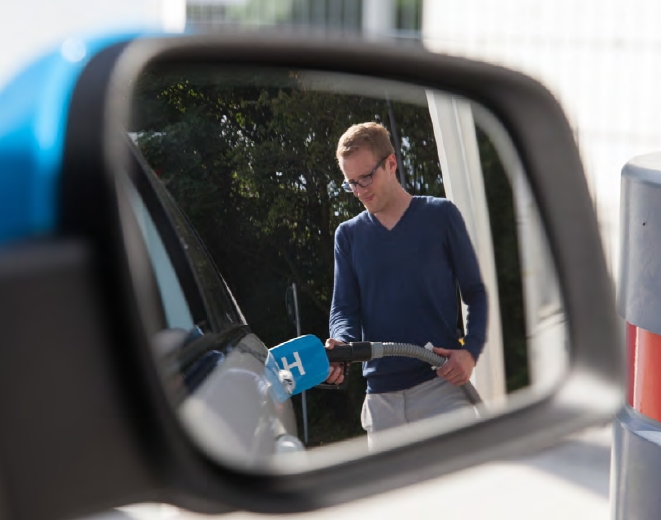
M.P.: The station will produce 40 kg of hydrogen per day, which is enough to fill about 5 cars. But for now, I am counting on one vehicle, a Toyota Mirai belonging to the Polish branch of Toyota. For now, to refuel, it is reportedly brought on a tow truck to Germany. Certainly, over time, more cars will start to appear, but to interest the market in hydrogen fuel, more stations need to be built. For now, we are stuck in a vicious circle: we don’t have hydrogen cars because there is no infrastructure, and there are no stations because there are no cars. Meanwhile, Europe already has hundreds of stations and a few thousand cars. By 2025, there are to be as many as 4,000 hydrogen stations on our continent. Meanwhile, in our country, Lotos announces the construction of 2 stations next year, so in 2022 we will probably enter with 3 stations in Poland, two of which will be in Warsaw.
U.G.: So how to speed up this process? Where to start the hydrogen revolution on our roads?
M.P.: We certainly have to assume that the first customers at Polish stations will arrive from Western Europe. They are already driving hydrogen cars and need infrastructure – also in Poland. If we assume distances of 300 km between stations, we could initially cover the country with a network of 20 stations. To saturate the market with them, we would need 50 stations. If we calculate that building one station costs about 4-5 million PLN, then the investment is not even that large. Especially since here we could count on significant subsidies from the EU.
U.G.: Hydrogen can be produced from renewable sources, but more than 90% of hydrogen is currently so-called dirty hydrogen obtained from coal. Who will control such an important issue as the origin of fuel on the market?
M.P.: Due to the production method, we distinguish 4 types of hydrogen: green, obtained using RES energy; blue, using natural gas; gray – industrial; and black, obtained from coal gasification. The essence of all the fuss around it is that it should be produced entirely from RES. In Poland, ideas are appearing to gasify coal, but this is nonsense and a contradiction of the idea. There will be no subsidies for dirty hydrogen, so there is no point in thinking about it. In the European Union, a special organization was created some time ago, whose task will be to certify hydrogen. This organization will systematically check whether the hydrogen you are selling was produced from RES or if it is dirty.
U.G.: In one of your statements, you described electric cars as a dead end for the automotive industry. In what way do they fall short of hydrogen ones?
M.P.: The advantages of a hydrogen car over an electric one are three: weight, charging speed, and range. Electric cars, even on very fast connectors, need to be charged for at least half an hour to charge them to about 80% of their capacity. And now you can imagine 3-4 cars in a queue, because that can happen, and calculate the waiting time. It is also worth mentioning here that charging at home takes many hours, requires investment in chargers, connectors, and does not guarantee that the fuses won’t “blow”. In the case of a hydrogen car, you refuel to full in 3-4 minutes, i.e., 4-5 kg of fuel at a pressure of 700 bar. It’s just like regular LPG. Another problem with electric cars is the range. These are basically city cars, because they do less than 300 km on a single charge. There is another issue. In the USA, there were places where many rich people lived who bought Teslas, and when everyone started “refueling” electricity, the grid in the entire area failed. Today’s power grids are not adapted to such high power consumption. If electromobility develops, the entire energy sector must first be modernized. I believe that electric cars are currently a bit of a dead end for the automotive industry. To get out of it, huge subsidies would be needed. And since subsidies in Poland are small, electricity for cars is more expensive than diesel. And if you buy a car more expensive than a traditional one and the fuel also costs you more than regular oil, and on top of that you don’t know if you will get from point A to point B, you have to be a fanatic to persist in this game. And in our country, electric cars are not zero-emission cars, because we use coal to produce electricity. Hydrogen cars, although not yet as popular as electric ones, are a promising alternative. They are not only lighter than electric ones but also have very nice ranges: passenger cars will travel 700-800 km on a single refueling, and trucks even up to 1000 km. In addition, they have a very high torque, so they are fast. And it’s not about speeding in them, but they are really comfortable to use. If only the opportunity arises, I will definitely switch to a hydrogen car.
The article comes from the magazine Logistyka 4/2020.
The e-edition of the magazine is available in our offer!