









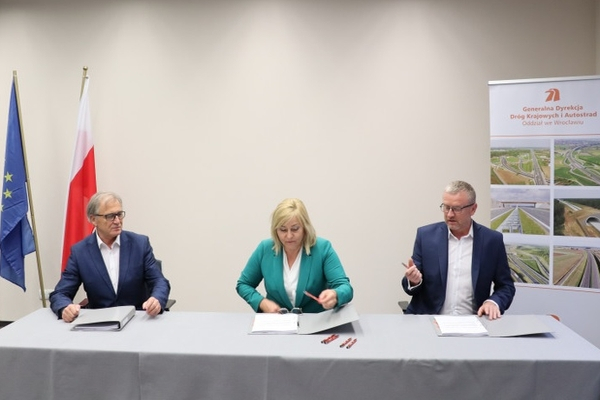
The General Directorate for National Roads and Motorways (GDDKiA) has signed a contract for the Regional Implementation Project as part of the National Road Traffic Management System (KSZRD) on the TEN-T network – stage I. The Lower Silesian and Opole sections of the A4 motorway and the A8 Wrocław Motorway Bypass will be equipped with a uniform, integrated intelligent telecommunications system. It will enable the launch of ITS services on motorway sections in the region.
KSZRD is the largest ITS project in Europe. Its goal is to build and implement a central system enabling dynamic traffic management on the most important transport corridors managed by GDDKiA.
The contract for the A4 motorway and A8 AOW is the first of four contracts to be signed as part of the Regional Implementation Projects. It covers the Lower Silesian and Opole sections of the A4 motorway from the Wrocław Południe junction to the border with the Silesian Voivodeship, as well as the A8 Wrocław Motorway Bypass (AOW A8).
The implementation contractor is a consortium of Wasko (leader) and Trax Elektronik (partner). It will support and maintain the system for 5 years. The system implementation will be carried out in several stages. First, the contractor will develop a comprehensive design for the reconstruction and modernization of the Traffic Management Center in Widawa, Wrocław, and a design for the implementation of the Traffic Management System. The next stage involves construction works, installation of necessary equipment, and implementation of individual system elements, in particular distributed implementation modules along with hardware infrastructure in the road strip and ICT solutions for the Traffic Management Center. Training for system users is also planned.
Part of the Lower Silesian section and the entire Opole section of the A4, as well as the A8 Wrocław Motorway Bypass, will be equipped with modern devices that monitor road traffic conditions and changes in real-time. This will enable dynamic traffic management through speed and lane control, incident detection, and control of coordinated traffic lights. Drivers will be provided with essential information, including traffic conditions and travel times, road incidents, weather conditions, or detours. All of this will primarily translate into a higher level of safety and travel comfort.
The contractor’s base remuneration is 166,619,863.20 PLN gross. Integration of the system with the central system is planned by the end of 2022.
In the next stage, contracts will be signed for the next three Regional Implementation Projects covering the following roads: S6 and S7 in the GDDKiA branches in Gdańsk and Olsztyn, A1 and A2 in the GDDKiA branch in Łódź, and A1, A4, S1 in the GDDKiA branch in Katowice.
The total length of the road network covered by the KSZRD Project is approximately 1,100 km, which accounts for about 28% of the length of the TEN-T core network in Poland. The National Road Traffic Management System will have many functions to improve road traffic and increase travel comfort. Thanks to the use of solutions classified as intelligent transport systems, the system will automatically detect and warn about obstructions, inform about current travel times and the availability of parking spaces at Motorway Service Areas (MOP) along motorways and expressways. In the event of obstructions, it will automatically introduce graduated speed limits and direct vehicles to an open lane, and in the case of a complete road blockage, it will automatically determine a detour route. A modern website will also be created with comprehensive information about national roads and the prevailing road conditions in real-time. The implementation of the project will enable smooth and much safer use of national roads, and drivers will be provided with a range of services increasing the quality of travel around Poland.
The implementation of the National Road Traffic Management System is co-financed by EU funds and carried out under the Connecting Europe Facility (CEF) in the amount of over 123 million euros.
Source: GDDKiA