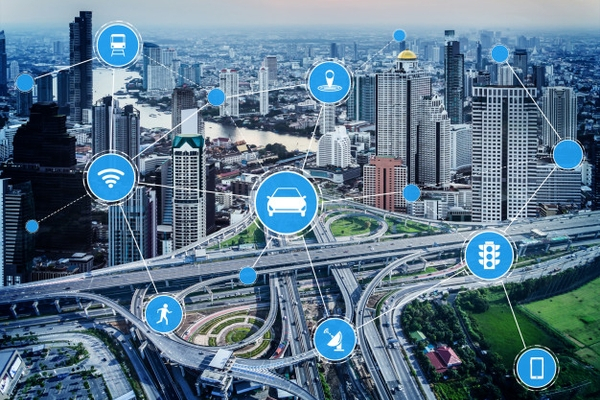
We are increasingly discussing the prospects of hydrogen-fuel-based transport, testing autonomous trucks, and planning last-mile deliveries using drones. The development of digitalization and artificial intelligence allows us to build increasingly advanced systems for managing goods transport and traffic control in cities. Environmental protection and concepts aimed at reducing noise, pollution, and traffic congestion in cities are playing an increasingly important role. In the new issue of LOGISTYKA magazine we addressed the topic related to the future of transport in Poland and around the world. We asked experts about current trends and which technologies and solutions will dominate in transport in 10-20 years.
 Maciej Bachman, President of the Management Board, PEKAES Group
Certainly, the TSL industry will increasingly feel the benefits of process automation across the entire supply chain. There are already many places where an automated system successfully and much faster performs many tasks in transport handling, which translates into significant financial benefits. Therefore, advanced technologies in the field of artificial intelligence or blockchain-based solutions, which are currently in the testing phase, will come to the fore.
Over the next 20 years, we will also see an increase in the importance of rail transport. This forecast stems from our experience in working with contractors on the New Silk Road. SPEDCONT, a company from the PEKAES Group that handles, among other things, the connection with China, is recording a steady increase in volumes. And this is happening, even in recent months, despite the coronavirus pandemic and the market turmoil it caused. Besides that, one can also expect the development of alternative drives, which will be a natural process, given the requirements for the transport industry regarding CO2 emission reduction.
 Tomasz Czyż, expert at INELO Group, GBOX
The future of transport is primarily a strong emphasis on ecological solutions. The EU’s assumption is to achieve climate neutrality by 2050, which will be possible through the widespread use of electromobility and vehicles powered by alternative fuels. New technologies related to electromobility are boldly entering the passenger car market. In the case of trucks, these are currently isolated experiments, limited by the current technology of energy storage in batteries. On the other hand, alternative fuels are performing more and more boldly on the market, with particular growth visible in the market for LNG-powered vehicles. While few Polish carriers are currently investing in alternative fuels, in the future, using such solutions will be a necessity.
The goal that transport is striving for will also be the optimization of journeys, which will involve the use of vehicles with significantly higher load capacity; solutions with longer trailers or those that combine 2-3 units into one set are already being considered and tested today. The industry is also facing complete digitalization; transport will be 100 percent based on systems such as TMS, which will help optimize the functioning of the enterprise, generating time and fuel savings, and consequently, reducing costs. Perhaps the professional profile of the driver will also change – they will no longer be responsible for driving the vehicle, their role will transform into an operator, all thanks to artificial intelligence and autonomous cars that will not require a driver’s license from the trucker, but only the ability to use digital devices.
 Jessica Heinz, Head of Marketing and Business Development, Dematic Central Europe
Urbanization is increasing worldwide. Traffic intensity is rising. Space is becoming increasingly scarce. Traffic jams dominate city streets. In addition to commuters, most car traffic consists of deliveries to shops, pharmacies, car repair shops, and restaurants. But there are also more and more entities delivering parcels and meals ordered online. Decision-makers and city authorities are working to reduce road traffic, noise, and exhaust emissions. The focus is on creating comprehensive transport and logistics solutions in urban areas. Attention is being drawn to the use of intelligent traffic management and new technologies to shape traffic in cities. Greater flexibility in route planning could shorten travel times between customers. The only industry that knows this well is intralogistics. Many years of experience in handling millions of orders in distribution and logistics centers provide it with excellent foundations in this regard. After all, warehouses have the same goal – to deliver products from one point to another as quickly as possible, exactly to the right place, so that they can be located there as quickly as possible if needed. Experts in the field of intralogistics, such as Dematic, could help develop a completely new system for managing urban areas, using the principles of material flow calculations for this purpose.
To optimize supply chains in cities, Dematic is introducing a solution called Micro-Fulfillment to its offer – small, compact, automated warehouses with an area of about 900 sq m, located in the city or within a store – close to the customer, which allows for order fulfillment within one hour. A pilot project called Dematic Pack-My-Ride automates the process of loading delivery vehicles to optimize the so-called “last mile,” which is the most expensive stage of delivering goods to the customer. It is predicted that within the next 5–10 years, the “last mile” will change so much that the classic parcel delivery model will become a thing of the past.
 Agnieszka Kubiak, PR and Internal Communication Specialist, Electromobility Development and PR Department, Solaris Bus & Coach S.A.
According to EU regulations, in 2030, cars registered in EU countries will have to emit almost 1/3 less carbon dioxide compared to those that will hit the roads in 2021. Changes related to zero-emission transport – both in the area of passenger vehicles and public transport – are visible at every step. This is not just a trend, it is the future of public transport development and a natural manifestation of concern for the environment. And although vehicles with engines meeting the strict Euro 6 standard still play an important role in many bus fleets, there is no doubt that European transport is currently in a phase of significant transformation.
The climate policies of European metropolises, introduced successively, will mean that fewer and fewer cars will enter city centers. Mobility needs will increase the share of services such as car-sharing, e-hailing, or so-called micromobility. Our company, however, sees an opportunity for public transport in these changes. Public transport operators can use the potential of these changes to increase their share and the number of passengers on public transport, with a special share of zero-emission buses that are friendly to residents and the environment. In 2018, alternative drives accounted for 36% of all vehicles produced by Solaris. In 2019, this indicator was already 40%, and we ended the first half of 2020 with a 46% share of low- and zero-emission vehicles.
As for the most technologically advanced hydrogen drive, since the premiere of the Solaris Urbino hydrogen model last year, nearly 60 vehicles have found buyers, which we will deliver to the Netherlands, Germany, and Italy. This is the best proof of how the bus industry is moving extremely dynamically towards e-mobility. At Solaris, we assume that the development of all electromobility options – e-buses, trolleybuses, and hydrogen-powered models – should proceed synergistically. This is a necessary process to ensure sustainable transport of the future.
 Bartłomiej Kwapisz, Head of Marketing & Innovations, Arval BNP Paribas Group
The way companies approach mobility is changing before our eyes, and providing transport is becoming a service that companies use according to their needs. Until recently, the most visible new trend was electromobility and the increasing willingness of companies to install chargers for electric vehicles on company premises. Although the coronavirus pandemic did not significantly weaken the electromobility trend, it caused entrepreneurs to start looking for other, flexible forms of providing cars to employees. Almost overnight, medium-term rental, as well as bicycle rental… gained popularity.
We believe that soon companies will be more willing to provide employees with a so-called mobility budget. Users will use it with great freedom, within generally outlined rules. It could be a subsidy for renting a private vehicle, it could be mobility cards, i.e., cards from which funds can be used only for travel by public transport, taxis, or short-term rental of cars or bicycles. Car sharing is still developing, supported by the development of convenient mobile applications. At the same time, we assume that currently, for safety reasons and the need to comply with hygiene rules, fleets of shared cars within one company will grow faster than those generally available.
In the future, company travel by autonomous vehicles is possible. The ability to travel to a specifically chosen place and the simultaneous ability to work while traveling is a tempting vision, but not that distant at all. Last year, Arval already started transport with completely autonomous vehicles between one of the Paris metro stations and its office, providing employees with a convenient commute to work.
 Daniel Podkalicki, Head of Road Freight Forwarding Department, Tirsped Sp. z o.o.
In a constantly developing and evolving global economy, it is often difficult to keep up with innovations, automation, and digitalization. In the context of these global processes, the TSL industry, including transport, must face the reality of the 21st century. One of the key areas concerning transport, where changes are happening constantly and quickly, is informatization. This trend will continue. Innovative solutions and automation are being implemented, among others, in the process of route planning, human work, and increasing efficiency. Environmental protection and road safety are further challenges. In this context, there is a forecast of an increase in freight weight in rail transport at the expense of road transport. Another area that will certainly undergo changes in the field of transport is road safety. The trend of hiring foreigners will also continue. However, due to COVID-19, changes in EU legislation should be expected, and previous forecasts will likely be modified.
 Wojciech Olasek, Logistics Planning Manager, Volkswagen Poznań
In the next decade, the transport industry will have to prepare for a number of changes in the way it operates. The main factors determining these changes will be: a shortage of drivers, changes in law within the EU, and the industrialization of the transport market, with a simultaneous dynamic increase in the handled tonnage. In the coming years, we must count on an increasing share of trucks powered by alternative fuel (including electric drive, based on inductive charging on motorways), which will be forced by the EU’s pursuit of reducing the burden on the natural environment as well as the policy of corporations striving for CO2 neutrality in the entire production chain. The first electric trucks have already appeared on the roads, and as time passes, thanks to economies of scale, this technology will become more accessible. An aspect that cannot be forgotten is the very rapidly progressing industrialization, and consequently, the autonomization of vehicles. We are already observing this trend in the area of passenger cars, however, with the constantly progressing shortage of drivers, work on solutions for transport will significantly accelerate in the coming years, especially in international traffic.
The development of these technologies is associated with large financial outlays, and such solutions will first be used by larger carriers with appropriate financial backing, allowing for investments in future technologies, which will lead to the centralization of the transport market and strengthen the position of large enterprises.
An intermediate solution for the industry may be intermodal transport, using rail infrastructure, enabling the transport of entire sets, taking into account the concept of HUBs, where after unloading, the set would be taken over by a driver and local distribution of goods would take place. This solution will allow reducing the impact of road transport on the natural environment as well as addressing the current driver deficit. However, it requires close cooperation between two – currently competing – types of transport – road and rail.
 Elżbieta Burliga, Business Development Director, First Data Polska SA
The coming years will bring many changes, and those that are currently taking place will deepen. These changes will concern not only the type of fuel, exhaust emissions, or the type of transport, but also the approach to tariffs used by public transport or the method of payment for tickets. Newly introduced tariffs will have to meet the growing expectations of passengers. A model of payment for the effectively traveled distance is becoming increasingly popular, as is the case, for example, in the Netherlands, where in the whole country you pay with one OV-chipkaart in every means of transport only for the distance traveled, as well as integrating trips with applications and payment cards. This is the standard of the future. Offering platforms where a passenger will be able to plan a trip, choose the most attractive payment model, and make a payment will be the key to success. First Data Polska’s experience shows that the development of contactless payments, NFC technology, and banking applications are becoming an integral part of transport projects.
We write more about the transport of the future in the magazine Logistyka 4/2020.
The e-edition of the magazine is available in our offer!