









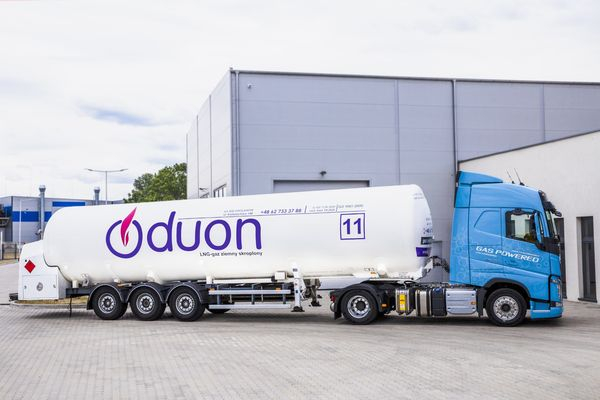
As global markets move towards reducing CO2 emissions, the TSL industry is switching to low-emission fuels.
Companies are incorporating low-emission standards into their sustainability policies, and reducing CO emissions during the transport of goods is increasingly becoming a tender requirement imposed on carriers. The European Union supports transport based on vehicles powered by liquefied natural gas. Member states are introducing facilities for low-emission fleets and developing LNG refueling infrastructure. All of this is intended to facilitate the TSL industry’s transition to gas-powered vehicles – and to accelerate the decarbonization of transport and the reduction of other pollutants.
Low-emission vehicles as a business opportunity for the TSL industry
The “Race to zero” has presented a challenge to the TSL industry, which generates approximately 20-25% of global CO2 emissions. In the face of this, more and more transport companies are supplementing their fleets with vehicles powered by liquefied natural gas. This aligns with the expectations of customers who, for environmental reasons, are looking for carriers operating a low-emission fleet. A recent example is the actions of the Żywiec Group1, which signed a contract with a transport company for beer distribution using LNG-powered trucks. The goal of the cooperation is to reduce greenhouse gas and particulate emissions.
“Green” tenders available only for LNG fleets
The Żywiec Group is not the only corporation actively seeking an eco-friendly carrier. More and more transport companies that have invested in a fleet powered by liquefied natural gas are gaining access to “green” tenders. Many large companies now have sustainability departments that influence the choice of a supplier that meets their climate goals. By owning low-emission vehicles, carriers gain a competitive advantage – and a chance for a very attractive contract.
The best time to invest in a tractor powered by liquefied natural gas
According to a 2019 report by the Polish LNG Platform, the market for LNG-powered vehicles will grow, and there are currently about 500 registered in Poland. At the same time, the demand for transport services provided by eco-fleets is increasing. This has been recognized by, among others, transport service providers for Ikea, who are required to use modern vehicles with cleaner fuels (in accordance with the “IKEA Principles for the distribution of home furnishing products” code)2. This is a consequence of the policy to reduce greenhouse gas emissions by 70% by 2030. By the end of 2020, Lidl will introduce as many as 100 LNG-powered tractor units in Germany.
Easier decision thanks to LNG vehicle tests offered by manufacturers
Tractors powered by LNG from three manufacturers are available on the Polish market: Iveco, Scania, and Volvo. Purchasing or leasing them allows you to hit a favorable moment – ahead of the competition. Manufacturers provide the opportunity to test an LNG tractor, thanks to which the carrier can check how the machine performs on the road – and whether it is profitable for their business. Poczta Polska successfully tested an LNG tractor last year as part of implementing a program for the gradual replacement of its fleet with low-emission vehicles3. Similarly, DHL tested trucks powered by liquefied natural gas in Poland, Germany, and Belgium as part of its goal to reduce logistics-related emissions to zero by 2050. 4
Renting LNG refueling installations – fleet fuel security and a source of income
Currently, an LNG tractor unit is able to travel about 1500 km on a single refueling. For logistical reasons, it is best to do this at the carrier’s base, using an LNG refueling installation. Savings resulting from the low price of fuel and favorable policies of member states (such as exemptions from road tolls in Germany and northern Italy) allow for a faster return on investment in renting LNG refueling installations. Moreover, carriers can sell natural gas to third parties – becoming a refueling station for other companies transporting goods using a low-emission fleet. In this way, an LNG refueling installation provides the carrier with secure access to gas – and revenue that increases the profitability of the rental.
Selling natural gas – a transport company’s chance for expansion in a growing market
The Western European example shows that the LNG revolution is setting a new direction for business development. It is estimated that by 2030 there will be a significant jump in the development of the natural gas vehicle fleet. Currently, there are about 2,500 LNG vehicles in Europe. Over the next decade, this number will increase 112-fold – to 280,000, and the total share of LNG and CNG vehicles in the European market will increase by 25%.
LNG and CNG refueling stations will follow low-emission vehicles. There are currently 300 of them across Europe, of which 5 are in Poland, but the development of infrastructure in the country is gaining momentum and further stations are already planned. This means that transport companies that already have LNG installations for their fleet can test a new business model by offering the sale of surplus gas to external parties – increasing the profitability of the investment.
 Source: https://www.ngva.eu/stations-map/
Green PR in the TSL industry
Owning your own fleet and LNG refueling installation is good PR for a transport company. A carrier’s yard can become an important point on the eco-map of Europe and attract valuable business partners and customers. It is worth considering new directions for business development in the TSL industry – including the long-term effects of setting up your own LNG installation or station. Build a strong position in a still unsaturated market – before the competition does.
The TSL industry is inevitably heading towards zero-emissions. This is influenced by the actions of companies (including including ecological propulsion as a condition in tenders), EU and European government policies (regulations limiting CO2 emissions, MAUTs), and the development of ecological fleets by tractor manufacturers. Making the turn to LNG at the current stage of eco-transport development, one step ahead of the rest of the industry, gives a chance for the dynamic development of a transport company and an increase in its market share – not only by acquiring new customers but also by reducing transport costs.
Check if LNG is profitable for your fleet in the Savings Calculator.
1. https://grupazywiec.pl/nasze-dzialania/grupa-zywiec-wdraza-ekologiczny-transport/
3. https://media.poczta-polska.pl/pr/446300/poczta-polska-testuje-auta-zasilane-gazem-lng
