









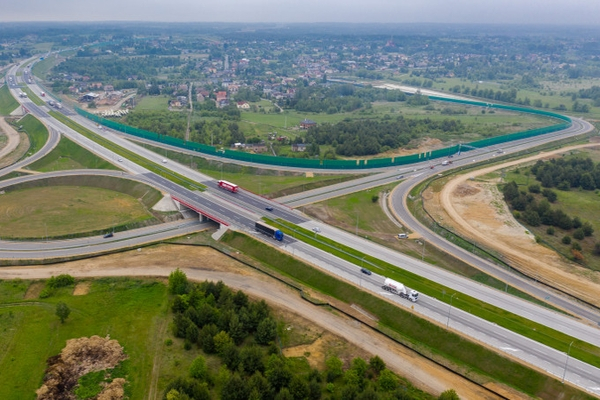
The General Directorate for National Roads and Motorways (GDDKiA) is implementing a program to build 100 bypasses. The quality of life and safety of city residents will also be improved by sections of expressways that bypass urban agglomerations.
100 bypasses
The program for the construction of 100 bypasses for the years 2020-2030 was announced on February 8 this year and complements the GDDKiA’s activities related to the implementation of the National Road Construction Program for the years 2014-2023 (with a perspective up to 2025). The 100 bypasses include 7 that were on the PBDK reserve list. These are road bypasses for Głogów (DK12), Strzelce Krajeńskie (DK22), Starogard Gdański (DK28), Krosno Odrzańskie (DK29), Kostrzyn nad Odrą (DK31), Wąchock (DK42), and Ostrołęka (DK61). The program implements investments outside the network of motorways and expressways, but some of these investments will facilitate direct access to high-speed roads. They will therefore facilitate travel on national roads. 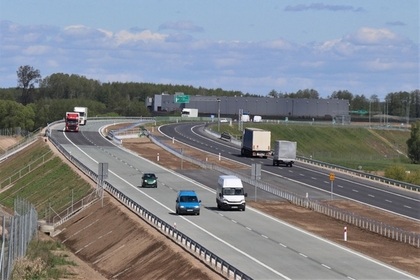 The cost of implementing the 100 bypasses will amount to nearly PLN 28 billion. The construction will be financed from the National Road Fund managed by Bank Gospodarstwa Krajowego. The NRF receives funds from the fuel fee, loans, and credits, mainly from international financial institutions, as well as from bonds. The NRF account will also be enriched by revenues from the Electronic Toll Collection System and EU funds from operational programs within the 2014-2020 and 2021-2027 perspectives.
Tenders are already underway to select contractors for two bypasses – Wąchock (DK42) and Lipsk (DK79). By the end of the year, tenders will be announced for the bypasses of: Sztabin, Suchowola (both on DK8), Strzelce Krajeńskie (DK22), Brzezie (DK25), Smolajny (DK51), Gostyń (DK12), Grzymiszew (DK72), Koźmin Wielkopolski (DK15), Żodyn (DK32), Gryfino (DK31), Szczecinek (DK20), and Pułtusk (DK61). The signing of contracts with contractors for these 14 bypasses is planned for next year. Designers are preparing documentation for subsequent bypasses, and GDDKiA is preparing to announce tenders for investments for which the preparatory process will be conducted from scratch. This applies to nearly half of the hundred planned bypasses.
Motorways and roads
Among the investments planned in the PBDK are expressways, as well as motorways, which, in addition to their function as transit routes, also serve as bypasses that divert traffic from cities and towns. These include, among others: the already operational Radom bypass on the S7, Częstochowa on the A1, Bydgoszcz on the S5, Ryki or Kołbiel on the S17, Łódź along the S14, or sections of the S2 in Warsaw supplementing the capital’s bypass. Thanks to the construction of the S61, the Łomża bypass will also be created, the S19 will bypass Białystok, Bielsk Podlaski, Kraśnik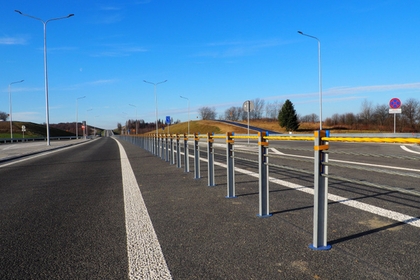 and Janów Lubelski, on the S12 the Chełm bypass will be built, and on the S17 the Zamość bypass and the currently implemented Tomaszów Lubelski bypass.
Further routes are at the stage of preparing design documentation, e.g., S10 and S1. Although these are not “bypass” type investments, their route will bypass dozens of towns. Residents of, among others, Piła, Nakło nad Notecią, Kalisz, Jastrowie, Ujście, Oborniki, Środa Wielkopolska, Rogoźno, Tarnowskie Góry, or Piekary Śląskie will benefit from them.
After the update of the PBDK 2014-2023 in June 2020 and increasing the expenditure limit to PLN 163.9 billion, the Program is to end with the construction of a total of 3,767.9 km of roads. This result will include, among others, motorways with a length of over 324 km, expressways with a length of nearly 2,949 km, and 43 bypasses with a total length of about 447 km. By June 24, 2020, 1,186 km of new roads were opened to traffic, of which nearly 58 km were motorways and almost 1,000 km were expressways. Among the opened road sections, there are also 17 bypasses with a total length of about 162 km. After taking into account 4 bypasses implemented outside the PBDK, their total length is over 176 km. 16 bypasses with a total length of about 180 km are under construction.
This year, the Sanok (DK28) and Węgorzyno (DK10) bypasses were opened to traffic, and during the summer, the Dąbrowa Tarnowska (DK73) bypass will be operational. In addition, there will be sections of expressways constituting bypasses: Wałcz, Kobylanka, Morzyczyn, and Zieleniewo on the S10, Kołbiel on the S17, and the S5 section Bydgoszcz Opławiec – Bydgoszcz Błonie, which will complete the Bydgoszcz bypass.
Bypasses are under construction: Kępno and Olesno on the S11, Tomaszów Lubelski on the S17, Łańcut (DK94), Iłża (DK9), Nowe Miasto Lubawskie (DK25), Kędzierzyn-Koźle (DK40), Praszka (DK45), Niemodlin (DK46), stage III in Legionowo (DK61), Morawica and Wola Morawiecka (DK73), Stalowa Wola and Nisko (DK77), and Poręba and Zawiercie (DK78). As part of the S14 construction, the western bypass of Łódź is being built.
14 bypasses with a total length of over 110 km are in preparation, for which funds for implementation are secured. These are, among others, the bypasses of Chełm (S12), Radomsko (DK42), Kołbiel (DK50), Zator (DK28), Łochów (DK62), or Opatów (S74).
Source: GDDKiA