









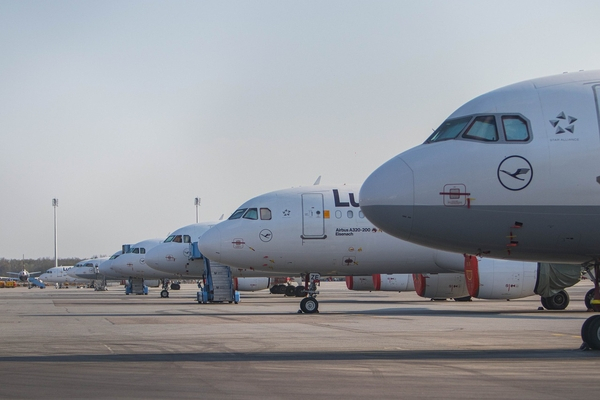
The coronavirus pandemic has caused an economic recession and massive losses in the aviation industry, which was forced to suspend most flights. Airlines around the world have requested support amounting to approximately USD 90 billion. Most countries will decide to grant it, as the costs of supporting air carriers will ultimately be lower than the losses caused by refusing aid to this sector. The TOR Economic Advisors team has prepared a report titled “Airlines. Public aid during the pandemic,” in which it examines the situation the aviation sector has found itself in as a result of the coronavirus epidemic.
The first economic victims of the epidemic were airlines, which had to reduce the number of flight operations to almost zero. The International Air Transport Association calculated in April that losses in the aviation industry would reach over USD 314 billion in revenue this year. It is predicted that this amount could reach as much as USD 400 billion.
The aviation sector has generated approximately USD 2.7 trillion annually in recent years, which is 3.65% of global GDP. The International Air Transport Association estimated that this figure would double by 2034. The impact of aviation on the global economy is enormous – it develops tourism, trade, and business. It is also an industry that provides employment for many people. In Europe alone, air transport supports 12.2 million jobs – that is 3.3% of all jobs in European countries.
The importance of the logistics sector in the economy is strategic. Airlines proved this, among other things, during the ongoing pandemic by enabling repatriation flights for citizens to their home countries. Furthermore, in this specific situation, many air carriers around the world, including LOT, are using passenger aircraft for all-cargo transport of medical supplies. Many countries are therefore responding favorably to requests from air carriers for financial aid.
The largest carriers from the United States and global giants such as Singapore Airlines, Lufthansa, and Air France-KLM can count on multi-billion support.
– Governments around the world have decided to provide financial support to airlines – in the case of the largest companies, it exceeds USD 10 billion. Such a scale of aid is justified by the role that the aviation sector plays in the economy. Supporting carriers and their quick return to flying entails an improvement in the situation not only for the immediate environment (airports, handling, technical maintenance, fuel suppliers, air traffic management) but also for the wider business environment, from hotel operators to IT service providers or call centers. These are hundreds of thousands of jobs – writes Adrian Furgalski, Chairman of the Board of the TOR Economic Advisors team, in the report.
In Europe, most carriers will receive aid. According to official sources, by the beginning of May, governments had already allocated nearly EUR 87 billion to support carriers in order to mitigate the effects of the coronavirus. It is estimated that the final amount of support globally could reach EUR 106 billion. The Polish government has allocated PLN 140 million to support Polish airports.
– The European Commission has implemented rules liberalizing the approach to granting public aid to airlines. This is, of course, a good move, because European aviation could not remain at a disadvantage when such support began to flow in large streams on other continents. In many cases, it goes beyond the problems caused by the coronavirus, giving carriers a stronger starting point after the pandemic ends, even including the possibility of acquiring other airlines. A lack of support for LOT could have squandered the last years of the carrier’s dynamic development – claims Adrian Furgalski in the study.
Full report
Source: TOR Economic Advisors team