









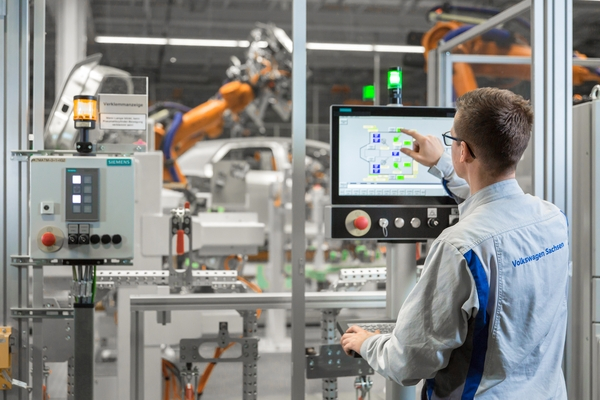
Siemens is equipping Volkswagen’s Zwickau plant with the hardware necessary for electric vehicle production. The company has already modernized two production lines and helped develop an automation standard for the mass production of a range of different car models.
– We want to increase the level of automation in our production processes while reducing their complexity. We decided to partner with Siemens because they have been our partner for a very long time. They are also one of the world’s leading industrial automation and digitalization companies, and they possess the necessary experience and knowledge gained from implementing such projects – said Thomas Zembok, Head of Factory Automation and Digital Production at Volkswagen AG.
Volkswagen plans to produce 1.5 million electric vehicles annually by 2025. For mass production to succeed, the Zwickau plant must be thoroughly modernized by the end of 2020. Digitalizing production processes will help the factory meet the challenges of e-mobility.
The electric vehicle to be produced at the Zwickau plant uses the MEB (Modular Electric-Drive Matrix) platform, which consists of a battery and two axles. Depending on the version, it will have either front-wheel, rear-wheel, or all-wheel drive. Production facilities manufacturing models using the MEB platform will be adapted to the sixth generation of the VASS (Volkswagen Audi Seat Skoda) standard. The VASS standard defines specific automation solutions (covering hardware, software, and visualization) and includes dedicated training for employees.
The first of the two lines intended for the body shop and final assembly has already been commissioned, and production has started. The second line is in the preparation stage and will launch in the fall of 2020. The Siemens technology used on both lines includes solutions such as TIA Portal (Totally Integrated Automation), Simatic series controllers, HMI (Human Machine Interface) panels, and industrial PCs. Thanks to this, the level of automation on the final assembly line will increase from 17 to 28 percent, and on the body shop line from 85 to 89 percent. Automation solutions are also seamlessly integrated with further stages of the production chain, for example in logistics, where automated guided vehicles (AGVs) are used.
In 2021, production of six models using the MEB platform for three of the group’s brands will begin at the Zwickau plant. The first next-generation electric vehicle to roll off the production line last November is the ID.3.
– The VASS standard has a huge advantage – it allows Volkswagen to adapt the solutions used within it to production plans implemented in other plants. The new standard is also an important element allowing for the further digitalization of Volkswagen’s production processes. It offers multiple benefits, such as the ability to monitor the operating parameters of production equipment and seamless machine-to-machine communication. The ultimate goal of the new standard is to increase production efficiency – said Bernd Mangler, Senior Vice President of Automotive Industry Solutions at Siemens Digital Industries.
Source: Siemens