









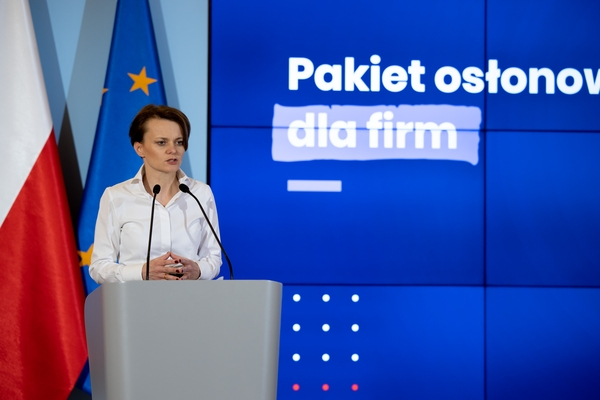
Due to the coronavirus epidemic, many companies are suffering large losses resulting from downtime. Transport, as an industry severely affected by the spread of the epidemic, has requested government assistance. The Ministry of Development is already preparing a draft special act on this matter and is announcing a protection package for entrepreneurs.
– Prime Minister Mateusz Morawiecki has tasked me with preparing – together with the Ministry of Finance, ZUS, KAS, UOKiK, BGK, PFR, and ARP – a package of protection solutions for entrepreneurs. As a result of intensive meetings and discussions in recent days, we have created a catalog of actions that can support our companies in the current situation – says Minister Jadwiga Emilewicz. – That is why the government is taking all possible actions to minimize the effects of the epidemic. The most important things are human health, limiting the spread of the virus, and minimizing the number of illnesses. In parallel, we are also taking all possible actions to limit other negative effects of the epidemic, including those on the Polish economy, our companies, and employers. Prevention is important to maintain health. It is equally important to prevent undesirable phenomena in the economy. This is exactly the role that the protection package for companies in connection with the spread of the coronavirus, prepared by the government, is intended to play.
Protection package
The draft protection package for entrepreneurs will include proposals for legislative changes. They are intended to improve the situation of entrepreneurs, among others, through:
– Relief on liabilities, including facilities in the payment of taxes and ZUS contributions,
– Improving the financial liquidity of companies – financial instruments for companies, including guarantee support and loan subsidies,
– Protection and support for the labor market, including solutions for companies forced into downtime.
This requires, among other things, amendments to acts regarding: VAT, the granting of public aid, including de minimis aid, support for BGK, and specific solutions related to the protection of jobs.
Payment deferrals
– facilitating VAT settlement – postponing the entry into force of the new JPK from April 1, 2020, to July 1, 2020
– facilities in split payment,
– postponing the deadline for the obligation of companies to register in the Central Register of Beneficial Owners (Anti-Money Laundering Act) from April 1 to July 1, 2020,
– earlier VAT refunds,
– facilities for suspending business activity,
– including expenses related to the cancellation of trips as tax-deductible costs for industries affected by the crisis,
– abolition of the prolongation fee,
– changing the public aid scheme, expanding it for SMEs and large companies.
Improving financial liquidity
– “backward” deduction of losses from income (i.e., losses from 2020 from 2019) – a loss incurred from business activity in a given year can be deducted from income earned over the next five years,
– guarantee support and loan subsidies – actions of BGK,
– granting aid under de minimis aid. Currently, the amount of de minimis guarantees granted by BGK cannot exceed 60% of the loan amount and exceed the amount of PLN 3.5 million (individual guarantee) – a postulate to increase the guarantee to 80% of the loan amount.
– interest rate subsidies for loans – by expanding the scope of the disaster fund to include the epidemic.
Protection and support for the labor market
The government proposes an amendment to the act on specific solutions related to the protection of jobs. It wants to facilitate things for entrepreneurs who are in crisis. It postulates shortening the crisis period that entitles one to support from 6 to 3 months. Whereby a crisis means a 15% drop in economic turnover, sales of goods, or services.
In the event of downtime, employees of such an entrepreneur would be entitled to:
– a benefit from the Guaranteed Employee Benefits Fund up to 100% of the unemployment benefit (PLN 823.60) increased by the amount of social security contributions
– and remuneration financed from the entrepreneur’s funds in a total amount of at least the minimum wage for work.
Sickness and care benefits
An entrepreneur with sickness insurance who cannot conduct business activity due to the coronavirus will receive a sickness benefit from ZUS on general terms, i.e., if they receive a medical certificate or a decision from the state sanitary inspector regarding quarantine or isolation.
The entrepreneur will also receive a care benefit if they provide personal care for a sick child or another family member (medical certificate), a child subject to isolation or quarantine (sanitary inspection decision), or a child under 8 years of age in the event of an unforeseen closure of a nursery, children’s club, kindergarten, or school (insured person’s declaration).
If the unforeseen closure of the facility is related to the coronavirus, the adopted special act provides for an additional care benefit for a period not exceeding 14 days for this reason.
ZUS – currently available relief in repayment or remission of contribution liabilities
Legal provisions and ZUS actions support entrepreneurs in the face of potential difficulties in conducting business activity in several ways.
Entrepreneurs affected by delays or lack of deliveries, payment bottlenecks, employee absenteeism, related to the increase in morbidity or activities aimed at ensuring the safety of citizens, can count on ZUS assistance: deferral of the payment deadline for contributions, installment plan, remission of liabilities.
Deferral of the payment deadline for contributions – if an entrepreneur has a problem with paying current or future contributions by the statutory deadline, the payment deadline for which has not yet expired. The entrepreneur will then not pay interest for delay, but only a prolongation fee.
Installment plan – if an entrepreneur has debt due to contributions and cannot pay it off at once, they can submit an application to spread the repayment of the debt into installments. The entrepreneur will then not pay interest for delay, but only a prolongation fee. After signing the agreement, any enforcement proceedings are suspended.
Remission of liabilities – if an entrepreneur has suffered material losses as a result of an extraordinary event, which causes that paying the liabilities due to contributions could deprive them of the possibility of continuing business activity. Only liabilities due to contributions for oneself are subject to remission. Remitted contributions and the period will not count when determining the right to benefits.
Advisors for relief and remission work in ZUS branches. They provide information and help to complete and fill out documents. You can talk to an advisor by phone or make an appointment.
Source: Ministry of Development