









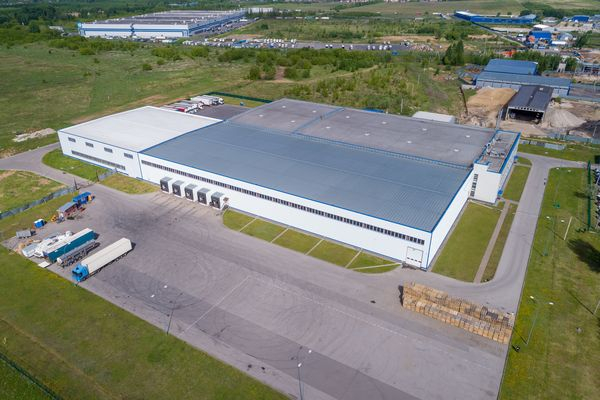
AXI IMMO has prepared a report summarizing 2019 in the warehouse market in Poland, highlighting the 10 most important facts that shaped the sector’s image last year and will influence its future in the coming months.
– High, stable demand at the level of 4 million sqm, a record number of new investments in major markets, but also in new locations, and a large nearly 50% share of speculative projects under construction, this is the picture of the warehouse sector at the end of 2019 – comments Anna Głowacz, Director of the Industrial Department at AXI IMMO. – The Polish warehouse market is growing at an average rate of 15% per year, which it owes to high interest from both tenants and investors. Both groups assess it as stable and safe – adds Anna Głowacz.
1. Investment market marked by the sale of large BTS projects
In 2019, the volume of investment transactions in the warehouse sector amounted to 1.48 billion euros. This was a result 17% lower compared to the record-breaking 2018, mainly due to prolonged negotiations and the postponement of closing transactions worth over 1 billion euros to 2020. Both European funds and capital from Asia, which is present mainly through European platforms, are investing in warehouses. A constant problem is the low availability of products, the effect of which is an increasing number of transactions at the development stage and “share asset”. Unlike in 2018, when portfolios were sold, last year belonged to large “single tenant” transactions. New buyers were found for, among others, Amazon projects in Bolesławiec and Central Poland or Zalando in Olsztynek. Capitalization rates show a further tendency towards compression.
2. Record demand for the third year in a row
Demand for warehouse space in 2019 in Poland remained at a high level for the third consecutive year. A total of nearly 4 million sqm was leased, of which 67% were new lease agreements. Five major markets accounted for 80% of total demand. The most space was leased in the Warsaw region (1.27 million sqm), followed by Upper Silesia (600,000 sqm) and Central Poland (590,000 sqm). The most new lease agreements were signed in the Warsaw region.
3. The sector is growing thanks to logistics and e-commerce
In the leasing structure throughout 2019, the share of logistics companies remained at a high level between 35-45%, reaching 40.5% at the end of the year. Logistics operators are leasing additional warehouse space due to new contracts, but are also adapting supply chains to the new requirements of e-commerce customers. The result is a demand for space intended for handling returns, fast-moving warehouses, or regional distribution centers.
4. Total stock on a straight path to exceeding 20 million sqm
In 2019, 2.72 million sqm of new warehouse space was delivered to the market. This is a result 23% higher than in the previous year. Total warehouse stock at the end of the year was over 18.6 million sqm. The most space was delivered to the market in the Central Poland region (656,000 sqm), followed by Upper Silesia (573,000 sqm) and Lower Silesia (430,000 sqm). The Polish warehouse market is growing year-on-year at a rate of over 15%.
5. Nearly 50% of new investments are speculative projects
At the end of the year, 1.9 million sqm was under construction, with the most in Upper Silesia (478,000 sqm), followed by the Warsaw region (470,000 sqm) and Lower Silesia (270,000 sqm). It is worth adding that over 260,000 sqm is being built in the Tri-City region, which accounts for 1/3 of the existing stock in this region. Developers are not afraid of speculative projects. The share of this type of investment in the supply structure at the end of the year was 49%.
6. New markets with growing potential
Beyond the 5 major markets, we are observing the constant development of smaller and new markets, such as: Szczecin, Kielce, Legnica, Gorzów Wielkopolski, Białystok, Lublin, or Olsztyn. Total stock across all smaller markets at the end of the year amounted to 3.3 million sqm and increased by 26% compared to 2018. The largest increase in space took place in the Warmian-Masurian Voivodeship, due to the commissioning of a BTS for Zalando with an area of over 120,000 sqm. Demand generated in new markets exceeded 770,000 sqm, of which 95% were new lease agreements.
7. Vacancy rate with an upward trend
The effect of commissioning a large number of speculative investments and tenant relocations is an increase in the vacancy rate, which at the end of 2019 was 6.5%, representing an increase of 2 percentage points compared to the end of 2018 and is the highest result in 5 years. In the coming months, this trend will be maintained. The highest vacancy levels were recorded in the Central Poland region: 11.2% and in Upper Silesia: 8.2%. In smaller markets, the highest availability of space was recorded in the Bydgoszcz and Toruń region (8.1%), the Tri-City (8.0%), and Kraków (7.5%).
8. Rents were rising, now they are stable
In the first part of 2019, base rates showed an upward trend, but stabilized towards the end of the year. Average base rates in big-box facilities oscillated in the range of 2.9 – 3.8 euros/sqm, which translated into effective rates between 2.1 to 3.2 euros/sqm. The lowest possible rent rates were still in the Poznań region and the vicinity of Warsaw. The most expensive location remains Warsaw city, where base rates oscillate in the range of 4.9 – 5.5 euros/sqm. In the coming months, base rates will remain at a stable level, while effective rates will show a slight downward trend in regions where the vacancy level is rising.
9. Sector growth dependent on e-commerce
The warehouse real estate sector will remain on a path of stable growth. The trend of increasing demand from e-commerce and the rise in the number of investments in urban locations will shape the market image in the coming year. Development activity will remain at a high level, however, we can expect a decrease in the number of purely speculative investments. On the demand side, we will record more smaller transactions related to expansions and supply chain restructuring than spectacular, single investments.
10. Perturbations in the global economy as a challenge
A possible decline in demand will be related to macroeconomic factors, such as: supply chain disruptions related to the spread of the coronavirus, a visible decline in production resulting from a drop in consumption, especially in Western Europe, and low availability of employees with simultaneously rising labor costs. The global economy, including the warehouse sector, can expect a temporary economic slowdown due to the coronavirus.
Source: AXI IMMO
The full report is available below in PDF format.
The report comes from the website: https://www.axiimmo.com/raporty-i-publikacje/raport-podsumowanie-2019-r-10-faktow-o-rynku-magazynowym-w-polsce-axi-immo