









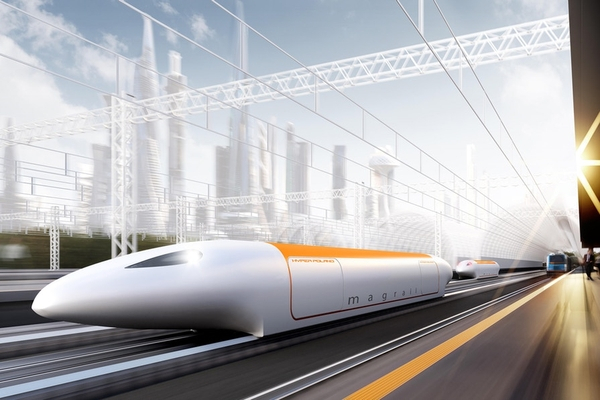
The Polish company Hyper Poland, which is building a prototype of a Polish hyperloop, has announced a second round of fundraising on the British investment platform Seedrs. The Poles want to raise over 450,000 euros to allocate it to further tests and the development of the technology for the railway of the future, based on magnetic levitation and a linear motor. The fundraiser was announced yesterday and has already reached 84% of its goal.
Hyper Poland is a company founded by engineers associated with the Warsaw University of Technology. For over two years, it has been developing its own project of technology inspired by the hyperloop. It proposes the implementation of this technology in three stages: magrail (magnetic railway moving on existing, slightly modified railway tracks), hyperrail (introduction of magnetic railway into a vacuum tunnel), and the target hyperloop (a closed vacuum tunnel underground). The ongoing fundraiser on the Seedrs platform concerns tests within the first stage.
In the case of the magrail system, a modernized railway track will be equipped with a linear motor and mechanisms integrating both surfaces while respecting the railway gauge. The linear motor will be used for both accelerating and braking the vehicle. The magrail vehicle will have a hybrid suspension system. At low speeds, it will move on wheels, and then, as speed increases, it will use magnetic levitation. Such a solution will significantly reduce the wear and tear of the track and the vehicle itself, as well as limit resistance, which will translate into lower energy consumption. This will allow travel at speeds reaching 300 km/h, and where high-speed rail tracks have already been built – 415 km/h.
It is worth mentioning that the company was included on the prestigious Lufthansa Innovation Hub list of the most innovative ventures in the world in the field of transport. We wrote more about this extraordinary project in last year’s June issue of Logistyka magazine. If you have not had the opportunity to learn about the Hyper Poland project before, we encourage you to read the article, which you will find in the attachment.