









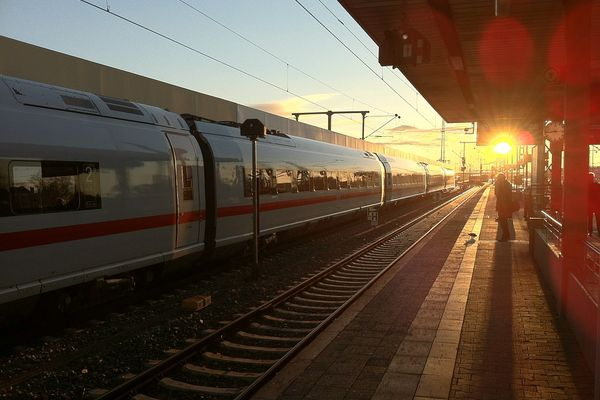
The European Commission has granted support for cooperation with France in preparations for the planning, design, and construction of High-Speed Rail. The French National Railway Company (SNCF) will advise on, among other things, technical standards for the construction of HSR in Poland.
The European Union will support Poland under the Structural Reform Support Programme. The agreement will be concluded for a year and a half, and the value of the funding from Brussels will range from 2.1 to 3 million PLN. The French National Railway Company (SNCF) will receive payment for the consulting service provided to our country from the European Commission.
– The project of the CPK and the Ministry of Infrastructure concerns the exchange of know-how and supporting institutional capacity for the construction of HSR in Poland. Our cooperation will include consultations during which SNCF will present, among other things, solutions and regulations regarding HSR, taking into account the specifics of the Polish market – says Deputy Minister of Infrastructure and Government Plenipotentiary for CPK, Marcin Horała.
The direct beneficiary of this cooperation will be the CPK company, but it will also indirectly benefit: PKP Intercity, PKP Polish Railway Lines, the Railway Institute, the Office of Rail Transport, and the Ministry of Infrastructure.
– Cooperation with a foreign partner is advisable because HSR has not been built in Poland so far. France is the home of the TGV, the fastest trains in Europe. For the CPK company, this is of primary importance – emphasizes Piotr Malepszak, member of the CPK management board for the railway part of the investment. – We want to lead to the launch of an HSR system in cooperation with the best in Europe.
EU funding will allow for the exchange of experience between countries and support Poland in terms of technical and organizational standards used in the design and construction of HSR. This will enable, for example, the preparation of future railway tenders that include this technology. The European Commission will co-finance consultations on HSR because the CPK Railway Program fits into European ecological strategies, such as The European Green Deal and the assumptions of European transport policy, e.g., promoting low-emission transport and optimizing energy consumption, as well as other EU HSR initiatives, such as the V4 Warsaw-Budapest line.
– We assume that the Polish-French cooperation under the umbrella of Brussels will be a “win-win” situation, meaning that the benefits will be mutual. Furthermore, thanks to Poland opening up to French consulting, Polish railway companies will be included in the supply chain for the project and will gain easier access to the common market – summarizes Deputy Minister Marcin Horała.
In the competition, 9 out of 27 applications from Poland were selected – out of a pool of 609 submitted by all European Union countries. Poland received preliminary funding with a total value of over 17 million PLN. In addition to the application from CPK and the Ministry of Infrastructure, projects from ministries also received funding from the EC, including: Development, Finance, Science and Higher Education, and Agriculture and Rural Development. The CPK construction program includes investments in a new transfer airport for Poland and Central and Eastern Europe and a network of 1,600 km of new railway lines (including sections with HSR standards), intended to connect Warsaw and CPK with most of Poland’s largest cities in no more than 2-2.5 hours. A train journey from the capital to the new Solidarity Airport will take 15 minutes.
Each of the 10 spokes leading to CPK will consist of new track sections and renovated or modernized fragments of existing infrastructure. The CPK company will be responsible for the construction of the former, and PKP Polish Railway Lines for the modernization of the latter.
In the autumn, the first major railway tender for environmental inventories for new railway lines leading to the airport was settled. The estimated value of the order is over 26 million PLN. Inventories are necessary at the stage of obtaining environmental decisions, which precede obtaining a location decision and a building permit. The company will commission the first contracts for inventories in the first half of the year.
Source: Centralny Port Komunikacyjny