








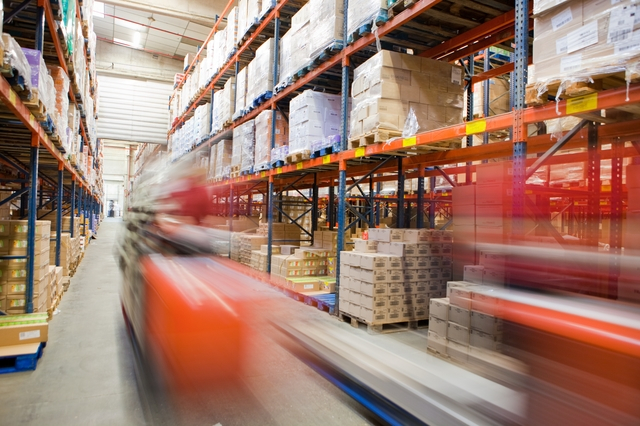
Modern leaders on the European market possess an extensive logistics network for the distribution of their products, which is technologically and informationally advanced. This ensures them a stable and established position as well as a competitive advantage. This is significant from the perspective of product distributors across Europe. A robust logistics infrastructure operates on the international market, serving as a necessary foundation for the proper functioning of an enterprise. A company must meet the requirements of the currently very volatile and demanding European market. Enterprises compete in the flawless delivery of products from the warehouse to the final recipient in the shortest possible time. This is possible by shortening the time of individual operations and eliminating potential human errors. To this end, large-scale automation of both internal transport and storage processes is being introduced into the logistics distribution network.
The article analyzes the operations of one of the largest giants on the European market – a concern in the industrial-chemical sector, in the context of transport optimization and the use of an automated warehouse.
Internal transport system
Internal transport has gained importance in recent years. This is due to the fact that a given commodity has value only when it is available in the right place and at the right time. Previously, internal transport focused on the object and the transport activity; now, it focuses on the transport process (as a function). The evolution of the transport process has contributed to the creation of a system of new devices and machines and the development of automation systems. Internal transport should be viewed as an entire system, which allows for the introduction of cheaper and better transport solutions. The most efficient are flexible production systems, where most technological processes, including transport, are controlled by a computer system.
Warehouse automation
The modern market forces the use of modern technologies and automation in warehouse management. Warehouse automation should be defined as the introduction of new technology. It is usually innovative and expensive, but as a result, its implementation leads to cost reduction and increased company competitiveness. Depending on the degree of warehouse automation, various solutions are used to accelerate warehouse processes.
Automation allows for tracking warehouse processes in real-time, controlling the flow of goods, and full identification of people, property, and assets. Barcodes are gradually being replaced by RFID technology. Human labor is being replaced by machines. The role of the supervisory system is fulfilled by an IT system dedicated to the given enterprise (usually ERP – Enterprise Resource Planning or WMS – Warehouse Management System). The most advanced form of automation is the integration of IT systems with the work of fully automated storage stacker cranes, where they also replace human labor in high-bay warehouses.
The full article is available below in PDF format.
Source: Logistyka Magazine