








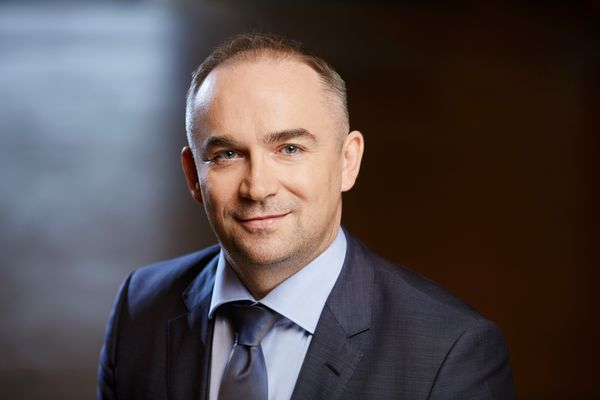
What new solutions are logistics operators implementing? Which services are currently in demand by manufacturing companies, and where does the potential for further development lie? We discuss this with Rafał Krajewski, General Manager of GEFCO Polska.
Editorial: Innovation is not bypassing the logistics industry. What solutions are operators introducing?
Rafał Krajewski: Nowadays, you can read about tests or implementations of new technologies for the TSL sector almost every day. The GEFCO Group also plays its part in this. One of the solutions we are developing is a personalized car transport service to the end customer, managed via a smartphone application. Furthermore, for several years now, we have been introducing new technological solutions, particularly in the area of IoT, supporting the management of expensive packaging in the supply chain – for example, a tailor-made solution improving the management of motorcycle pallets in Europe. We cooperate with start-up accelerators and incubators, universities, and laboratories, and within the company, we look for creative ideas through the GEFCO Innovation Factory. I consider taking such initiatives as necessary actions to build increasing value for our clients and to maintain our reputation as a leading European and global provider of integrated logistics services.
Ed.: And what does it look like in Poland?
R.K.: At the moment, we are focusing on utilizing the potential of RPA, or Robotic Process Automation. We try to delegate time-consuming and repetitive tasks performed on our IT systems to applications specifically prepared for this, while we focus on our core business activities. We are equipping our transshipment centers with state-of-the-art equipment for measuring the weight and volume of goods in order to collect and utilize the potential that has emerged with the advent of Big Data and accompanying analysis tools. In our warehouses, we plan to start testing drones for conducting inventory. We also cooperate with the Polish start-up environment, from which we acquire ideas for new solutions and working methods.
Ed.: Many people unequivocally associate GEFCO with automotive.
R.K.: Not without reason – our company started with logistics for car manufacturing, and this remains our natural area of operation. We serve vehicle manufacturers, spare parts, and automotive components. In Europe, we are considered a leader among operators dealing with logistics for this demanding sector. However, we are trying to diversify our client portfolio. In Poland, the automotive sector provides us with slightly more than half of our revenue, which means that the demand for our expertise and service in the area of high-tech, home equipment, or FMCG is also high. In addition to those mentioned above, we provide logistics for sensitive high-value products, goods with short shelf life and strong seasonality, and we manage supply chains for industrial clients, from the energy and cosmetic sectors. The medical sector, excluding medicines, is also not foreign to us. The range of clients served is truly large.
Ed.: Such diversification is certainly favored by time and business background?
R.K.: We opened our branch in Poland in 1999, but GEFCO has a longer history. The company was founded in 1949 at the initiative of the car manufacturer Peugeot, and the PSA Group remains one of our most important clients to this day. We are therefore celebrating a double anniversary this year. After 70 years of presence on the international market and 20 years in Poland, we have achieved the status of one of the ten largest partners in the world in terms of multimodal supply chain solutions, and we serve clients from over a dozen sectors. We operate in 47 countries, have a network of over 300 facilities, and employ 13,000 people. In Poland alone, we have 12 branches, and our team consists of over 500 employees. In total, we serve 2,000 active clients, and the scope of this service varies – from traditional transport through consolidation and warehousing, customs and tax services, to integrated operations within GEFCO 4PL.
Ed.: Which services are currently seeing the most growing interest from clients?
R.K.: Certainly, the transport of goods between Europe and Asia, which is mainly used by the automotive, industrial, and technological industries. Today, the GEFCO Group’s rail solutions built around the New Silk Road project offer great opportunities – we have connections between 35 Chinese and 34 European cities. The average transit time between terminals is 20 days; we provide LCL, FCL services, order consolidation, or block train transport. Year by year, for selected groups of goods, rail is becoming an increasingly strong alternative to traditional sea transport.
Recently, we have also introduced the transport of dangerous goods by rail between Europe and Asia to our offer. The cargo size can range from a single 40HC container to a dedicated block train. The delivery time, calculated from the departure of goods from major rail hubs in Poland or Germany, is only 30 days. Undoubtedly, services on the New Silk Road have significant development potential, especially in the context of subsequent installments of the trade war between the world’s largest powers.
Ed.: Thank you for the conversation.
