








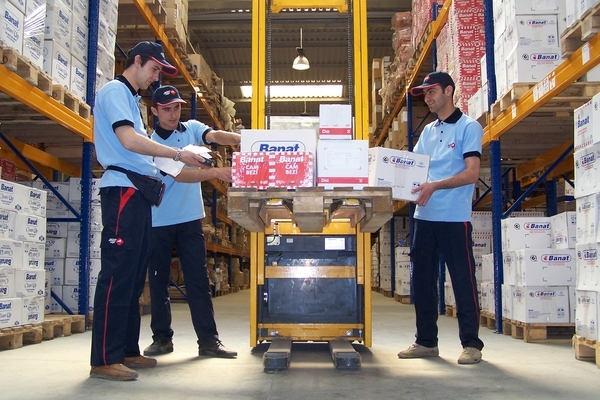
The high diversity of customer orders leads to the need for greater flexibility in the operational profile of warehouses, including distribution warehouses. A distribution warehouse is otherwise known as a commercial warehouse, which, according to [1], “ensures the distribution and continuity of material supply and consumption, where the functions of distribution, order picking, internal transport, and packaging are mainly fulfilled.” The warehouse that is the subject of the research contained in the article fulfills the aforementioned functions.
In order to meet customer needs, beyond performing basic services included in the scope of warehousing, companies are increasingly deciding to supplement their offer with so-called Value Added Services (VAS). These allow for more comprehensive and customer-tailored handling of stored loads. Value-added services (also called additional services or, according to [3], supplementary services) include, among others, packaging. Packaging, according to [4], is “the change of a product’s packaging or selected informational features of the packaging without changing the utility features of the product (for example, labeling, packing into holiday gift sets, combining into promotional sets) carried out using appropriate technical means and operations.” There is a great variety of variants for implementing the packaging process. In warehouses, it is still usually performed manually, but there are also warehouses that introduce mechanization and automation of these processes. Automation of processes consists of performing activities included in the scope of a given process only by mechanical devices. Mechanization, on the other hand, besides using devices (not necessarily mechanical), also means the active participation of people in operations performed as part of a specific process. […] Value-added services usually generate relatively low costs in the warehousing system. […]
Logistical task for the packaging subsystem
The company serves the book and toy industry. In the mentioned industries, the phenomenon of seasonality is not observed. The logistical task in the distribution company consists of carrying out the packaging process (packing and wrapping or packing and strapping) of loads delivered from the warehouse (goods from suppliers) in the packaging room, using the materials and devices available in this room, and transporting the packaged units to the warehouse, from where they are sent to customers.
Spatial layout of the packaging subsystem
The packaging subsystem has been organized in a rectangular room, divided into several functional zones. […]
Technological facilities. For packaging purposes, the company uses devices intended for manual and automatic packaging: these are package strappers and wrappers. Manual strappers, also called banding tools, are devices used for strapping light and medium-heavy loads (for example, cartons with contents) with polypropylene (PP) or hard polyester (PET) tape using metal seals. After inserting the seal into the device, the employee inserts the tape into the same opening, and then tensions it using a simple lever. After reaching the desired tension, they pull the second (bent) lever, thereby crimping the tape with the seal. By pulling the same lever in the opposite direction and squeezing the handle, the employee cuts off the excess tape. The specification of the used banding tools is available in [6]. Automatic strappers have built-in mechanisms for managing tape welding, and human work is limited to programming the device’s operating mode, placing the package on the machine, rotating it by 90° after automatic strapping in one direction, and then removing the finished, strapped package. The specification of the used strappers is available in [9].