









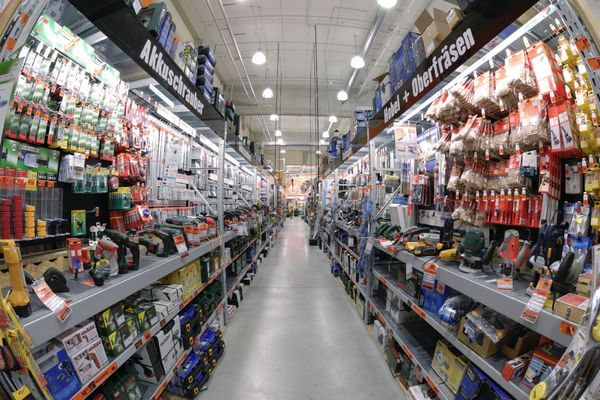
Sales of “home and garden” products in Europe are estimated at 168 billion euros. This is a huge and growing market that Polish manufacturers are also competing for. Some of them have been supplying their goods to the shelves of Western DIY stores for years, but others do not succeed. Why? The logistics operator Dachser, which serves 18,000 DIY stores across Europe, offers advice on how to cooperate with chains in this segment.
– More than a quarter of global DIY product sales are in Western Europe, with Germany being the largest market. In this country, the average annual expenditure on “home improvement” products is 465 euros per inhabitant, while in Poland this level is more than three times lower, at just 183 euros per capita. This clearly shows how attractive this market is for Polish manufacturers. Domestic producers can compete for the European consumer with price, quality, and design, but in addition to this, other conditions must be met to remain in the offer of such demanding partners as European DIY stores for a longer time – explains Juliusz Pakuński, Business Development Manager, Dachser DIY-Logistics in Poland.
First: ensure product availability – DIY chains are systematically reducing order sizes while increasing their frequency. In this way, they flexibly manage their offer and avoid holding inventory, which costs money and requires additional space. Polish manufacturers must therefore be prepared for smaller but more frequent deliveries. Thanks to access to an extensive network of daily connections of a logistics operator across Europe, stock shortages can be avoided.
Second: display the goods on the shelf – proper product display has a major impact on customer interest and, consequently, on subsequent orders from the store. Practice shows that it is worth investing in entrusting the service to a professional merchandiser – the costs are much lower than sending your own representatives abroad.
Third: ensure timely deliveries – punctuality should be the highest priority when working with DIY chains. It happens that if shipments are not delivered on time, financial penalties are even imposed.
Fourth: secure access to so-called time windows – agreeing with the store on a specific time slot in which a given manufacturer’s goods are unloaded is a way to avoid queues and a faster route to the store shelf. Smaller suppliers can take advantage of this method through a logistics operator that has an appropriate agreement with the chain.
Fifth: check the completeness of the order – it is essential that the shipment contains everything it should. Only complete goods can reach store shelves. Therefore, it is worth relying on professional warehouse service using modern technologies. A specialized partner managing a multi-user warehouse is more flexible, and the WMS (warehouse management system) they use facilitates inventory management and eliminates the risk of potential errors.
Sixth: take care of quality – products should meet quality expectations. Intact packaging content will help build customer trust. How to ensure this? Transport in swap bodies, quality control at every stage of order fulfillment, scanning of packaging during all transshipments of goods, and at the customer’s site in one transport system provides 98 percent certainty of successful delivery.
Seventh: coordinate the cooperation between the sales and logistics departments – the flow of information and understanding the needs of both these departments is the recipe for successful cooperation.
– A commercial partnership with European DIY stores is within reach of many Polish manufacturers, you just need to be aware of the expectations of this type of client and be able to adapt to them. It is worth fighting for, because although half of the offer in “home and garden” stores comes from factories in Asia, the remaining half comes from European suppliers. There is no reason why our producers should not have a strong representation in this group. Even companies that do not have experience in foreign trade or cooperation with Western DIY chains can think about it, provided they find a logistics operator to support them. Such a partner can be Dachser, which specializes in serving domestic exporters – says Juliusz Pakuński.
Dachser is a logistics company offering specialized solutions tailored to the needs of the DIY market. As part of the so-called DIY-Supply Pipeline, the operator ensures the efficient flow of goods from production lines to store shelves. As a result, Dachser delivers approximately 6 million shipments to 18,000 European DIY stores each year. A solid foundation for such service is – in addition to many years of experience and industry knowledge – Dachser’s extensive network of branches and road connections covering the entire continent. This allows for safe and timely delivery to any DIY store in Europe. In addition, the operator provides additional services, such as warehousing of goods or in-store product handling – from quality and quantity control, through shelf stocking and ensuring proper display, to handling returns, complaints, and managing promotional campaigns. Thanks to cooperation with Dachser, both major manufacturers and smaller producers can plan export growth without the need to establish a foreign branch.
Market data comes from the “Global home improvement 2018” report published by fediyma (European Federation of DIY Manufacturers).