









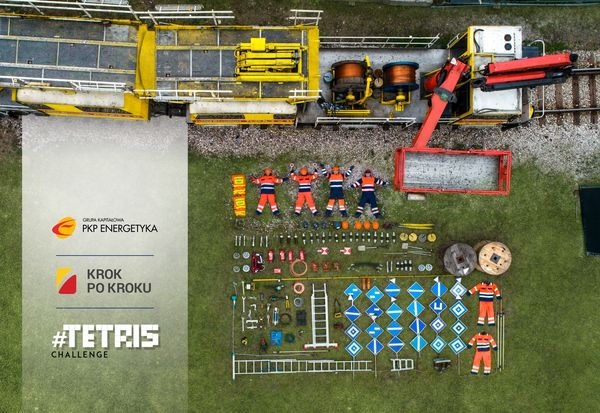
Police, fire departments, ambulance services, the military – services from all over the world are taking part in the Tetris Challenge. Employees of PKP Energetyka have also taken up the challenge. Now, everyone can take a look inside a catenary maintenance train and see the equipment used by the staff who ensure the proper functioning of the overhead line network. It is thanks to them that electricity flows uninterrupted and rail passengers reach their destinations on time.
The Tetris Challenge is a challenge that has become an internet hit. Police officers, ambulance staff, and soldiers arrange themselves and the equipment they use in their daily work into a colorful puzzle, resembling the world-famous logic game Tetris. Then, they take a photo from a bird’s-eye view and post it online. Thanks to this fun activity, we have a unique opportunity to see what the equipment of police cars, ambulances, fire trucks, and now also the catenary maintenance train used by PKP Energetyka looks like.
– The Tetris Challenge is great fun. When our employees found out about this campaign, the first association that came to mind was Kaizen and the ‘Step by Step’ program. Kaizen is a way of thinking where the right things are always in the right place, just like in the Tetris game. Thanks to this approach, we work more easily and efficiently – says Grzegorz Kaliński, Deputy Section Manager at PKP Energetyka.
Kaizen is a Japanese management philosophy that contributes to, among other things: improving quality, eliminating inefficiencies, proper workplace organization, and process optimization. In this approach, a major change is achieved through many, often small improvements (which is why Kaizen is often described as a method of small steps). Improvement starts with a single employee, and the process is continuous – one change leads to others. Importantly, the entire company is involved in the program at all levels. PKP Energetyka began implementing Kaizen in 2017 as part of the dedicated ‘Step by Step’ program. The results of the implemented changes include: increased work quality, safety, and engagement, as well as over 360,000 man-hours saved annually, which have been allocated to, among other things, the development of employee competencies.
{youtube}www.youtube.com/watch?v=-OO-ulZwt9w&feature=youtu.be{/youtube}