









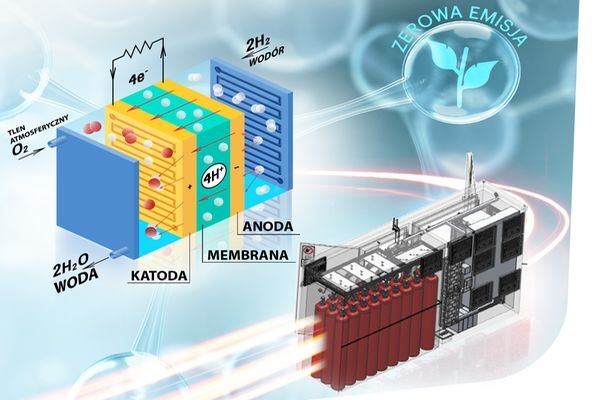
At this year’s TRAKO International Railway Fair, PKP Energetyka presented a fuel cell that will replace diesel engines in rail vehicles in the future. The Intelligent Integrated Distribution Network Management System of PKP Energetyka was recognized and awarded as the most innovative solution in the field of railway infrastructure.
The development of railways is inextricably linked to their electricity supply. Increased demand for rail transport (new connections, intercity trains, freight transport, high-speed rail) necessitates the expansion and improvement of modern electricity distribution fit for the 21st century.
PKP Energetyka plays a key role in this railway ecosystem, responsible for the reliability and quality of electricity supply for railways across the country. The infrastructure enabling the power supply to the traction network in Poland consists of nearly 600,000 objects and installation elements, including over 20,000 km of power lines supplying 814 traction substations, 6,213 other power stations, and 9,000 transformers. This comprehensive network has undergone a digital transformation over the last four years, which has prepared it for the technological and climate challenges our country is facing.
Intelligent Integrated Distribution Network Management System
During this year’s TRAKO Gala, PKP Energetyka received an award for the most innovative solution regarding railway infrastructure management. The Intelligent Integrated Distribution Network Management System is actually a series of solutions introduced in recent years at PKP Energetyka within four layers:
– Digital network model – all physical objects have been transferred to an IT system in the form of a so-called “digital map,” which maps both objects and the relationships between them in a computer program. The program updates data on an ongoing basis and transmits it to network employees equipped with tablets with a mobile version of the system.
– Smart Grid – systems supporting the Distribution System Operator (DSO), including: a system of smart meters and a central information database, a geographic information system, and an electronic archive of technical documentation. Today, about 200 virtual servers work for distribution, and the data occupies about 300 TB. In terms of teletransmission, over 45,000 modems operating in M2M (machine to machine) mode form one of the largest Smart Grid networks in Poland.
– Intelligent management using big data – two main IT solutions: “Network Asset Management” (ZMS), which maps all investment, modernization, and operational processes on the distribution infrastructure, and SCADA (Supervisory Control And Data Acquisition) – a “traffic management” system overseeing the electricity supply process.
– Real-time management of people and equipment – the PLANER system, supporting work planning on the network. Unification and full electronization of traction network maintenance processes.
– The innovative nature of our solution is determined primarily by the pace and scale of digitalization and the level of its final utility. Within 4 years, the digitalization of processes and data reached a level of about 90% – 95%, from an initial level close to zero. The result of implementing our four-layer transformation includes, among other things, fewer power outages (a decrease in the SAIDI index from over 400 to 160 minutes), faster repair times, and consequently, greater predictability of train schedules and passenger comfort – says Konrad Tyrajski, member of the board of PKP Energetyka.
Fuel cell
PKP Energetyka observes increasing social awareness and higher expectations for solutions in the field of ecology and energy efficiency. One of the goals set by the company and all employees is to reduce the negative impact on the environment, including the emission of harmful substances into the atmosphere. Therefore, the company is getting involved in projects aimed at developing fuel cells, such as methanol or hydrogen-powered fuel cells, and the possibilities of their application in railway energy.
At this year’s TRAKO fair, PKP Energetyka, in cooperation with DB, presented for the first time an ecological fuel cell, a modern alternative to the diesel engine, which already acts as an emergency power source in the event of a distribution network failure, and in the near future may power vehicles on non-electrified sections and replace diesel locomotives.
In the commercial solution of this type – the Off-Grid Box, presented at the fair, a PV panel works with a fuel cell operating on methanol, enabling power supply independently of the traditional power grid. When energy production from the sun is insufficient, the fuel cell automatically turns on. An intelligent algorithm ensures the efficiency of the process, and the device itself is monitored 24/7. The whole system is optimized in terms of both investment and operation. It is worth emphasizing that the fuel cell can also operate based on hydrogen, depending on the needs and capabilities of the recipient.
– Due to global trends in reducing exhaust emissions, trains powered by ecological fuel cells will in the future replace traditional diesel vehicles on non-electrified lines, especially in densely populated, tourist, or protected areas. Very important in these cases is not only the ecological aspect of this solution but also the quiet operation of the electric motor powered by the cell. The use of fuel cells as an alternative to diesel generators can also be used as an emergency power source where there is no access to the grid, e.g., at a construction site, for telecommunications transmitters, or monitoring systems – says Damian Artyszak from the Research and Development Office of PKP Energetyka.