









Solaris Sverige AB, the representative of the Polish company Solaris Bus & Coach S.A. on the Swedish market, is participating in the innovative “EVolution Road” project, which involves the construction of an electric road that automatically detects and charges electric vehicles. A Solaris trolleybus will be adapted for tests on this innovative road. The goal of the initiative is to test new ways of charging electric vehicles in practice and to develop transport systems free from fossil fuels.
“EVolution Road” is an electric road that allows for the charging of bus batteries and other electric vehicles both while driving and while stationary. The innovative research and development project, initiated by the Swedish company Elonroad AB together with the Faculty of Engineering at Lund University, will be implemented in close cooperation with representatives of industry, academia, and the public sector. The test vehicle used in the project will be a Solaris trolleybus.
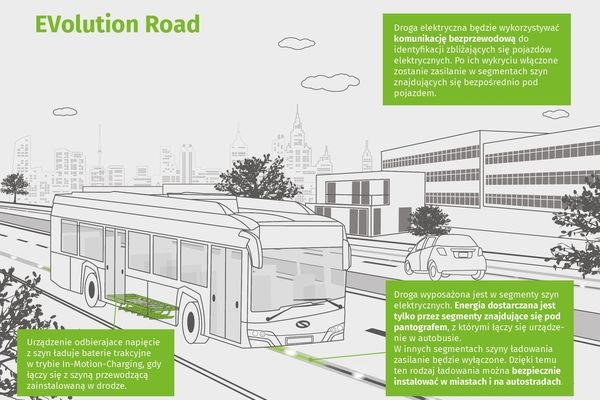
The test section of the route will be located in the city of Lund in southern Sweden. The one-kilometer stretch of road will be equipped with a set of electric rail segments, each 1 meter long. A specially developed unit that picks up voltage from the rails will be installed in the chassis of the Solaris Trollino selected for the test drives. The vehicle’s traction batteries will be charged when the receiver located in the chassis connects to the conductive rail installed in the road. The Polish manufacturer will be responsible for developing the integration between the on-board charging systems and the conductive receiver installed under the vehicle. Construction of the demonstration road section will begin in the first quarter of 2020, and the entire project is planned for a period of three years. The total value of the investment is 9 million EUR, and the contracting authority and main financier is the Swedish Transport Administration.
The electric road will use wireless communication to identify approaching electric vehicles. Once detected, power will be switched on in the rail segments located directly under the vehicle. Energy can be supplied only through the specific rail segment with which the receiver installed in the vehicle connects and receives the energy transmitted by it. Thanks to this, this type of charging can be safely installed both in cities and on highways.
One of the main advantages of this type of charging – also called “in-motion charging” – is that the vehicle does not need to be equipped with a large number of traction batteries. This, in turn, results in a reduction in the weight and the purchase and operating costs of the electric vehicle. It also allows for significant time savings, as this solution eliminates the need to stop to replenish energy in the batteries.
The installation of charging rails interferes only slightly with existing urban infrastructure. The project does not require masts or overhead wires, nor is there a need to create structures to protect against the effects of potential collisions with pantograph charger masts. Plans assume that fees for using the electric road will be paid automatically thanks to wireless communication between the vehicle and the road.
Partners of this world-class innovative project, in addition to Solaris, include the Faculty of Engineering at Lund University, the Swedish National Road and Transport Research Institute, the municipality of Lund, and the companies: Elonroad, Innovation Skåne AB, Kraftringen Energi AB, Ramboll AB, and Skånetrafiken.