









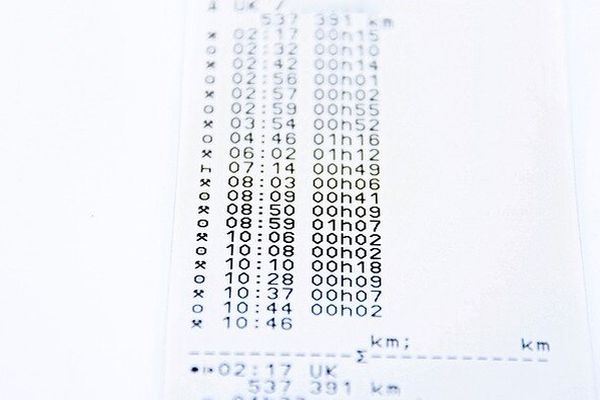
The Confederation of Organizations in Road Transport Enforcement (CORTE) is closely monitoring the implementation of smart tachographs. The regulation requiring a smart tachograph in every new heavy goods vehicle has come into force, so what comes next?
Problems from the start
The number of heavy goods vehicles in Poland is growing year by year. According to a report prepared by the Polish Automotive Industry Association (PZPM), 16.8 thousand heavy goods vehicles were registered in the first half of 20191. This is over 1.7 thousand more than in the same period of 20182. There are over 234 thousand Polish trucks driving on European roads3, which is the highest number among all EU countries. However, this carries serious consequences in connection with the discussed mandatory equipment of new vehicles with smart tachographs. The first problems appeared in Poland as early as May, when it turned out that second-generation tachograph cards would reach workshops too late. A similar supply problem affected the devices themselves. Components for smart tachographs, especially motion sensors, were sometimes in short supply.
– It is worth remembering that since June 15, smart tachographs have been gradually entering into use as new vehicles appear on the market. The lack of workshop cards was a certain problem, but it did not paralyze the market. Changes related to the introduction of smart tachographs were not a problem for the Inelo brand, because we had prepared an update for the software calculating driver working time in advance. Thanks to this, entrepreneurs using the new tachographs gained the ability to download and analyze data from the new generation of devices and cards – says Mateusz Włoch, an expert at the Inelo brand.
It can be safer
Eurostat reports that 25,000 people died on European roads in 2017. Police statistics show that 1.9 percent of accidents are caused by driver fatigue or even falling asleep. Although the share of truckers in these road accidents is relatively small, hovering around 3.2 percent4, it is necessary to continuously improve the system to increase road safety. Smart tachographs are one of the methods to combat unfair practices of manipulating driving time. Enforcement authorities, having the ability to read data from a digital device, are able to identify a much larger number of vehicles where working time standards or other legal regulations may be violated, e.g., by detecting switched-off tachographs. As a result of such remote pre-selection, a larger percentage of drivers who may pose a danger in road traffic due to violations are removed from the roads.
– Such actions can exclude carriers who engage in illegal practices from the market. Truckers, on the other hand, will avoid long stops related to vehicle inspections, as mainly those vehicles where regulations are most likely being broken will be stopped – notes Mateusz Włoch.
The Federal Office for Goods Transport conducts mobile inspections in Germany from patrol cars, but remote inspections using DSRC readers mounted on gantries will soon begin. During a remote inspection, the inspector does not have access to all information recorded by the tachograph, but only to 19 selected items, including:
• vehicle registration number
• current vehicle speed
• information about driving without a card (last 10 days)
• motion conflict
Smart tachographs vs. AETR
One of the problems for which there is no clear solution is the issue of using tachographs in non-EU countries that respect the provisions of the AETR agreement. Let us recall that the AETR convention is a European agreement regulating the working conditions of vehicle crews performing international road transport. A provision of the convention turns out to be problematic, which implies that vehicles from outside member states are not currently obliged to have smart tachographs. This may lead to unfair behavior by transport companies and, above all, to a decrease in safety on European roads. Interestingly, this also works the other way around, as by sending a vehicle with a smart tachograph to countries outside the Community, the carrier risks accusations from inspection authorities of transporting with an inappropriate tachograph. However, the situation may soon change, as AETR countries are slowly becoming interested in the issue of smart tachographs. The matter is also complicated by the fact that in non-EU countries, the calibration of smart recorders is not possible due to the lack of specialized workshops, lack of workshop cards, and trained personnel in the operation of these devices.
What will the future bring?
Work is already underway on the assumptions for the next generation of recorders. Future tachographs will offer many improvements, including:
• border crossing control, which would allow for limiting abuses by companies providing services in a country where they do not have their headquarters (so-called cabotage transport).
• registration of vehicle loading and unloading locations
Also importantly, the proposed changes also concern a larger number of vehicles covered by the obligation to install new tachographs – we are talking about vehicles with a GVW of over 2.4 tons.
– Recently, there have also been discussions regarding the further future of using tachographs – there is talk of using tablets and smartphones equipped with special applications for this purpose. Since these are commonly used devices, the costs associated with purchasing, servicing, and replacing tachographs would realistically decrease. However, at the moment, a major obstacle is ensuring the safe use of smartphones and tablets while driving and the excessive amount of data that would need to be stored – adds Mateusz Włoch.
1https://www.pzpm.org.pl/Publikacje/Raporty/Raport-kwartalny-KPMG-w-Polsce-i-PZPM-Branza-motoryzacyjna-Edycja-Q3-2019
2 https://www.pzpm.org.pl/pl/Publikacje/Raporty/Raport-kwartalny-KPMG-w-Polsce-i-PZPM-Branza-motoryzacyjna-Edycja-Q3-2018
3 PZPM, Automotive Industry Report 2019/2020
4 Report Road accidents in Poland in 2018, National Police Headquarters – Road Traffic Office