








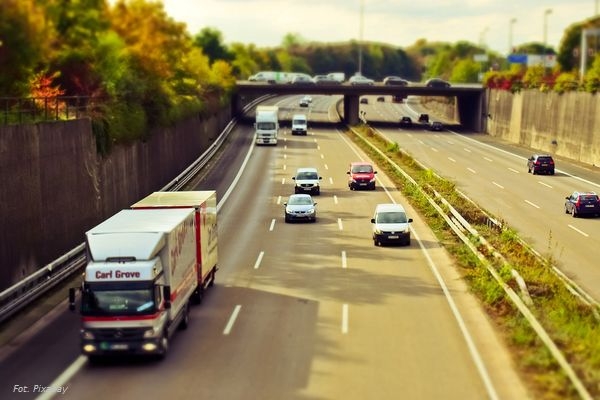
Did you know that the total share of transport in greenhouse gas emissions in the European Union is about 25 percent, of which 18.4 percent is generated by heavy-duty vehicles and buses1? One of the main goals of the new Members of the European Parliament is to reduce environmental pollution from exhaust fumes by as much as 30 percent within a decade. To achieve this, a number of new regulations have been introduced. EU policymakers have taken steps to reduce CO2 emissions from trucks by 15 percent by 2025 and by another 15 percent over the next five years. What is Europe already doing in this direction? Does Poland have anything to do with being eco-friendly? And what does this mean for carriers and professional drivers?
The Old Continent is ruled by diesels
– According to EU estimates, the demand for freight transport will increase by 80 percent by 2050 compared to 20132. This state of affairs generates significant environmental changes and an inevitable fight for cleaner air. Although vehicles are produced using new technologies and generate less pollution, diesel-powered cars still dominate our roads – including those with lower CO2 emission standards – says Kamil Wolański, an expert at the National Center for Driver Settlement (OCRK). – Data indicated by the Polish Automotive Industry Association shows that at the end of 2018, there were 707,300 trucks with a GVW of over 3.5 tons registered in Poland, and as many as 38 percent of these vehicles are 11-20 years old3. Meanwhile, diesel consumption in 2018 reached a record level of 20,345,000 cubic meters4. – adds the expert.
Although maritime and rail transport generate lower carbon dioxide emissions into the atmosphere, the transport of goods within the EU is dominated by road hauliers. In 2018, this type of transport accounted for about 80 percent of goods transported in Poland, while in the EU it is about 49%.5 6 According to the European Environment Agency (EEA), in 2015, the biggest problem with meeting nitrogen dioxide emission standards occurred in places with high traffic density in urban areas – primarily in France, Germany, the UK, and Italy. In the report of the Supreme Audit Office (NIK) published in September 2018, one de lege ferenda conclusion emerged – legal preparation for creating low-emission zones in Poland. However, these changes were not included at the parliamentary work stage. The draft law on electromobility and alternative fuels developed by the Minister of Energy, which was indeed implemented on February 22, 2018, and regulated the issues of creating low-emission zones by municipalities, still does not fully fulfill its function. Although the cited NIK report showed many issues requiring change in the government document, the act is currently in force.7
How does Europe do it?
Athens, Paris, and Madrid want to get rid of diesels from their streets completely by 2025. Brussels and Milan plan to achieve the same by 2030. London, on the other hand, is to introduce a total ban on diesel-powered cars by 2040. Since 2008, a Low Emission Zone has been in force in almost the entire capital of the United Kingdom, which includes trucks and buses that do not meet the Euro 4 emission standard. From mid-October 2020, drivers of vehicles with Euro 1, Euro 2, and Euro 3 standards who decide to enter the Greater London region will have to face a fine of up to about 1,500 PLN. In Germany, the fight against diesel engines has also begun. In Berlin, Hanover, Frankfurt, and Cologne, Clean Transport Zones were introduced as early as 2008, and currently, nearly 60 German cities have them. Currently, over 90 percent of vehicles (including trucks) moving on the roads of our western neighbors meet these ecological requirements. France does not want diesel cars registered between 2001 and 2005 to pollute the Parisian air. From 2022, a similar ban is to cover subsequent years, i.e., 2006 – 2010.
– For breaking the entry ban, the owner of a heavy-duty vehicle faces a fine of up to 375 euros – says the OCRK expert. – Interestingly, France wants only low-emission trucks to be able to enter the center of Paris from 2024. Norway has gone a step further – from 2025, it will not be possible to sell vehicles with internal combustion engines there. The latest reports show that such actions are also planned in Sweden, Ireland, Israel, and India from 2030. Moreover, carriers who invest in trucks with a higher Euro 6 emission standard can count on lower fees than owners of less ecological vehicles. For example, in the UK, since February 2019, fees for Euro 6 class vehicles are 10 percent lower, while for trucks with Euro 5 standards and lower, the rate has increased by 20 percent. – explains Kamil Wolański.
Eco, Polish style
In Poland, the situation does not look good either – in 4 out of 46 zones, the permissible CO2 level was exceeded, and this is primarily due to transport exhaust fumes8. In the Republic of Poland, regulations regarding low-emission zones (LEZ) are contained in the Act on Electromobility and Alternative Fuels. These regulations allow local government units to create clean transport zones in which traffic is restricted to vehicles other than electric, hydrogen, or natural gas-powered ones. However, the act does not protect Poland against the possibility of importing and using vehicles that do not meet emission standards in other European countries and gives local governments great freedom to regulate these issues at their own discretion. In the NIK report, we read that regulations constructed in this way carry the risk that municipalities will not be interested in creating clean transport zones, as they can freely decide on making eco-areas available to vehicles of other categories. This, in consequence, will not contribute to the reduction of pollution, i.e., it will not fulfill its function at all9.
The first city in Poland that decided to introduce a clean transport zone was Krakow, but it did not enjoy the eco-area for too long. After two months of restrictions for the most non-ecological vehicles, the Krakow City Council decided to extend the possibility of moving around the zone for cars of any type to 10 hours a day, which in practice means that between 6:00 AM and 8:00 PM, any vehicle can drive in this area without restrictions. These changes were introduced at the request of entrepreneurs running their own businesses within the designated area – as they claimed, the new regulations contributed to a drop in their turnover by about 1/310. Unfortunately, Poland has not yet developed an optimal legislative path that will help effectively introduce clean transport zones – those that will effectively fulfill their role.
– The range of vehicles – including trucks – with alternative drives to diesel is constantly expanding. Numerous benefits for eco-carriers encourage making conscious choices. However, on the other hand – diesel engines are more efficient, which ensures them a host of fans. It is clearly visible that an eco-revolution is taking place before our eyes, also in transport, which is strongly supported by EU directives, technological applications, and automotive concerns, so in a few years, the road transport market will take on a completely new dimension – concludes Wolański from OCRK.
1 Towards clean and smart mobility. Transport and environment in Europe, European Environment Agency, 2016, p. 20 – data for 2014
2 Towards clean and smart mobility. Transport and environment in Europe, European Environment Agency, 2016, p. 5
3 PZPM Report 2019/2020; p. 42
4 PZPM Report 2019/2020
5 Statistics Poland (GUS), Freight and passenger transport in 2018, 14.06.2019
6 European Court of Auditors, Improving the transport sector in the EU – current challenges, 2018, p. 18
7 https://www.nik.gov.pl/aktualnosci/mordercze-spaliny.html
8 https://www.nik.gov.pl/aktualnosci/mordercze-spaliny.html
9 https://www.nik.gov.pl/aktualnosci/mordercze-spaliny.html
10 http://nettg.pl/news/156158/przedsiebiorcy-wymusili-zmiany-na-urzednikach-strefa-czystego-powietrza-obnizala-dochody-firm