









Characteristics of road infrastructure.
The purpose of this article is to describe the organization of oversized cargo transport using the example of a model house. The article identifies the issues of transport and the organization of the entire transport process for the selected cargo. The development of technology and the economy has influenced the growing interest in oversized transport. The construction of new roads, bridges, pipelines, buildings, and wind farms favors the development of the transport of cargo exceeding standard parameters.
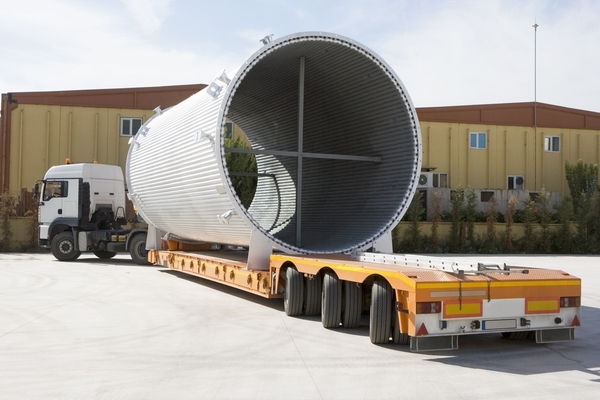
Various types of cargo currently being transported, whose parameters deviate from accepted standards, are called oversized cargo. Examples of such cargo include: machinery (excavators, overhead cranes, crane parts, crushers, pile drivers, tractors, etc.), road infrastructure components (bridge spans, tunnel parts, barriers), wind farm components (blades, turbines, wind towers, power masts), technological line elements (tanks, reactors, boilers), and construction structures.
Oversized cargo.
“Oversized cargo is cargo whose movement requires the use of special means of transport and handling equipment with a lifting capacity corresponding to the weight of the cargo”. Abnormal transport is the transport of such cargo where at least one parameter (length, width, height, tonnage) exceeds statutory standards. According to the Act of March 21, 1985, on Public Roads, the permissible parameters of a vehicle combination including the cargo should not exceed: 16.50 m in length, 2.55 m in width (with a vehicle width of 2.55 m, the width of the combination including the cargo cannot exceed 3.0 m, but only in such a way that it does not protrude more than 23 cm on one side), 4.00 m in height, and 40 tons. Abnormal cargo can be divided into:
– those exceeding the dimensions of standard vehicle combinations – structures, machinery, technological line elements. These are loads whose weight does not exceed 25 tons, length is 15-16 m, width 3.5-4.0 m, and height 3.0-3.5 m. They do not require specialized types of semi-trailers for transport;
– large-size – elements of energy, mining, and steel structures. These loads are characterized by low weight and length, with lengths measuring from 6 to 7 m;
– heavy – loads with high weight (from 70 to 100 tons). These include heavy machinery, wind tower components, tanks and reactors, and military vehicles;
– heavy with concentrated mass – loads with a very high mass, reaching up to several hundred tons. These include, among others, generators, turbines, and transformers. These loads adversely affect the road surface and are a heavy burden on road infrastructure;
– long – elements of the construction industry and road infrastructure (spans, bridges, pillars and overhead cranes, wind turbine blades/rotor blades).
The length of these loads can even reach 75 m.
Depending on the dimensions of the transported cargo, the use of appropriate and specialized semi-trailers is required. Semi-trailers can be divided into:
– platforms – (e.g., “Mega” type) are adapted to transport cargo weighing up to 25 tons, with a length of 13 m and a maximum height of about 3.0 m;
– extendable (Tele, MegaTele type) – adapted for the transport of long cargo, up to 20.8 m (MegaTele) and up to 36 m (Telesattel);
– low-loader (Semi type) – adapted for transporting cargo higher than 3.0 m and heavy-duty loads up to 50 tons;
– recessed ( “Tiefbett” and “Kessel” type) for transporting high cargo (from 3.5 m in height), featuring a low deck. They are also used for transporting heavy cargo (up to 48 tons);
– modular – for transporting specialized cargo characterized by abnormal parameters.
Organization of oversized cargo transport.
The organization of every oversized cargo transport is an individual case because it combines several aspects:
– transport time (distance from the place of loading and unloading, international or domestic routes);
– cargo characteristics and its parameters (parameters such as: length, width, height, tonnage, and material of construction: steel, concrete, wood);
– selection of specialized rolling stock (selection according to cargo parameters along with securing equipment such as: straps, chains, spacers, twistlocks, etc.);
– obtaining appropriate permits for oversized transport;
– pilotage;
– preparation of road infrastructure for the duration of the transit (dismantling of traffic lights and road signs along with their re-installation).
The organization of oversized cargo transport is carried out in accordance with legal requirements, current traffic regulations, and acts regarding permits and pilotage.
The full article is available below in PDF format.
Source: Logistyka Magazine