








The new DHL logistics trend report “Digital Twins in logistics” explains the concept and growth of “digital twins,” and demonstrates their importance to the entire industry. It concerns a technology based on creating digital copies of physical objects to better understand and manage them. It is already well-established in some industries and could significantly change logistics operations in the near future.
A digital twin is a unique, virtual reflection of an object, process, or service. Its task is to monitor and simulate the physical state and behavior of a given object. The digital copy is constantly connected to it and reflects the changes occurring in the real world in real-time.
Logistics applications of digital twins
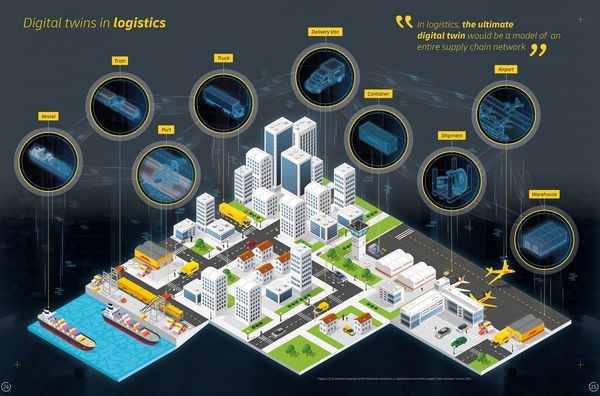
Digital twins can have many different applications throughout the logistics chain, for example, in container fleet management, shipment monitoring, or logistics system design. For instance, sensors placed on individual containers show their current location and monitor them for damage or contamination. This data is transmitted to a digital network that uses “machine learning” technology to ensure its most effective use.
Digital twins can also be applied not only to individual objects but also to entire networks and ecosystems, such as 3D warehouse models connected to inventory and operational data. The system can provide an ongoing overview of machine status and product availability, as well as predict and make autonomous decisions regarding inventory levels or deliveries. The same principle also applies to entire global logistics networks.
– It is projected that by 2025, the digital twin market will grow by more than 38 percent annually, exceeding a value of 26 billion dollars – says Wojciech Łukasiewicz, Logistics Projects and Solutions Manager at DHL Express Poland. – Digital twins offer unparalleled opportunities for tracking, monitoring, and diagnosing the state of assets. This brings a range of business benefits, from supporting collaboration and data-driven decision-making to continuous process optimization or the creation of new business models. As they develop and become commercialized, digital twins will permanently change traditional supply chains.
Report on the future of logistics
In the report, DHL analyzes implementation challenges, such as cybersecurity issues. Related technologies are becoming increasingly reliable and affordable. Consequently, companies in many industries are finding digital twins invaluable for managing complex asset systems in real-time and increasing the efficiency of their processes. The report concludes by considering the investments and changes necessary for the successful implementation of digital twins in logistics.
Trend report: “Digital Twins in Logistics – A DHL perspective on the impact of digital twins on logistics” is available for free at http://logistics.dhl/digitaltwins