









Human life on Earth is a unique phenomenon in the Universe. For it to be possible, many overlapping factors must be met. Undoubtedly, one of them is the existence of the ozone layer, located about 20 km from our planet’s surface. It protects living organisms from ultraviolet radiation type A and type B emitted by the Sun. In the event of its thinning or, worst of all, its disappearance, life on Earth would be impossible. Hence, the discovery of the phenomenon that causes the destruction of ozone in the upper layers of the Earth’s atmosphere led to the need to define ways to limit the emission of harmful substances into the atmosphere. These contain chlorine and bromine, which accelerate the thinning of the ozone layer (especially in the areas around the poles). These substances include, among others, refrigerants used daily in industrial and private practice in refrigeration equipment, air conditioning, and heat pumps.
Refrigerant phase-out policy
The policy of safely phasing out environmentally harmful refrigerants from use in the coming years is closely linked to international agreements that have been made in this regard. This results directly from European Union law and is part of the sustainable development policy. Looking from the point of view of a country located in the European Union, it can be stated that, based on Regulation (EC) No 1005/2009 of the European Parliament and of the Council of 16 September 2009 on substances that deplete the ozone layer, substances from the hydrochlorofluorocarbon (HCFC) group may be produced in accordance with the restrictions presented in Table 1.
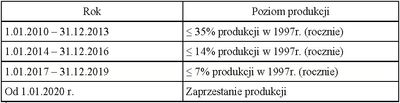
Tab. 1. Reduction level of produced refrigerants.
It is also known, as follows from Article 11(4) of the document, that from January 1, 2015, the use of HCFC group substances for the maintenance or servicing of refrigeration equipment, air conditioning, and heat pumps is prohibited in Europe.
For comparison, one can provide a summary of the general findings of the Montreal Protocol, on the basis of which restrictions in the European Union were established, along with the schedule for phasing out HCFC group substances in the United States. It is worth mentioning that since the beginning of international agreements regarding the protection of the ozone layer, i.e., the Vienna Convention in 1986, the United States has always ratified all agreements, while individually negotiating the most favorable conditions for the elimination of environmentally harmful refrigerants from the market.
The article contains 22,100 characters.
Source: Logistyka Magazine
13_Rucinski_Rusowicz_Grzebielec_Jaworski_Wycofanie_czynnikow_chlodniczych.pdf