









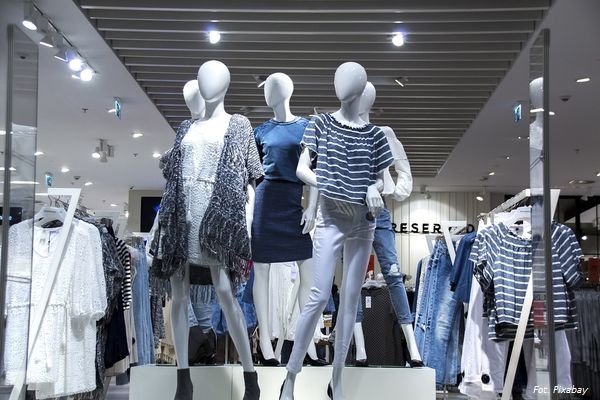
Interactive mirrors, innovative shopping baskets – this is how traditional retailers are fighting for the customer who is increasingly shopping online and, consequently, visiting brick-and-mortar stores less often. Online stores are not staying behind, introducing further amenities and services. The biggest winners in this retail arms race are customers, who are being pampered like never before.
The dynamic development of the e-commerce market is a huge challenge for traditional retailers. Data published by PwC shows that 17 percent of Poles shop using a smartphone at least once a week, and 47 percent declare a willingness to do grocery shopping online. From the “Poles Shopping” report, we also learn that 23 percent of respondents are already ordering essential products online, and 37 percent intend to do so in the future. For traditional retailers, losing customers who prefer to order products from the comfort of their homes rather than looking for them on store shelves means not only declining revenues but, in some cases, even the loss of financial liquidity and the closure of the business.
Companies that have built their business model on traditional points of sale will not give up without a fight. They know perfectly well that a large part of society prefers to take a closer look at the offer or simply enjoys trips to “temples of consumerism.” To remain competitive, one must fight for such customers with all one’s might. And how to do it, if not by implementing attractive innovations? This is why more and more companies engaged in physical sales are investing heavily in new technologies and looking for creative solutions to increase customer satisfaction.
Sephora’s mysterious baskets
Recently, a photo of unusual equipment in a perfume store went viral on the internet, which, according to experts, perfectly reflects what a modern approach to creating pro-consumer innovations is. 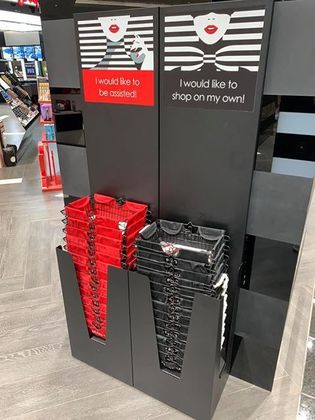 It shows two types of shopping baskets: red – intended for people interested in the help of a salesperson, and black – intended for customers who prefer to shop on their own and do not wish for unnecessary contact with employees. We have learned that they were introduced for use as part of a pilot project in selected Sephora perfumeries in Canada and Romania. Based on the evaluation of the project, a decision is to be made about placing similar baskets in other countries.
– Everything starts with an in-depth interview, getting to know the customer, and examining their needs. That was likely the case here as well. The project creators learned that some customers complain about the intrusiveness of salespeople, while others value their help. How to solve such a problem? Best through a brainstorming session where hundreds of ideas are generated. The next stage is prototyping. It is thanks to this that we learn about aspects that require improvement – explains Ireneusz Piętowski, an innovation consultant from DT Makers, a company specializing in projects implemented using the design thinking method.
His experience shows that when implementing projects using the design thinking method, all sorts of problems come to light, and the solutions created in the creative process can be so original that even the greatest inventors would not be ashamed of them. It is no wonder, then, that in the West, brands such as Carrefour, Tesco, or Zara, encouraged by the results, are using design thinking more and more often.
– Retailers are reaching for creative problem-solving methods because they understand the importance of customer experience. It is difficult to satisfy a customer if you do not examine their behavior at the deepest level, empathizing with their life situation, needs, and desires. Only after getting to know a person in this way can we properly match a solution. It does not always have to be a new, expensive technology. Brilliant innovations are also those that are simple and low-budget. It is important that they hit the mark – adds Irek Piętowski, an innovation consultant from DT Makers.
This point of view is reflected in Adobe’s research. It turns out that companies that follow a design philosophy consciously put the customer first. 46 percent of the largest organizations of this type cite an emotional bond with the customer as a defining feature of advanced design. Interestingly, as many as 50 percent of companies described as design-led boast a growing number of loyal customers. In the case of Sephora, implementing innovations to increase customer comfort is particularly important, as according to PwC, as many as 75 percent of consumers buy medicines and cosmetics online. Convincing a small part of this group is a real mission impossible. At the current pace of e-commerce market development, retaining an existing customer is already a huge success.
Mirror, mirror on the wall…
The clothing industry is also struggling with the problem of customer migration to e-stores. According to PwC, clothing and footwear are the most frequently purchased products online. The “Poles Shopping” report shows that as many as 79 percent of respondents buy such products online. These are potential customers of traditional clothing stores, which are doing everything to attract them. “Everything”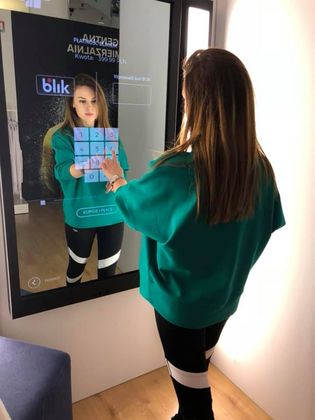 means, among other things, experimenting with technologies such as virtual mirrors, thanks to which we can pay for purchases right in the fitting room. Recently, in the Warsaw shopping center Blue City, the sports brand 4F tested futuristic solutions from the company Abyss Glass. Customers of its store in virtual fitting rooms prepared for this occasion could pay for selected products by entering a BLIK code directly on the mirror surfaces. This is possible thanks to RFID technology, which automatically recognizes clothes brought into the fitting room and displays them on the device. Everything happens without the use of cameras, which in places like fitting rooms are, for obvious reasons, unacceptable.
Thanks to Abyss Glass mirrors, store customers can also order a different size of clothing or view a personalized offer of accessories, automatically matched to the items of clothing being tried on, and ask staff to bring them. The mirrors are also intended to display information about the material the clothing is made of, the collection, and the price.
– Everything started in 2015. While browsing the internet, we came across a solution offered by a Dutch DIY enthusiast who instructed how to build an interactive mirror for home use. We became interested in the topic and started analyzing the market. It turned out that at that time it was not a widely available popular product that you could just buy – says Arkadiusz Adamek, the creator of the product.
The mobilization of forces on the part of traditional retailers has not gone unanswered. E-commerce companies are also racing to innovate, but above all, they compete with each other, making every effort to increase turnover and the pool of regular customers. The fight for the consumer accustomed to shopping in retail outlets has taken a back seat. This happened primarily because the level of smartphone penetration and the digital maturity of Poles is self-propelling the development of the entire industry. Nevertheless, in the interest of market position, online sellers are doing their utmost to refine the services they offer. The best example of this is the Polish company Muscat, which is said to have mastered customer experience to perfection.
Home Fitting Room
At first glance, it is clear that its business idea lies in simplicity. This Polish brand sells glasses – stylish and at reasonable prices. Each pair is handmade, so compared to optical chains, Muscat offers customers a much more solid product. However, an excellent offer would be of no use if not for the unique online sales model. Its key element is the home fitting room – a service that only leaders of the fashion e-commerce industry can boast of.
How does it look in practice? After visiting the Muscat online store, you can choose 5 models of frames that you want to try on at 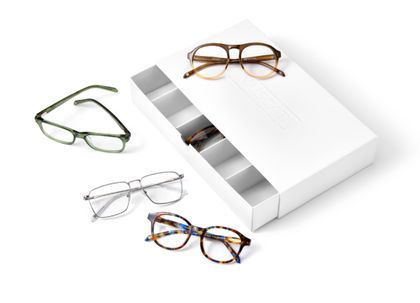 home. We have 5 days for this, and the fitting is free and does not oblige you to purchase. A potential future customer receives a free package with a set of products. In this way, they can look at the glasses up close and evaluate their workmanship – just like during a visit to a point of sale. The service is a response to the expectations of customers who lack the time to visit a salon or do not feel comfortable trying on glasses in someone else’s company. Launching it became possible thanks to outsourcing logistics to an external operator – the company Omnipack – which fully coordinated this process. Efficient picking and preparation of sets for fitting means that the glasses reach those interested on the next business day after placing the order.
– Due to the interest in the home fitting room, product rotation is very high. That is why we created a special station dedicated to this brand in the Omnipack warehouse. We also appointed a team that deals exclusively with its service. We store all models in specially designed trays, and the rack structure itself is adapted to glasses. Thanks to this, we can easily react to variable volumes during the day, optimizing parcel delivery for them. A process planned in this way fulfills its task, especially when the courier picks them up every few hours – explains Rafał Szcześniewski, COO and founder of Omnipack, about what the service of a demanding customer looks like behind the scenes.
The strength of the Muscat online store lies in perfectly organized logistics processes that work like a Swiss watch. Soon, its customers, alongside the Home Fitting Room, will be able to take advantage of same-day delivery. This is another premium service that enjoys considerable popularity in the West. In Poland, interest in it is still growing, but we are still far from countries such as Germany, the UK, or the USA.
In the pursuit of innovative solutions, both among traditional and online retailers, a common aspect is visible. It is customer-centricity. Innovations that lack this element are doomed to failure. Stepping into the customer’s shoes and understanding their needs is a mission that is more important for retailers today than ever before, and thanks to new technologies, satisfying these needs also seems easier. Meanwhile, practice shows that only the best can do it, and they will be the ones calling the shots in the coming years.