








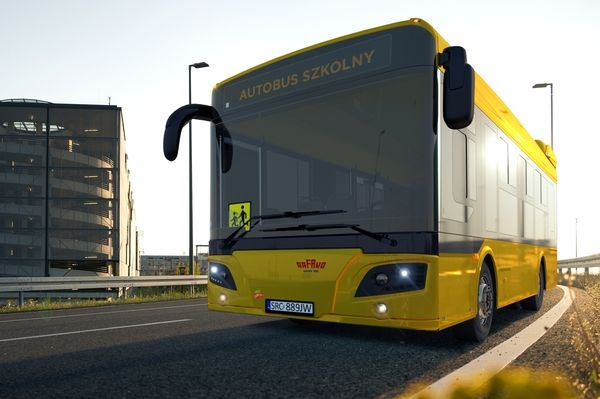
Every parent wants their child to get to school safely, comfortably, and on time. A zero-emission school bus has the potential to become a showcase for Polish electromobility.
Both manufacturers and city officials planning funds for the development of electromobility in their budgets are currently focusing on clean and sustainable public transport. At the same time, there is growing criticism regarding exhaust emissions from diesel-powered buses.
School buses almost exclusively use diesel fuel; for example, in the USA, 95% of the iconic yellow vehicles have diesel engines. This means children are exposed to polluted air, which directly contributes to the worsening of asthma symptoms and other respiratory diseases. Air pollution is now widely considered a carcinogenic factor.
In the USA, where the topic is widely covered in the media, local communities are lobbying for the widespread introduction of electric buses for transporting students. They point not only to the reduction of greenhouse gas emissions but also to long-term benefits, such as lower future healthcare costs and generally lower operating costs for electric buses over their entire service life.
Regarding the transition to electric transport, there are three most important areas:
1. Public education.
Only access to concrete data and its effective dissemination can strengthen social pressure to accelerate the process of replacing the old fleet.
2. Understanding needs and communication with manufacturers.
Every school district has its own unique transport needs. Buses in Warsaw will have different requirements than those in the Podlasie region. Tailoring the offer to these needs can be a key element in finding the best solutions.
3. Coordination of activities regarding public space.
Charging points must ensure the trouble-free operation of the buses.
In Poland, the replacement of the school fleet is just beginning. The company RAFAKO, among others, has prepared an offer for schools by presenting its school e-bus. The manufacturer ensures that it can be used not only in the centers of large cities. It will also work well on suburban routes, in cities with historic architecture, and in popular tourist destinations. A zero-emission school bus also has a chance to prove itself in smaller towns, where it must travel longer distances.
A well-developed network of electric school buses could become a showcase for Polish electromobility and play an important role in popularizing the idea within society. Essential to this issue is appropriate support (especially financial) for local governments and an open discussion about the transport that the youngest use to travel to school.