








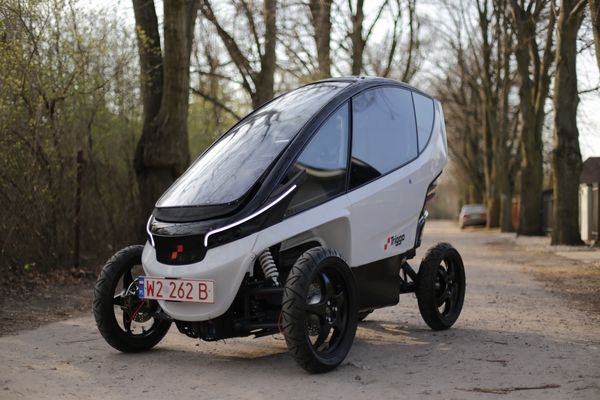
Triggo S.A., a Polish company working on a globally patented electric urban vehicle designed for carsharing and robo-taxi services, has begun road tests. The vehicle has been insured and approved for road use. Over the coming months, the company will complete its first pilot series of 9 vehicles, and in 2020, it plans to start production of the first commercial series.
The Warsaw-based company has entered the next stage of Triggo’s development by starting tests on public roads. The start of the drives was made possible, among other things, by obtaining third-party liability insurance from PZU. The initial test results are promising. In line with the design assumptions, the vehicle performs well in the demanding urban traffic environment. In particular, it allows for efficient maneuvering in traffic jams and in small parking spaces. The patented variable chassis geometry technology is key here, as it maintains Triggo’s small dimensions while ensuring vehicle stability at any speed and allowing for the construction of a safe cabin that protects the driver and passenger.
– The start of road tests in Warsaw is an important step in the development of Triggo, being a logical continuation of the tests previously carried out in controlled conditions. Through this, we will obtain important conclusions and feedback from using the vehicle in real-world operating conditions. Several months of testing will allow us to further improve and refine the design. We want future end-users to have a positive, one-of-a-kind driving experience with our vehicle. At the same time, we are working on obtaining type approval and are in talks with industry partners, also in the context of delivering units for the first commercial series in 2020 – says Rafał Budweil, CEO and founder of Triggo S.A.
In addition to the aforementioned projects, the company is participating in patent proceedings in India. Granting protection in the second most populous market in the world could expand the area of exclusivity for Triggo S.A. to territories inhabited by nearly 4 billion people. The company maintains its plan to conduct a public offering on the Warsaw Stock Exchange, which will help finance the construction of 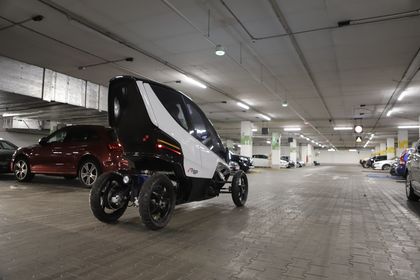 the first commercial series of Triggo and the commencement of activities aimed at implementing mass production.
Expert analyses indicate a continued systematic growth of the electric car market and shared transport systems. According to Deloitte, within two decades, 50 percent of purchased cars will have electric propulsion. The International Energy Agency indicates that a total of 0.3 billion such vehicles will be on the road worldwide by then. The Keralla Research center emphasizes that the number of people using carsharing systems will increase several times over the next 10 years to 35 million users, and the vehicle fleet will amount to 0.4 million units. The rising popularity of vehicles powered by unconventional drives is influenced by low environmental impact, the development of technology and infrastructure, and public support.
– Following trends in the automotive industry in Poland and on foreign markets, we see accelerating changes consisting of: on one hand, recognizing the advantages and strengths of electric vehicles; on the other, the increasingly widespread popularization of shared transport systems. Examples include carsharing platforms that are developing more and more boldly both globally and domestically. We firmly believe, however, that the real breakthrough lies in Robo-Taxi services, created by combining “app-based” rental with automatic vehicle repositioning. Triggo is designed for providing such services and is already ready for autonomization at the current stage – emphasizes Rafał Budweil.
Robo-taxi is a future-oriented market for passenger transport services, enabling the combination of high nominal gross margins observed in carsharing systems with significant unit revenues (Uber, Bolt, etc.). The essence is the autonomy of control, which allows for a significant increase in the average number of trips for each vehicle while simultaneously reducing the level of involvement of troublesome, manual human labor. It is predicted that the Robo-taxi services market will experience significant global growth along with the legalization and popularization of autonomous control systems. Triggo features a drive-by-wire control system, which is a ready-made starting point for installing autonomous driving modules. Polish legislation (the Electromobility Act) already provides for the possibility of testing autonomous vehicles in road traffic at the current stage. Therefore, there is a real chance to get ahead of foreign entities operating in these areas.
– At the moment, over 160 entities, in Europe alone, are working on automatic driving systems. Among them, we will look for a system supplier for Triggo. Our vehicle fits perfectly into the requirements of the Robo-Taxi market, and the granted international patent protection creates unique prospects for international commercialization. An additional advantage is the location of our project in Poland, a European country that remains very competitive in the area of design work and production – adds Rafał Budweil.
Triggo is a unique, fully electric vehicle that, thanks to its innovative design, combines the best features of mobility and ease of parking of two-wheelers with the safety and comfort of small city cars. A breakthrough feature of Triggo technology (the official debut of the first fully functional vehicle unit took place at the 590 Congress and Warsaw Motor Show in November 2018) is the variable geometry chassis, which allows for movement in two modes: road mode, ensuring stability for high speeds, and maneuvering/city mode, in which the vehicle maneuvers efficiently in traffic jams and takes up very little parking space. Its features make it perfectly adapted to the upcoming new urban mobility services. The vehicle uses, among other things, innovative “Drive-by-Wire” digital control and a swappable battery system, which shortens downtime associated with charging and makes the vehicle independent of public charging station infrastructure.
The vehicle is realized from the ground up by Polish technical expertise. The assumptions and concepts of Triggo are protected by international patents, currently covering an area inhabited by over 2.5 billion people. The project is a response to the growing demand for future-oriented shared transport services and electromobility in the largest metropolitan markets in Europe, Asia, and America. Triggo’s potential stems from the sale of both the product and licenses.