








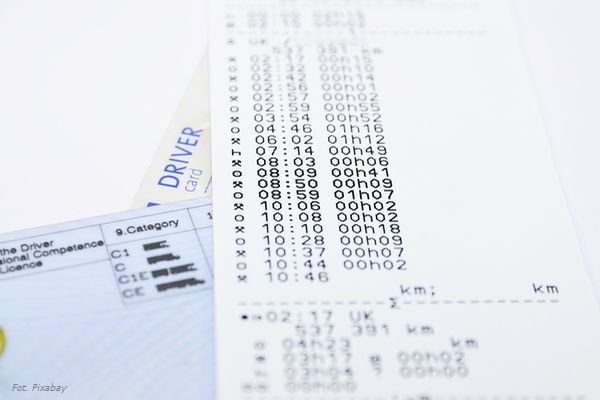
It was created to improve the fight of road transport inspectors against the manipulation of professional drivers’ working hours. Its task is to improve road safety. There is no doubt that it is needed. However, does such frequent improvement make sense? The digital tachograph, now called smart, is to be installed in all new vehicles with a GVW of over 3.5 tons from June 15. This is the fourth modification of the digital device. Will the era of driving with a switch finally end thanks to the smart tacho?
Fighting windmills?
In December, a Slovenian driver in Denmark was fined 307,000 PLN after local officers detected an exceptionally sophisticated system used to interfere with tachograph recording. In February, the Road Transport Inspectorate (WITD) in Kielce encountered the second case in Europe, and the first in Poland, of manipulation via the diagnostic port1, while at the beginning of March, the Lower Silesian ITD revealed a recorder switch controlled by a flash drive during an inspection2. Driving with a magnet or using someone else’s card3 are the most popular ways to circumvent regulations. In just 60 minutes, inspectors from the Świętokrzyskie region caught two vehicles using illegal practices4. All the mentioned cases clearly indicate the prevalence of actions aimed at bypassing driving time standards. The ingenuity of drivers knows no bounds, and tacho jamming systems are becoming increasingly complex. Authorities across the European Union are tightening penalties, inspection services are constantly training in the possibilities of detecting illegal practices, and yet it seems that this does not discourage drivers and entrepreneurs.
– Each subsequent version of the digital tachograph contains a number of security features intended to make it significantly more difficult to interfere with its records. Unfortunately, the newer the tacho version, the more advanced the mechanism of the device interfering with its operation – informs Mateusz Włoch, an expert at Inelo, a manufacturer of systems for analyzing and settling drivers’ working time. – Often, however, both drivers and entrepreneurs, despite high costs and great risk (high fines, loss of license, or even prison), still decide to manipulate. However, smart tachographs, in addition to the mentioned security features, also contain functionality that significantly improves the ability to detect illegal practices, i.e., remote early detection – the expert adds.
Remote inspections will do the job
One of the basic functions of 4.0 tachographs is fighting the plague of manipulation. A series of security features preventing interference with the device’s record is one thing, but the most important functionality equipped in the new recorders is the possibility of remote inspection. How does it work?
The smart tachograph has been equipped with a DSRC antenna, thanks to which inspections have the ability to read specific information remotely. Data on tachograph security breaches can be checked without stopping the vehicle, which will significantly streamline the inspection process.
– Thanks to this system, only those cars will be stopped for inspection where inspectors suspect that there may have been interference with the tacho record. Such a solution will certainly allow for catching a larger number of vehicles in which illegal practices are used – explains Mateusz Włoch from Inelo.
When will an inspector have grounds to stop a car to conduct a traditional inspection?
– Certainly, one of the grounds for stopping a vehicle will be an error saved in the tachograph’s memory: “motion conflict,” i.e., a situation in which an inspector during remote early detection obtains information about conflicting speed from the motion sensor and the location system. However, drivers do not have to worry that a conflict will occur during a lack of coverage, a ferry crossing, or a railway crossing – the expert clarifies.
During a remote inspection, the inspection service will not have access to all information recorded by the tachograph, but only to 19 selected items:
• Vehicle registration number
• Current vehicle speed
• Information about driving without a card (last 10 days)
• Motion conflict
• Other parameters specified in the example graphic
If the vehicle is not stopped by the services, the data read during early detection must be deleted within a maximum of 3 hours. For the remote inspection system to work fully efficiently, it is necessary to place the DSRC antenna (mandatory equipment in new vehicles registered after June 15 this year) in the central part of the vehicle’s windshield. This element will be subject to mandatory checking during calibration and tachograph inspections. The possibility of remote inspection also requires preparation on the part of the services – they will be obliged to invest in portable antennas, special gantries, or antennas built into inspection vehicles. Second-generation inspection cards will also be necessary for this type of inspection.
Connecting the dots
A very debatable issue, raising many concerns among drivers, is recording vehicle locations every 3 hours of driving, which previous tacho versions did not do. This is thanks to equipping the recorder with a GNSS receiver – the device receives a signal from the global navigation system – Galileo and EGNOS.
– Recording in the tachograph memory and on second-generation driver cards occurs at the start of the journey, its end, and every 3 hours of driving activity. It is worth remembering that both the start and the finish are not detected automatically, so the driver will still manually mark them in the tachograph – notes Mateusz Włoch. – The frequency of data recording will not be sufficient to settle business trips or foreign minimum wages, but it will significantly contribute to detecting manipulation of the device’s operation – he adds.
Drivers who comply with driving time standards and honestly record their working time should not fear the new system. It was created to increase road safety and exclude from the market those companies that engage in illegal practices. Neither the device itself nor the legislator’s regulations hide any secrets, nor should it be difficult to implement a recorder that is intended to streamline work behind the wheel and support the actions of road transport inspectors.
1 https://witd.kielce.pl/lista-wiadomosci/wiadomosci/unikalny-w-skali-kraju-przypadek-wykrycia-niedozwolonego-urzadzenia
2 http://dolnyslask.witd.gov.pl/dzialania-99999992-2-1-657.html
3 http://dolnyslask.witd.gov.pl/dzialania-99999992-2-1-677.html
4 https://witd.kielce.pl/kontakt/wiadomosci/wylaczniki-tachografow-niekonczaca-sie-opowiesc