








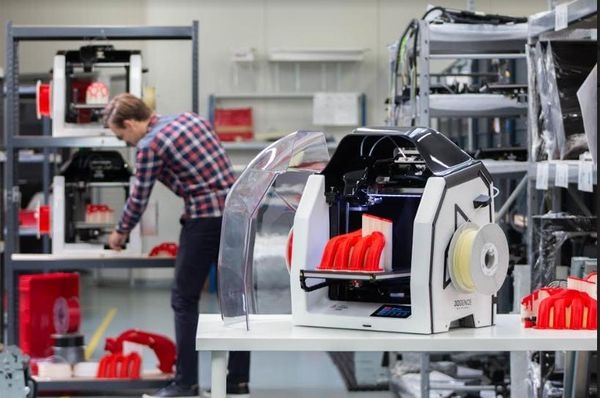
European rail transport is facing a huge challenge. It must deal with the necessity of serving more passengers more cheaply, faster, more quietly, and more ecologically. The European Commission has launched funds for work on new solutions that will help achieve this goal. Some manufacturers are already introducing innovations. What are they focusing on?
Shift2Rail is a project based on a partnership between the railway industry and the European Commission (EC). Its mission is to introduce innovations that will increase the attractiveness, efficiency, safety, and cleanliness of rail transport. All this to encourage Europeans to choose this means of transport. The Commission has allocated nearly 1 billion euros for the project’s activities.
Within the framework of Shift2Rail, among others, the Run2Rail project is operating, the goal of which is to investigate the possibilities of using lighter and more durable parts in trains. The Run2Rail team has a chance to prove that 3D printing methods and composite materials can be used to design trains that are more reliable, lighter, less damaging to the track, more comfortable, and less noisy than those produced by traditional methods.
Transport under the sign of innovation
Over the last few years, new production methods and materials, such as 3D printing and carbon fibers, have gained huge popularity and found application in almost every industry, primarily aerospace or automotive. Now they can change the way rail vehicles are constructed.
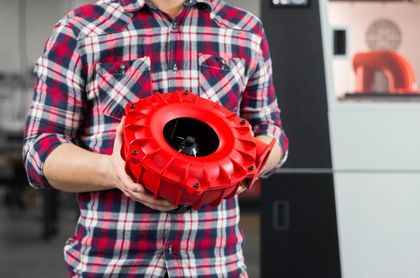 – Introducing innovation is an inherent element of every manufacturing company’s strategy. An increasing group of entrepreneurs is realizing the benefits they can gain through the use of 3D printing technology. The automotive and aerospace industries have been benefiting from it for years. However, rail transport is also starting to become convinced of additive manufacturing. It is no wonder, the materials that can be printed are constantly being improved and are becoming more durable year by year. Everything indicates that the tendency to use them in prototyping and the production of functional elements in transport industries will deepen – explains Karol Kula, Sales Manager at 3DGence, a company producing industrial 3D printers.
3D printing is mainly used for prototyping and for manufacturing spare parts and non-standard elements. Thanks to the ability to quickly produce very accurately reproduced rail vehicle parts, companies save time and reduce costs. They do not have to store spare parts, but can instead print any component on demand. Often also non-standard and tailored to the individual needs of the customer.
Trains from a 3D printer
The first attempts to use 3D printing in rail transport have already seen the light of day. Angel Trains, a company involved in leasing rolling stock, has produced train interior components that meet all standards using 3D printing technology. An armrest, a handle, and a table with a backrest have already been approved for use. The main goal of this project is the production of spare parts, lowering the costs of rolling stock, and longer vehicle operation.
Siemens uses 3D printing technology to manufacture non-standard tram components. Thanks to this, their delivery time is shortened from weeks to days. The company’s customers can place orders for such parts online. So far, among other things, driver’s seat armrests and coupler housing covers for Combino trams operating in Ulm have been printed.
General Electric, on the other hand, announces that by 2025 it will use additive manufacturing technology to produce 250 locomotive components. The company cares not only about shortening production time but also about eliminating parts composed of too many components. For example, an engine heat exchanger has 2,000 individual sub-assemblies, connections, or welds. All of them represent potential areas of failure that could disappear thanks to 3D printing and the production of more compact and thus smaller components.
Although the railway industry is only just beginning to notice the possibilities of 3D printing, there are more and more examples of its application. And this is because only innovative solutions will help the sector in the development that modern society expects of it.