








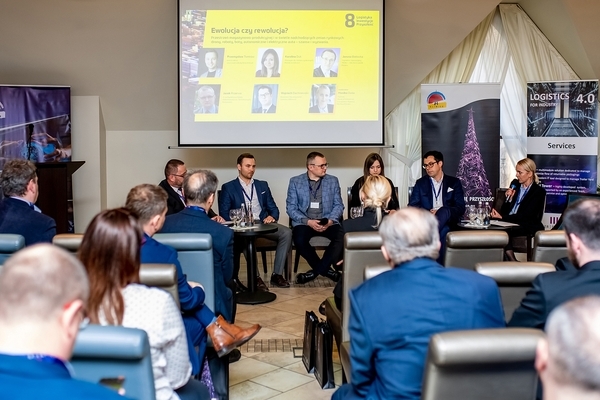
What changes await the logistics sector in the coming years? What investments should be planned to increase competitive advantage? On March 27 in Gliwice, we sought answers to these questions together with invited experts during the 8th edition of the “Logistics. Investments. Future” conference.
Changing consumer behavior, the growing importance of trade between Europe and Asia, dynamic technological development, the increasing share of the e-commerce sector, warehouse automation, and finally the use of drones and virtual reality – these are no longer futuristic concepts, but an evolution facing all market sectors, including logistics and production. We must also not forget the growing importance of electromobility. For several years now, automotive manufacturers have been focusing on eco-friendly solutions when creating new car models.
– The next step will be creating increasingly ecological and efficient supply chains – noted Janusz Bielówka, Operations Director at Müller – Die lila Logistik Polska. – Understanding these needs, we have created a multi-module system for managing and optimizing the flow of reusable packaging, COS, which will help achieve this goal.
The ongoing changes necessitate not only a revision of existing production processes and supply chains but also a change in employee competencies. For years, Gliwice has remained on the podium of top logistics and production locations in Poland. One of the elements building the city’s and region’s advantage is the ongoing analysis of market trends and the adaptation of the investment offer to them. Alongside obvious, constant assets such as an excellent location, proximity to the Katowice Special Economic Zone (KSSE), and the presence of a dynamically developing automotive industry in the region, Gliwice is gaining new advantages for potentially interested investors. Adam Neumann, Deputy Mayor of the city, pointed to the western city bypass currently under construction, which will in the future be part of national road No. 78 Chałupki – Chmielnik, and plans to pave the runway of the Gliwice airport, which is an excellent response to the needs of so-called small cargo traffic. That is not all – the city is currently working on releasing nearly 700 hectares of new investment land, intended to form the Gliwice Economic Area.
Among the guests invited to the conference were representatives of companies such as: Crusar Logistics, Müller – Die lila Logistik Polska, M4 Real Estate, Mobile Institut, Rossmann, Hillwood, the Polish Investment and Trade Agency, the Katowice Special Economic Zone, InnoCo, the Upper Silesian Agency for Entrepreneurship and Development, and the Upper Silesian Aviation Group. Discussions in such an interdisciplinary group allowed participants to look behind the scenes of the industry and jointly reflect on its future directions of development.
In connection with the challenges facing the sector, it will be necessary to modify the approach to product design, based on adding value at various stages of the product life cycle and analyzing observed signals and disruptions. As emphasized by Wojciech Ławniczak, Head of Strategy & Innovation at Very Human Services: All this so that initiatives can be created more efficiently, organized into scenarios and plans for the future, and implemented.
– The last few years have brought a significant acceleration in the adoption of modern technologies in the area of warehousing and distribution. Technological progress will take place in 3 areas: process automation, data management and the use of artificial intelligence for their processing, and achieving maximum flexibility in the supply chain – emphasized Monika Duda, Partner – Head of Industrial and Logistics Agency CEE at M4 Real Estate.
According to research conducted by PwC, nearly 60% of managers believe that acquiring people with competencies in the area of digital technology remains a major challenge. A huge challenge following technological evolution in the industry is therefore also acquiring employees capable of using dynamically developing technologies. One thing is certain – logistics and production are undergoing an evolution, and the sector is facing huge challenges related to the changing environment, new customer needs, and technologies revolutionizing the market.
The “Logistics. Investments. Future” conference is part of a nationwide series of meetings for logisticians, producers, and local government officials: Future 2 to 5, which is an interdisciplinary discussion about the future of the logistics and production industry in a 2 to 5-year perspective.