








The tire is the third fastest rotating element of a car and the only one in contact with the road. Is it worth following tests, and what should you pay attention to in them? How to choose the best tires for yourself?
Tires should be evaluated in terms of, among other things, steering response, vehicle handling safety in corners, grip and acceleration, noise level, wear patterns, impact on fuel consumption, braking distance in various weather conditions, or resistance to aquaplaning. What data should drivers look for in tire tests? What distinguishes a reliable test from amateur comparisons?
– Independent tire tests are a great opportunity for drivers to find a model that meets their expectations. The number of tire models available on the market is huge and can be overwhelming when a driver is considering purchasing a new set of tires. Reliable analyses are very helpful and allow drivers to thoroughly familiarize themselves with the capabilities of a given model or type of tire – and consequently, make a decision when purchasing them. However, it is worth paying attention to the key assumptions adopted in the tests – only then will we be able to make a wise, informed choice – says Piotr Sarnecki, General Director of the Polish Tire Industry Association (PZPO).
When looking at a test, do not rely solely on chart bars, because the scale adopted in them, e.g., in the case of braking distance, can be misleading. Therefore, compare and pay special attention to numerical data.
– For example, on a braking distance chart, the difference between the bars may be small because of the scale adopted. However, in numerical data, this will be, for example, 4 meters, which is almost the entire length of a compact car – adds Piotr Sarnecki.
A reliable tire test will always include information about:
1. The air temperature at which the test was performed
It has a huge impact on test results – publications that do not inform the reader about this value are actually of little use to drivers looking for reliable information, because, for example, a winter tire test on wet or dry pavement at 15-20°C will always show much worse results compared to summer tires. If the test is done at a temperature below 7-10°C, we will see that the soft compound of winter tires makes a difference as soon as it gets cold. Temperature and differences in weather conditions in the spring-summer and autumn-winter seasons affect the performance of these types of tires so significantly – and especially the braking distance of cars, which is crucial for road safety and drivers – that every test should state this variable. This applies particularly to comparisons of all-season tires with seasonal ones.
2. Tire size
It is not enough to just have the manufacturer’s name and model of a given tire – look for information about the exact tire size that was used in the tests. The same tire model can have different performance depending on the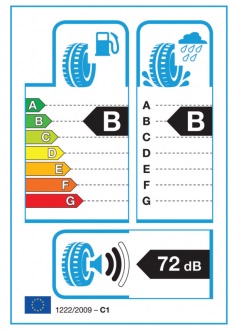 size! A highly rated tire model in one size may perform much worse in a tire test of a different size.
3. Surface type
Information about the type of surface on which the test was performed is fortunately very often included in publications about the performance of given tires. Independent tire tests are usually performed on several different surfaces – dry, wet, and for winter or all-season tires also covered with snow or, less frequently, ice, so as to compare their performance in a wide range of climatic and road conditions. The type of surface has a huge impact on test results in all its criteria.
– It should be remembered that equipping yourself with good, unused tires is the simplest way to increase your safety on the road. By driving on used tires, we risk our lives, the lives of our loved ones, and all road users – adds Piotr Sarnecki.
Read the label
Before we follow detailed tests, we can easily narrow down our tire search by comparing labels. A glance at the basic tire parameters will allow us to quickly get oriented in the tire market. Since November 2012, all new tires sold in the European Union must have appropriate labels. They will make it easier to compare three basic tire parameters before purchasing them:
• Fuel efficiency (icon with a fuel pump) – determined by the tire’s rolling resistance coefficient. It is expressed in classes from A to G, where A means the most economical tire – top-class A tires will save up to 7.5% of fuel compared to the lowest-class G tires.
• Wet braking (icon with rain) – informs about the braking distance. Class A means that a given tire model has the shortest braking distance on wet pavement – at a speed of 80 km/h, the braking distance will be up to 18 m shorter than with the lowest-class G tires.
• External rolling noise (icon with a speaker) – the value expressed in decibels emitted by a given tire at a speed of 80 km/h. The noise scale is shown in the form of three bars – the more black bars there are, the louder the tire.
Such information must also be displayed in e-shops and on purchase receipts. Of course, these are not the only important parameters – braking distance on dry pavement or on snow, resistance to aquaplaning, cornering grip, or traction are also important, and these can be compared in independent tests in the press and on the internet.
Source: PZPO