









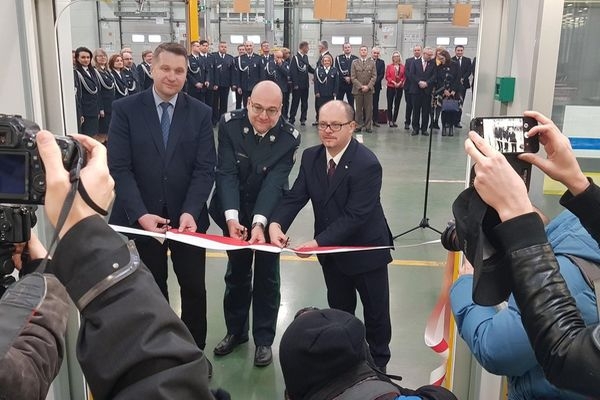
A new Postal Customs Branch has been established at the Poczta Polska sorting facility in Lublin, which will streamline the handling of shipments in international postal traffic. This is another element of the agreement signed in January this year between Poczta Polska and the National Revenue Administration (KAS) of the Ministry of Finance regarding cooperation in the field of customs clearance for postal items.
After establishing cooperation with China Post, Poczta Polska has become a very important partner in the dynamically developing market for shipments from Asia. One of the results of this cooperation is the launch of postal shipment transit through the rail transshipment terminal in Małaszewicze and the Poczta Polska sorting facility in Lublin. Shipments arrive here by rail from Chinese logistics bases in Chongqing, Tuanjiecun, and Yiwu. Thanks to this, the new Silk Road has connected Europe with the People’s Republic of China and the Far East of Asia by land. In addition, postal shipments travel from China to Europe by air via Warsaw’s Okęcie airport.
Until now, the Poczta Polska sorting facility in Lublin received cargo from ChinaPost in containers from the Małaszewicze crossing, but without customs handling, which was carried out by the Poczta Polska sorting facility in Warsaw. The task of the new branch will be to relieve the Warsaw Poczta Polska sorting facility and accelerate the introduction of shipments into domestic circulation, as well as to carry out the transit of postal cargo to other European countries.
– Today we are celebrating a joint success, which was preceded by many months of work, arrangements, and analyses. The undertaking was large, so the joy is also great. We had to make legal changes establishing a new organizational unit for customs matters in postal traffic, ensure appropriately qualified staff to carry out new tasks, as well as carry out many organizational and infrastructural activities. Therefore, I would like to thank both the representatives of Poczta Polska S.A., without whose cooperation the project would have had no chance of success, as well as the Directorate of the Revenue Administration Chamber and everyone who contributed to the fact that we can improve customer service by ensuring customs clearance of postal items at the new facility in Lublin – says Chief Inspector Piotr Walczak, Undersecretary of State, Deputy Head of the National Revenue Administration.
The new unit will employ 48 customs officers and 40 postal workers. Ultimately, it will be able to handle approximately 100,000 shipments per day.
– Poland is an important transit country. The construction of the new Silk Road makes the Polish market very attractive. That is why we decided to invest in the modernization of the logistics structure. Handling the growing number of shipments from abroad also requires good cooperation between postal workers and customs services. It is important to efficiently apply customs procedures along the entire route of the shipments, especially in Poczta Polska sorting facilities, so that shipments reach recipients faster – says Przemysław Sypniewski, President of the Management Board of Poczta Polska.
It is the duty of the Post Office to collect fees imposed by the National Revenue Administration and transfer them to the State Treasury. Every good imported from outside the European Union must undergo customs clearance. It is the officer of the National Revenue Administration who decides on the application of the appropriate customs duty and VAT rate. The establishment of the Postal Customs Branch in Lublin at the Poczta Polska sorting facility in Lublin was regulated by the Regulation of the Minister of Finance of October 15, 2018, which entered into force on November 20 this year. Handling the international parcel market is one of the three pillars of the new development strategy of Poczta Polska for 2018-2022. The goal of Poczta Polska is to coordinate trade between Asia and the European Union. Poczta Polska wants to achieve this task by taking over the handling of postal shipments from China to European countries that arrive here by rail and by concluding favorable agreements with Asian partners and operators of European countries.