








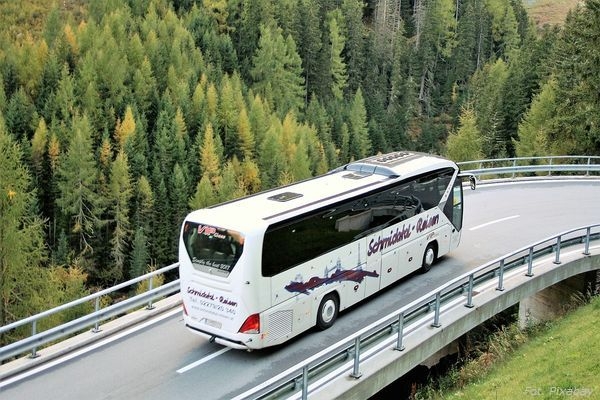
Over 378 million passengers were transported by bus in domestic and international traffic last year[1]. This is 3% less than in 2016. It turns out that we currently travel by bus and coach less frequently on urban and intercity routes, which is the opposite of trips to European Union countries. Passenger transport in international communication increased by over 7%. Most of these were regular routes, not occasional trips. Nearly 50% were routes to Germany, the number of people regularly traveling to the Czech Republic increased, and fewer people are now traveling to the UK. Experts from OCRK and GBOX comment on why this might be the case and how to transport people safely.
The report on economic emigration[2] shows that our neighbors across the Oder are the most frequent employers for Poles among European Union countries. Although our compatriots are stopping their mass exodus abroad in search of better wages, Germany remains the number one choice. Interest in work-related trips to the UK is falling, and with it the number of people regularly traveling to the British Isles (by over 17%). An upward trend, on the other hand, can be seen in coach travel to the Czech Republic (up by 30.8%), Austria (27%), and Hungary (19%). It turns out that over 100,000 Poles already live in the Czech Republic, and many have recently taken up paid employment there or are considering moving their companies. Why? Our southern neighbors are dealing with labor shortages by significantly increasing wages. Wage growth there will reach between 3 and 5% over the next few years[3].
Is there a driver traveling with us?
– This may cause Poles to travel south more often, and Polish carriers are recording growth in passenger transport on shorter routes to EU countries, but with increased frequency. It must be remembered that the work of a bus or coach driver is subject to strict regulations related to working time. For what purpose? Primarily to ensure the safety of all those traveling in domestic and international transport. According to regulations, a driver of a vehicle adapted and intended for the transport of more than nine people, including the driver, cannot drive for more than 4.5 hours without a break. After this time, there must be a break of at least 45 minutes. Furthermore, one person cannot drive for more than 9 hours a day, with the exception of two extensions per week up to a maximum of 10 hours of driving – reminds Kamil Wolański from OCRK. – For example, when taking passengers from Warsaw to Munich, the route must be planned very carefully and working time must be monitored. According to regulations, such a trip cannot be completed by coach with one driver within the 10-hour driving limit, which means that the driver should have two days to complete it. This is the basic principle of safe driving, and above all, safe passenger transport. Meanwhile, one of the most common offenses detected during inspections is still exceeding the driver’s working time – says Wolański.
Why should working time standards not be ignored?
It turns out that after 4.5 hours of night driving without a break, a driver’s condition resembles that of a person with a blood alcohol content of 1 per mille. Fatigue makes it impossible to concentrate on the road, significantly increases reaction time, and can lead to so-called “microsleeps”[4].
– Scientists and engineers are working on solutions that can eliminate such situations, which threaten the lives of the driver and passengers. In addition to autonomous coaches, which in the distant future may partially replace human participation in passenger transport, sensors have been created that are able to detect an error and react in time. These include, among others, traffic sign recognition systems, driver fatigue sensors, and obstacle avoidance systems. Complicated maneuvers can now be performed with great ease due to vehicles being equipped with cameras that give the driver a full field of view. Soon, an autopilot may be used to park or perform difficult operations with such large vehicles. It is also certain that telematics systems will be enriched with new functions, such as automatic accident notification – eCall, or interacting with “smart surfaces,” thereby adjusting optimal driving parameters – says Kamil Korbuszewski from GBOX, an expert in telematics and GPS systems.
It is worth noting that according to a GBOX study, as many as 87% of surveyed transport company owners appreciate the increase in safety precisely thanks to the implementation of such IT solutions. Telematics makes it possible, for example, to exclude dangerous places from a route (33% of respondents) and, thanks to it, emergency services can be notified immediately in the event of a threat, accident, or situation endangering health and life (30%). What is also important is the fact that unnecessary phone calls made by the driver are eliminated and the use of CB radio is minimized.
What is driving on our roads?
The newest buses – up to 4 years old – are the fewest, only 9.5 thousand. In Poland, we have the most eleven-year-old vehicles – over 38 thousand, and twenty-year-olds, 21 thousand. Thanks to the fact that carriers are increasingly deciding to implement telematics systems that improve driver efficiency, even the oldest Polish buses can benefit from, for example, devices connected to GPS that check working time, send documents, warn about accidents and other road hazards, and allow for limiting phone calls or quickly calling emergency services if needed.
– It is said that a driver makes between eight and twelve decisions per kilometer driven. They have less than half a second for each of them. And most importantly, the safety of road users, drivers, and passengers depends to some extent on each of these decisions. Telematics is there to facilitate the hard work behind the so-called wheel and reduce the risk factors of distraction and lack of concentration. In road transport and communication related to passenger transport, it should be a standard – says Kamil Korbuszewski, GBOX expert.
[1]GUS data, Transport activity results in 2017.
[2]https://polskatimes.pl/praca-za-granica-polacy-juz-nie-chca-wyjezdzac-do-pracy-za-granice-wolimy-zarabiac-w-kraju/ar/13206652, accessed 6.11.18.
[3]https://innpoland.pl/143931,gwaltowny-wzrost-wynagrodzen-w-czechach-oto-prawdziwy-rynek-pracownika, accessed 5.11.18
[4]Study conducted at Utrecht University
Source: OCRK