









Laws and regulations concerning road transport are intended to streamline the work of drivers, improve road safety, and set clear rules regarding the powers of inspectors. In practice, however, it turns out that regulations are often interpreted in very different ways. This time, Article 50 of the new Road Transport Act may cause trouble. The opinions of the Provincial Road Transport Inspectorates are divided on the issue of identifying violations and imposing penalties. And drivers are asking about night work in droves. The OCRK emergency hotline recorded over 400 calls for advice on this very topic in September and October. Where does the problem lie?
The Road Transport Act has been in force since September 3, including a provision regarding exceeding working hours at night, introducing a penalty that did not exist before. Now, for such a violation, one can pay from 50 to several hundred zlotys each time, depending on the scale of the offense, but only the carrier is punished. The sanction seems small, but understanding the new regulations itself is troublesome for drivers. Inspectors, on the other hand, have different opinions on enforcing the applicable standards. In response to numerous questions from Polish carriers, an OCRK expert discusses various scenarios and comments on possible solutions.
Regulations
Every company is obliged to establish two night periods and inform its employees about them. The first break results from the Act on the Working Time of Drivers and consists of four selected hours between 00:00 and 7:00.
– The most commonly designated time is 00:00 – 4:00 AM, as this is when most drivers take their rest. Here, it should be noted that even one minute of work during this period causes the driver to be subject to a 10-hour limit – says Łukasz Włoch, an OCRK expert.
The second mandatory document for company employees is the selection of eight hours between 21:00 and 7:00, which results from the Labor Code. Why?
– During these working hours, a salary supplement of 20% of the minimum wage is due, i.e., approximately 2.28 to 2.76 PLN for each hour. But this night period has nothing to do with the driver’s working time limit. However, carriers should remember about a different calculation of remuneration, because in the absence of payment of the “night supplement” and an inspection by the National Labor Inspectorate, such a violation will certainly be revealed – says Włoch.
As the OCRK expert notes, a common mistake made behind the wheel is including all activities between daily rest periods in the applicable 10-hour limit. Meanwhile, only driving events and other work recorded by the tachograph count.
Example
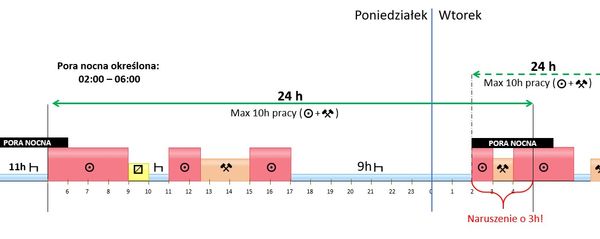
– Carriers, and especially drivers, should remember that if even a minute of work occurs during the designated night period, the driver absolutely cannot work more than 10 hours within a 24-hour period from the moment they start driving. For example, if the company has set night hours from 3:00 AM to 7:00 AM, and the vehicle started at 5:00 AM on Monday, which is still within the night period defined in the company. Therefore, the 10-hour limit cannot be exceeded between 5:00 AM on Monday and 5:00 AM on Tuesday. Such a situation is illustrated by the tacho record chart from the 4Trans program. A violation is clearly shown, as the driver worked 13 hours. They exceeded the working time by three hours, which in this case is subject to a 50 PLN penalty – says the OCRK expert.
Record of the driver’s working time from the 4Trans software.
During an inspection
Transporters fear penalties because it is very easy to commit an offense due to inattention or ignorance of the regulations. Checking tachograph data records can take place on the road, but also at the company. And what if the inspector does not know the night working hours of a given company?
– The matter is simple – then the working time between 3:00 AM and 4:00 AM is verified, because this interval is always present in the designated night period. According to the law, persons performing transport regardless of the type of employment may be subject to inspection. However, due to inaccuracies contained in Article 50 of the Road Transport Act, road transport inspectors in Poland have refrained from checking violations related to night work during road inspections. On the other hand, during inspections at the company, some control services apply a simplified rule and do not take into account driving and work events after the daily rest has been completed – says Łukasz Włoch.
Attention drivers, control services also include the Border Guard, the National Labor Inspectorate, or the Customs and Fiscal Service. These bodies can impose penalties regardless of the interpretation of the Provincial Road Transport Inspectorates. It is worth being vigilant and understanding the new regulations well.
Source: OCRK