








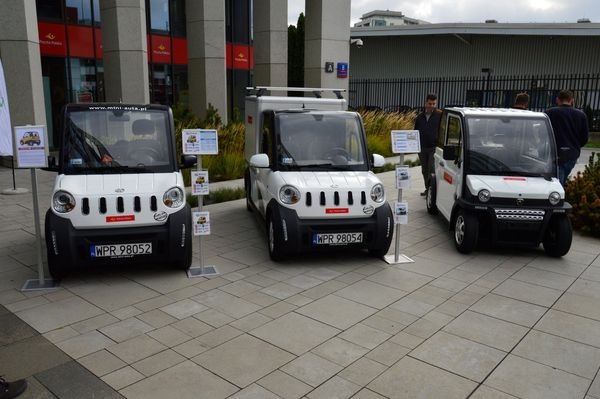
Mail carriers in Łódź, Warsaw, Tomaszów Mazowiecki, Konstantynów Łódzki, Raszyn, Nowy Dwór Mazowiecki, Piastów, Radom, and Pabianice will take part in tests of electric vehicles organized by Poczta Polska. This is the next stage of preparations by the designated operator for the entry into force of regulations resulting from the Act on Electromobility and Alternative Fuels. The largest electric car tests in Poland began in the spring, and the acquisition of electric vehicles will begin next year.
For the electric vehicle tests, Poczta Polska selected a wide range of designs and solutions obtained from 8 manufacturers and distributors of such equipment present on the Polish market. A total of 15 vehicles will be tested, including:
– scooters:
• iTango, Goodyear Ego2 (provided by Tomasz Wrzosek Tomax)
• Askoll eSpro45 (provided by VELOMOTORS Sp. z o.o.)
• Vectrix VX-2 (provided by M.P. Tech Sp. z o.o.)
• Romet Ecodelivery (provided by Arcus & Romet Group Sp. z o.o.)
• Ligier Pulse 3 (provided by Automicro Sp. z o.o.)
– small vehicles:
• SAM (provided by S.A.M. Polska Sp. z o.o.)
• Romet 6E (provided by Arcus & Romet Group Sp. z o.o.)
• Eidola City, Eidola Cargo (provided by APP Sp. z o.o.)
– bicycles:
• Romet ERT 100 M and D (provided by Arcus & Romet Group Sp. z o.o.)
• Maxim MC 010 (provided by Biuro Ekonomiczno-Handlowe Jan Zasada Sp. z o.o.)
Electric vehicles are intended to facilitate the work of mail carriers. The vehicles currently being tested will be used in particular for transporting letters and smaller parcels while maintaining safety and all transport standards. It is possible that the company will decide to purchase them in the future.
– Poczta Polska is conducting the “Electromobility” project to be as well-prepared as possible for the introduction of “Clean Transport Zones”. We are counting not only on savings, but also on the company being perceived as one that cares about local communities and is interested in a positive impact on the environment by reducing air pollution – says Grzegorz Kurdziel, a member of the Poczta Polska Management Board. – At the same time, we are very keen to improve the comfort of work for postal workers, which is why we are testing the utility of the vehicles in the daily work of mail carriers and couriers – adds Grzegorz Kurdziel.
This is the next stage of the “Electromobility” project implemented by the company. In April, tests began for electric vehicles with a load capacity of up to 800 kg. 15 vehicles from several manufacturers took part in them: Citroen Berlingo, Melex 381, 382, and 391, Nissan e-NV200, Peugeot Partner, Renault Kangoo, Zeppelin Goupil G4 and G5, as well as Komel – a conversion by the Institute of Drives and Electrical Machines. The tests were a kind of “proving ground” for drivers and technical maintenance and charging staff, as well as for the manufacturers who provided their vehicles free of charge.
Each of the testing drivers filled out a survey after the end of the several-day usage period, in which they had the opportunity to evaluate the vehicle. They evaluated, among other things, the vehicle according to individual technical and operational parameters (acceleration, braking, ride comfort, etc.), and also had the opportunity to write a short description of the test progress and the general characteristics of the vehicle. As a result, the results of the received surveys, subsequently evaluated through the prism of the transport tasks performed, allow us to conclude that in the vast majority, users rate vehicles they are familiar with and whose construction (level of ergonomics, placement of indicators, efficiency of the cooling/air conditioning system) they have managed to get used to higher.
At the same time, high marks were given to niche solutions such as closing the luggage compartment with a roller blind or accessing the luggage compartment through three independent doors. The container body (lack of wheel arches) and the maneuverability of the smallest of the tested vehicles were also appreciated. In total, during the tests, postal workers covered over 21,000 km, and the total number of days amounted to 785. All drivers taking part in the test had the opportunity to use vehicles that are currently at the forefront of technical solutions, but with different operating characteristics (better acceleration in urban traffic with a range resulting from battery power, not the location of gas stations, and not emitting noise – while at the same time “not warning” pedestrians or cyclists of their presence).
– Thanks to the tests, we checked which electric vehicles with a load capacity of up to 800 kg and which of their technical and operational parameters are particularly useful in our company’s operational activities. Next year, we will begin acquiring electric cars. The first vehicles to be included in the Poczta Polska fleet will have a gross vehicle weight of up to 3.5 tons – announces Paweł Skoworotko, a member of the Poczta Polska Management Board responsible for logistics and infrastructure.
Poczta Polska also tested charging stations. This was important from the point of view of gathering user feedback regarding their operational requirements and ease of use. Comments also appeared that did not result directly from the construction and technical functionality of the station itself, but took into account the improvement of working conditions in terms of operating electric vehicles. These include, for example, the expectation of a roof over the station. Users spoke positively about the modern design of the offered stations and praised the devices characterized by readability and ease of use. Certainly, an important expectation is the acceleration of car charging, which is associated with connecting more power to the chargers, and the devices themselves are already ready for this.
In accordance with the Act of January 11, 2018, on Electromobility and Alternative Fuels, Poland is focusing on the development of electromobility and powering vehicles with alternative fuels. The solutions adopted in the Act, such as clean transport zones, make it necessary to gradually replace the fleet powered by traditional fuels with alternative power. Similar regulations to the aforementioned Electromobility Act have been introduced in most EU countries. The result of this is the widespread introduction of electric vehicles into fleets, e.g., in the postal services of Germany, France, and Denmark, which is preceded by detailed tests.