








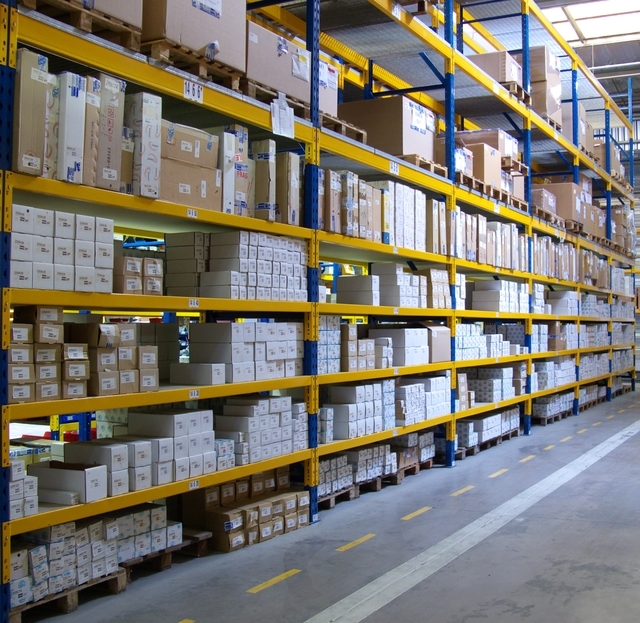
In the broadly understood supply chain management process, warehousing is one of the key elements. Due to increasing competition, companies strive to minimize supply chain-related expenses to remain attractive to potential buyers of goods or services.
The costs of the logistics process in service enterprises include, among others, inventory holding costs, which in turn can be grouped as:
- inventory creation costs,
- inventory holding costs,
- delivery costs,
- stockout costs.
This paper focuses on the group of inventory holding costs, which constitute a fundamental part of an enterprise’s expenses. Inventory holding costs include, among others, warehousing costs, i.e., expenses related to energy or fuel consumption resulting from the need to maintain appropriate temperature conditions for storing goods.
General characteristics of warehouses
Warehouses are an element of the logistics system where periodic storage of products, semi-finished products, inventory, etc., takes place, as well as their direction to the next unit in the supply network. We divide them according to various criteria, i.e., by:
- state of matter and storage susceptibility of loads,
- technical and construction solutions and the degree of protection of inventory storage susceptibility,
- degree of implemented mechanization of warehouse processes,
- function and economic purpose.
Due to technical and construction solutions and the degree of warehouse protection, warehouse structures are classified into:
- open warehouses, e.g., storage yards,
- semi-open warehouses, e.g., sheds,
- closed warehouses:
- above-ground – single-story or multi-story, low-bay and high-bay,
- underground, e.g., cellars, mounds,
- special warehouses, e.g., cold stores.
In this paper, special attention is paid to closed warehouses, as this is the most numerous group among warehouse facilities. It is in them that various goods can be stored, e.g., cement, artificial fertilizers, food products, and many others.
Closed warehouses usually store goods that require protection against external conditions: precipitation, solar radiation, etc., and those requiring appropriate temperature or humidity conditions. Closed warehouses are fully covered by building partitions, i.e., external walls, roof, floor, and joinery (doors and windows).
The article contains 22,560 characters.
Source: Logistyka Magazine