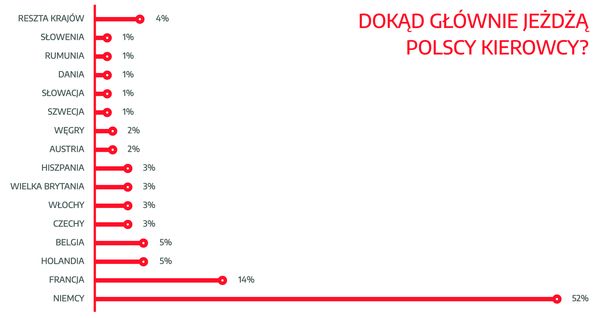
Germany and France are the countries where trucks from Poland travel most often. This is according to the latest OCRK report. Belgium and the Netherlands follow, with the United Kingdom further down the list. These are the main business travel destinations for Polish drivers. Do they remember the important regulations and rules in force abroad?
Polish transport companies have dominated the European transport market. As recent Eurostat data shows, truck drivers from our country performed the most tonne-kilometres in international and cabotage transport among all EU member states. In 2017, the number of cabotage operations increased by 17%, and Eastern European countries, including Poland, are breaking records in this sector. Where do we travel most often and most willingly? It is not a big surprise that most Polish truck drivers go to Germany. According to the OCRK report, more than half (52%) of carriers delegate their drivers to our closest western neighbor. The second destination is France (14% of delegations), and the Netherlands and Belgium (5%) are in third place.
Companies sending their employees on international or cabotage transport should remember that local regulations regarding the calculation of minimum wages and the enforcement of violations related to working time differ from those in force in Poland. Ignorance in this area can unfortunately significantly increase costs and sometimes even expose one to heavy fines. So what should you pay attention to?
German precision
When going to Germany, you must remember that the local service controlling transport over 3.5 tons (BAG) is known for its meticulousness and frequent inspections. It checks tachograph readings very carefully, which can determine whether the driver has correctly used the available working time and performed the appropriate amount of rest and breaks. The indicated data is also the basis for calculating remuneration in accordance with the German minimum wage. In the Federal Republic, it has been 8.84 euros per hour of work since 2017. This obligation involves the need to register the driver as a posted worker and to record the moment of crossing the border. In the event of an inspection regarding the payment of the German minimum wage, the entrepreneur must present translated documents, i.e., an employment contract, working time records, confirmation of receipt of remuneration, or tachograph readings.
– Also interesting is the requirement for communicative knowledge of the German language in the case of oversized transport, i.e., among other things, construction elements exceeding 20 meters in length. One Lithuanian transport company found this out in a rather unfortunate way when, in a dispute over the above regulation, the Administrative Court of Baden-Württemberg upheld the opinion on the requirement for advanced language skills for people transporting such materials – says Łukasz Włoch, an OCRK expert.
Sad news also awaits drivers who use CB radios. From 2020, provisions of the amended Road Traffic Act will come into force, which will completely prohibit the use of these devices. “Mobilki” (CB radio users) who do not comply with these recommendations should expect a fine of up to 200 euros. It is worth remembering that this is an extension of the regulations in force since 2017, prohibiting drivers from using any devices that require the user to take their eyes off the road. Similar regulations apply in Austria, Northern Ireland, and Romania.
French bureaucracy
And what is the situation in France?
– In addition to the requirement analogous to the German one to calculate and pay the local minimum wage (from 9.88 to 10.06 euros), one must take into account the infamous French bureaucracy. Unlike Germany, it requires drivers to carry documents such as a posting certificate translated into French, an employment contract (for temporary employment agency workers – copies of temporary employment contracts and employee assignment contracts), and an “A1” form (certificate of social security coverage in Poland). Entrepreneurs sending their drivers to France should also remember that the company must have a representative in the Republic to resolve issues related to driver remuneration and mediation in contacts with local inspection services – explains Łukasz Włoch.
Truckers performing transport in France should also take into account that there are even more restrictive regulations than in Germany regarding the use of mobile phones. These devices can only be used there while parked at a parking lot, with the engine turned off. This is an obvious and significant difficulty for truck drivers who often drive under time pressure, and finding a free parking space to make a call to the destination sometimes borders on a miracle.
The Netherlands and others
Polish drivers also travel to other EU countries. In each of them, you can encounter specific rules and regulations that you should keep in mind. For example, in the Netherlands, there is also a minimum wage, but the requirement applies unambiguously only to cabotage transport. In the case of international transport (excluding transit), information on the scope of application has not been explicitly confirmed by the Dutch embassy.
– However, in accordance with the regulations of the Posting of Workers Directive 96/71, we recommend including international routes in the minimum wage – says Łukasz Włoch, OCRK. It is different in Belgium, where the regulations explicitly cover only cabotage, and the issuance of posting certificates should be done using the Limosa online system. Current inspections concern the correctness of filling out this declaration. You should also be careful about taking regular weekly rest in the cabin in these countries. Entrepreneurs will pay up to 1800 euros for drivers caught in the act.
Where else do we go and what should we remember?
Regulations in force since July 2018 in Denmark and Spain, which are struggling with the problem of crowded parking lots, may be problematic for domestic drivers. As a result, these countries decided to introduce bans on 45-hour rest periods taken by drivers in vehicles. In Denmark, the maximum time in some parking lots is currently 25 hours. If it is exceeded, you can expect fines of up to 2000 DKK. However, these regulations raise suspicions of the European Commission, which in an official statement on July 19 indicates that under Regulation 1072/2009, they discriminate against carriers who do not have a registered office in Denmark. It may turn out that the Danes will have to abandon the controversial provision.
It is also worth looking at Switzerland (a country outside the EU), for example, where you have to be especially careful about exhaust emission standards. Local customs officers pay special attention to vehicles using AdBlue emulators, directing those with faulty SCR systems to authorized workshops. If the system is defective or it is proven that devices emulating AdBlue operation were installed, a rate is charged to equalize fees to the level of vehicles not using this agent. The above solutions are part of the LSVA tax (tonne-kilometre rates there depend mainly on the aforementioned emission standards, but also on the vehicle’s weight, its category, and the length of stay) and are an element of the Alpen-Initiative concept implemented for over a dozen years, aimed at shifting road transport to rail. A further and more radical step in this direction is also the Swiss government’s idea to create a network of underground tunnels, which by 2045 are to take over up to 40% of freight transport in that country. Goods would be transported using autonomous carts. This project already has partial funding secured for the section from Härkingen to Zurich. It may turn out that Switzerland has a chance to disappear from our carriers’ road map in the near future.