









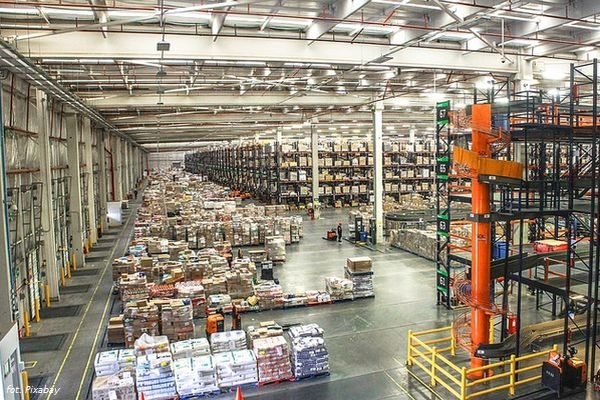
Positive macroeconomic data, including the upward revision of the GDP forecast to 5%, are reflected in the results of the warehouse sector. In the first half of this year, 2.02 million sq m were leased, of which 65% consisted of new lease agreements and expansions. Developers are not slowing down; at the end of June, over 2.3 million sq m were under construction, with approximately 50% expected to be completed by the end of the year. Despite the high number of new investments, the vacancy rate fell to 4%, according to the AXI IMMO report summarizing the situation in the warehouse market in Poland in the first half of 2018.
Demand: Dominance of Central Poland and dynamic development of Eastern Poland
After a very strong first quarter, the number of transactions in the second was 37% lower, but in total, a record 2.02 million sq m of space was leased over the 6 months. This result is 11% better compared to the first half of 2017. 65% of transactions were new lease agreements and expansions. The highest gross demand, i.e., new agreements and renewals, was recorded in Central Poland, where 430,000 sq m have been leased since the beginning of the year. The Warsaw region took second place (380,000 sq m), and Wrocław third (287,000 sq m). The most new contracts were signed in the Central Poland region, followed by Warsaw and Poznań.
On the demand side, 5 traditional locations dominate, where 1.56 million sq m were leased, but the number of transactions in smaller and new markets is constantly growing. The share of new regions in the demand structure amounted to 23%, 12% more compared to the same period last year.
– The market that recorded the highest growth of 512% in demand dynamics was the Eastern Poland region, which translated into 153,000 sq m of leased warehouse and production space. The region’s high result is mainly due to a 130,000 sq m lease agreement for Zalando near Olsztynek, but the number of ongoing transactions indicates increased interest in the eastern part of the country from new players and manufacturing companies present in the region. It is also worth mentioning that the Poznań region, after a slowdown last year, recorded a 67% growth in sales dynamics. Over 260,000 sq m were leased in Poznań, over 105,000 sq m more than in the first half of 2017. – comments Anna Głowacz, Head of Industrial, Leasing Agency at AXI IMMO.
Supply: A record number of square meters under construction
Developer activity remains at a high level; since the beginning of the year, 640,000 sq m have been completed. This is a good result, but 11% lower compared to the same period last year.
From January to the end of June, the most space was created in Central Poland (225,000 sq m), followed by the Warsaw region (115,000 sq m) and Upper Silesia (nearly 100,000 sq m). In total, these three regions generated 68% of the total new supply in the first half of the year. At the end of June, total warehouse stock in Poland reached 14.5 million sq m. The largest share in new supply was held by developers: Panattoni (65%), followed, far behind the leader, by Goodman (12%), P3 (8%), and Hillwood (6%).
– Developers are taking advantage of the very good economic climate and are delivering a record number of square meters. At the end of June, 2.3 million sq m were under construction, over 600,000 sq m more than in the same period last year. The most space under construction is in Central Poland – 710,000 sq m; twice as little, i.e., 350,000 sq m, is being implemented in the Upper Silesia region, followed by Warsaw and its surroundings with 240,000 sq m. Among new locations, the most is being built in Eastern Poland, over 215,000 sq m. – adds Anna Głowacz.
Vacancy rate: Low availability of space, especially in new markets
Stable, high demand, even with a high number of new investments, causes the vacancy rate to show a downward trend. At the end of June this year, the unleased space ratio was 4%, which was 0.2 p.p. lower compared to the previous quarter and 1.9% lower than in the first half of 2017. A lack of space ready for immediate occupancy exists in Western Poland. Tenants also have little choice in young markets, i.e., Bydgoszcz and Toruń (0.25%), Szczecin (0.75%), and Eastern Poland (1.5%). The highest availability, due to the size of the regions and natural tenant rotation, occurs in the main markets, i.e., Upper Silesia (6.4%), the Warsaw area (5.8%), and Poznań (5.3%).
Rental rates on a continued upward path
Since the beginning of the year, rates in most regions have shown an upward trend, especially regarding newly built facilities. The increase in transaction rates is a result of higher costs associated with investment implementation. The most attractive effective rates are still obtainable in the Warsaw area (1.9 – 2.4 EUR/sq m), mainly in existing facilities. An upward trend is also visible in Poznań and Wrocław.
Forecast of good economic conditions maintained
The warehouse market in Poland is becoming increasingly mature, but the demand for new warehouse and production space is not weakening, thanks to high consumption, good production indicators, and company investments. The sector’s potential is still very large, despite the increasingly visible problem of labor shortages.
The development of new warehouse locations based on former provincial cities will continue. The reorganization of supply chain models, as well as completed and planned new sections of the A1 motorway or expressways, will favor new investments in cities such as Częstochowa, Gorzów Wielkopolski, or Kalisz.
Urban investments, necessary for fast deliveries to the end customer, will gain importance. Such projects have so far been implemented mainly in Warsaw, with single ones in Wrocław or Łódź. Currently, in response to changes in supply chains, developers are implementing and preparing investments that will fit into “last mile” logistics. Particularly active in this field are Panattoni with the City Logistics format and 7R with the City Flex platform.
The upward trend in rental rates will continue due to higher costs of land acquisition and the construction of new projects. However, despite the increase in rents by 0.2 to 0.5 EUR per sq m, rental rates in Poland still remain highly competitive compared to Western European countries or even our southern neighbors, the Czech Republic.