








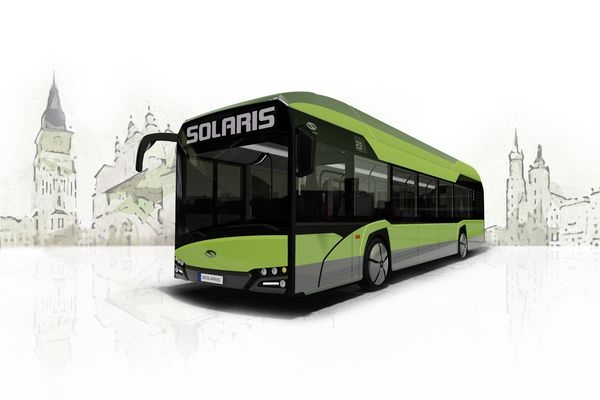
Responding to the increased interest of the European market in zero-emission public transport vehicles, Solaris Bus & Coach announces the premiere of another eco-friendly bus. The Solaris Urbino 12 hydrogen – a new generation hydrogen bus powered by energy from a hydrogen fuel cell – will join the ranks of vehicles with alternative drives. The official premiere of the vehicle is planned for 2019.
The Solaris Urbino 12 hydrogen will be a completely zero-emission vehicle. The energy needed to power the bus’s drive system will come from hydrogen, which in turn will be converted into electricity in a fuel cell. Thanks to the technology used in the vehicle, the hydrogen bus will be able to cover a record-breaking range (among all electric buses) on a single refueling – over 350 km. The vehicle will also be equipped with a small Solaris High Power traction battery with a capacity of 29.2 kWh, designed to support the fuel cell during peak energy demand. The battery will be charged with energy derived from hydrogen. Additionally, the vehicle will have the option to charge the battery via a plug-in socket (as is standard for electric buses). The drive will consist of an axle with integrated electric motors with a nominal power of 60 kW each. The twelve-meter bus will be characterized by high passenger capacity and will carry up to 80 travelers.
The new generation Solaris Urbino 12 hydrogen is a continuation and development of a concept that first saw the light of day in 2014 with the delivery of two articulated electric buses (Solaris Urbino 18.75) to Hamburg, powered by a hydrogen fuel cell to extend the range. In the buses presented 4 years ago, the main source of propulsion was batteries. In the new hydrogen bus, the electricity powering the vehicle will come from hydrogen, while the battery will only serve an auxiliary function.
These are not the only modern solutions proposed in the vehicle. The twelve-meter Solaris Urbino hydrogen will be equipped with an ultra-modern, latest-generation fuel cell with a power of 60 kW. The manufacturer will also use the latest solutions in hydrogen storage technology, mounting tanks made of composites on the roof of the vehicle – thanks to this, the mass of the tanks will drop by about 20% compared to the previous model. To minimize energy consumption in the vehicle, a climate comfort system with a CO2 heat pump will be used, which will allow for the use of waste heat from the fuel cell. This is a completely new proposal that is intended to guarantee extraordinary efficiency and significantly increase the vehicle’s range.
– The revolution in eco-friendly public transport is a fact – Solaris has decided to respond to this demand with another product. And hydrogen buses have all the predispositions to exist more widely on the market: they are cheap to operate, lighter than electric buses, have a range sufficient to travel 350 km on a single hydrogen refueling (which is the average daily mileage of a city bus) and are completely zero-emission – the only substance emitted while driving is water vapor – says Dr. Dariusz Michalak, Vice President of Solaris Bus & Coach responsible for Research and Development.
Both Solaris Urbino 18.75 electric buses with a hydrogen cell delivered to Hamburg in 2014 run regularly on the line 109 route. In addition, last year the Polish manufacturer delivered the first trolleybus powered by a hydrogen fuel cell to extend the range to Riga. By the end of this year, a total of 10 such vehicles will be operating in the capital of Latvia.