








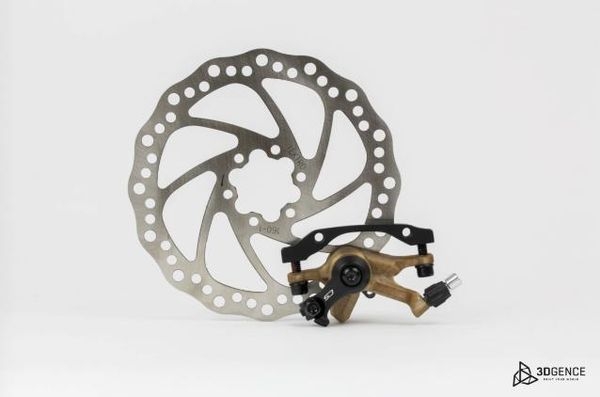
Scientists from the Singapore University of Technology and Design have just announced that they have developed a new material that can be used for 3D printing. It is cheap, lightweight, and renewable, consisting of cellulose and chitin. The material has already been used to print a turbine blade that is 1.2 m long and weighs only 5.2 kg.
– Subsequent discoveries by scientists are opening up new possibilities for the use of 3D printing in industry. In 2017, 22% of companies used 3D prints in their production or maintenance processes. However, the industry is striving to print not only prototypes but also finished products – says Mateusz Sidorowicz from 3DGence.
Research from 2017 shows that 3D printing is primarily used in the R&D departments of companies that are working on new solutions and, thanks to this technology, are verifying their ideas without involving other departments. Companies also use 3D printers to shorten product implementation time. They create prototypes and improve them on an ongoing basis, eliminating emerging errors. Because they do this on-site and use their own materials, the entire process is faster and, above all, cheaper than collaborating with external suppliers. 3D printing is also an opportunity to produce spare parts on-site 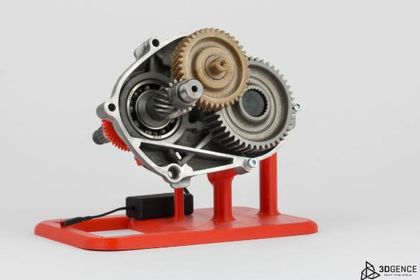 for machines and production lines. 3D printing is also increasingly used for finished details mounted in products. Gartner predicts, among other things, that by 2021, 75% of passenger aircraft will be equipped with components created using 3D printing. Already today, General Electric Aviation prints tens of thousands of nozzles annually for its new LEAP engines, and Airbus prints thousands of plastic brackets, clips, and mounts.
– Manufacturers of machines, cars, or airplanes are looking primarily for appropriate durability and savings today. The materials appearing are indeed becoming more and more durable. One of those that we offer to our clients and which is definitely worth paying attention to is PEEK. It has exceptional mechanical properties, chemical resistance, and high thermal resistance. Water-soluble support materials are also very popular. Thanks to them, it is possible to print very geometrically complex shapes without losing valuable model material or product quality, which can suffer when breaking off supports made of traditional filament – explains Mateusz Sidorowicz from 3DGence.
And how does 3D printing translate into savings in companies? The Electric Motorcycle Factory (LEM) prints, among other things, the fairings of its motorcycles on 3D printers.
– If it weren’t for 3D printing, we would have to spend many hours of work creating positives, negatives of molds, and then the finished element. Making such molds, including milling and finishing, costs several thousand zlotys. The use of 3D technology allowed us to reduce costs to approx. 400 PLN – explains Wojciech Pawlak from the Electric Motorcycle Factory.
It is estimated that over the next 5 years, the 3D printing market will grow by 374%. This will be influenced by innovations that will make it possible to use 3D technology in new branches of industry. Scientists and manufacturers are already working on new materials to offer companies widespread, convenient, cheap, and fast printing not only using polymers but also metal or resins. Thanks to this, 3D prints will be able to serve as spare parts for machines, devices, and final products.