








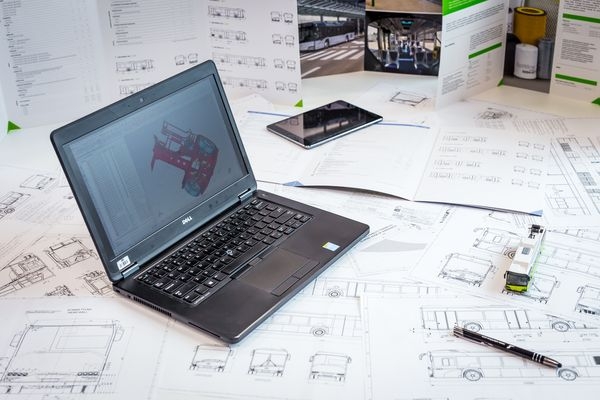
The Research and Development Office of Solaris, which currently employs nearly 150 engineers, not only develops new designs for complete vehicles but also introduces innovative components and systems used in buses and trolleybuses into mass production. Some of the areas that Solaris engineers have been working on recently include air conditioning and heating systems, as well as power steering systems.
Most of the effort put into the development of heating systems in electric buses is related to reducing energy consumption and ensuring a greater range. To this end, manufacturers often choose to use a diesel-powered heating furnace. Such a solution, while effective at very low temperatures, is far from emission-free. Solaris, which encourages customers to use electric heating, proposed an innovative solution in its electric Urbino 8.9 LE electric buses for RCKiK Katowice: a heating system powered by LPG. This is a low-emission solution and significantly cheaper than using a traditional diesel furnace. Furthermore, LPG tanks are smaller than the previously used CNG, making their installation less complicated.
In the hydrogen vehicle currently being built at the Bolechowo factory, Solaris will, in turn, propose a heating and air conditioning system in which the working medium will be CO2, which is the most environmentally friendly refrigerant. The use of an electric heat pump allows for the recovery of waste energy from the hydrogen drive cooling system, thereby significantly reducing energy consumption from the battery, which in turn results in extending the vehicle’s maximum range and guarantees efficient operation at low temperatures. All this takes place with fully emission-free operation.
Another change that Solaris engineers are already preparing for is the gradual reduction in the use of the R134a refrigerant, used in current air conditioning systems. According to European Union regulations, it is to be completely replaced by the much more environmentally friendly R513a by 2030. Thanks to the efforts of the Polish manufacturer and one of its suppliers, the air conditioning systems of vehicles from Bolechowo can already be refilled with the cleaner agent today.
Changes have also affected the power steering system. For some time now, a new solution has been standard in all electric and hybrid buses leaving the Bolechowo factory. Optionally, it can also be used in trolleybuses. We are talking about an electric power steering pump powered by standard 24V batteries. This solution results in reduced energy consumption – as the pump does not load the main engine – which also increases the vehicle’s range. Further arguments in favor of this design are the variable rotational speed of the pump, thanks to which the steering assistance force is greater at low vehicle speeds and decreases as speed increases. Above all, however, this solution leads to a significant increase in safety, as the power steering pump itself is not dependent on other devices, the failure of which could, in extreme cases, result in a loss of vehicle control.
Over the last 4 years, Solaris has spent 145 million PLN on research and development. This expenditure translates directly into the safety and technological advancement of the manufactured vehicles. Thanks to these features, among others, the Solaris Urbino 12 electric was chosen as the best city bus of the year in the prestigious ‘Bus of the Year 2017’ competition.