








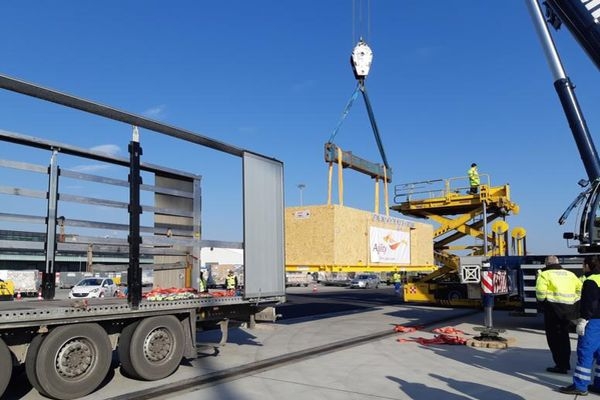
Agility, a global provider of integrated logistics solutions, has organized the delivery of a steam turbine rotor to a power plant in South Korea for a client in the energy sector. Within 3 days, the cargo weighing over 20 tons covered a distance of approximately 9,000 km.
The steam turbine rotor was transported in a specially prepared crate 7.7 m long, 2.3 m high, and 1.81 m wide, which was intended to ensure safe transport and prevent damage during loading and unloading. The transport, organized on a door-to-door basis, consisted of three stages. First, the device was transported from Wrocław to the airport in Vienna by a truck with a 24-ton capacity semi-trailer, from where it was transported by a Boeing 747F aircraft to Seoul Incheon Airport in South Korea. The final stage was transporting the cargo by a low-loader platform truck to the power plant in Bucheon.
– While preparing the proposals, we checked and presented various transport variants, including sea and charter. The client chose the air transport version as the most optimal and best suited to their needs – says Piotr Klimecki, Business Development Manager at Agility Logistics, responsible for developing the project and supervising the organization of the transport.
When planning the transport of the steam turbine rotor, Agility Logistics freight forwarders had to pay special attention to the method of loading and unloading, both onto the truck and the aircraft, as well as proper securing during transport. Despite its large size and weight, the device is very sensitive to damage. Such rotors are properly balanced and custom-built almost “to the micrometer” for use in a specific turbine at a power plant. This is why even a small scratch caused during transport could seriously damage it, rendering the device useless. Therefore, the method of preparing the cargo for transport was of key importance. The steam turbine rotor was placed in a crate and on a stand with special connecting elements. The entire assembly was designed by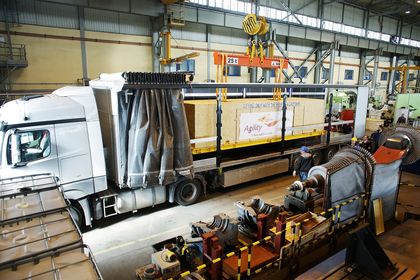 Agility specifically for the requirements of the airline and the transport capabilities of the Boeing 747F aircraft. The crate was loaded onto the truck from the top of the trailer using a gantry crane. The loading method also determined the choice of aircraft. Due to its size and weight, the crate could be loaded from the front through the characteristic “nose door” of this model. A lift and a crane with a five-meter spreader beam were used for this purpose.
– Organizing oversized transport requires very good and precise planning, preparation, and execution. The foundation is good communication, trust, and cooperation between the freight forwarder, the airline, the client, and the recipient. Everyone must know well in advance what they have to do and what they are responsible for. According to the client’s decision, the steam turbine rotor had to be delivered by air for safety reasons and to meet the tight delivery deadline. As a freight forwarder, we had to ensure that the cargo was adapted to the requirements of the airline and the capabilities of the Boeing 747F. Together, we determined how to design the crate. The teams in Vienna and Seoul also received detailed instructions from us in advance regarding, among other things, the preparation of the crane for loading and unloading or methods for safely lifting the crate. Any shortcomings could have resulted in damage to the rotor, which would have meant large financial losses for our client. Preparing such a transport involves great responsibility, and we are happy that the entire operation was a success – concludes Piotr Klimecki.
In addition to the steam turbine rotor itself, Agility Logistics also delivered its accessories to the Korean power plant. Their total weight amounted to 25 tons. The entire order was completed within 14 days. Agility Logistics specializes in serving companies in the energy and industrial sectors, organizing air, sea, road, and rail transport for its clients. These also include oversized and special shipments. The company organized sea transport to Houston, USA, for over 850 gas extraction pipes nearly 12 m long. Their total weight was 340 tons.