









The annual obligation to change the clock from winter to summer time also applies to professional drivers who record their work using a tachograph. They are required to fully account for their activities. Changing the time is often a source of problems for drivers regarding working time records and difficulties during roadside inspections. How to correctly change the time in a digital or analog tachograph?
Analog tachograph
It is easiest to make changes related to time adjustment in analog devices. Their relatively uncomplicated technology allows for updating the time in a few simple steps. However, one must remember what will appear on the “chart”.
– In analog tachographs, setting the time from winter to summer is quite simple, as we now move the clock forward by one hour (from 2:00 to 3:00). It is important, however, to properly account for this “appearing” hour in the general work plan. On an analog tachograph, this hour will appear as “no data”, so it is worth making a note on the back of the chart regarding the time change in the tachograph due to the switch from winter to summer time. When planning a break, it must actually be taken, rather than using the “extra hour” after moving the clock and continuing to drive without the required rest. – comments Mariusz Hendzel, an expert at the ITD-PIP Transport Law Firm.
An undoubted advantage of the analog tachograph is that we can choose the moment of changing the settings ourselves, i.e., adjust the clock after reaching the destination and thus properly plan the moment of the break on the road.
Digital tachograph
The process is slightly different when the driver uses a digital tachograph. This device operates according to Coordinated Universal Time (UTC). This time is independent of time zones, and furthermore, UTC time itself cannot be changed.
– That is why, when analyzing violations or calculating working time, computer programs perform the time zone shift within their own algorithm. These changes depend on the country of vehicle registration. And here, the moment of the time shift depends on the computer program and not on the driver themselves. Some systems perform this correction exactly at 2:00 AM, creating a “virtual” break in activities even if the driver did not stop the vehicle at that time. Others do it more practically, modifying activities only after the vehicle has stopped, so as not to disrupt the natural driving record made by the tachograph in UTC time. – explains Mariusz Hendzel.
The time change is mandatory and must be strictly remembered. The tachograph is a device that records the driver’s working time, and the driver must make every effort to ensure that the data is as accurate as possible.
Changing the time in the tachograph – step-by-step guide
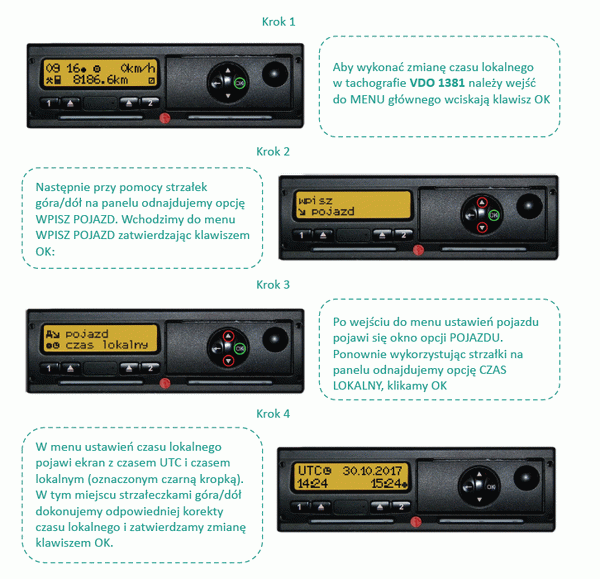
The article, along with the graphic guide, was prepared by Kancelaria Transportowa ITD-PIP Sp. z o.o.