








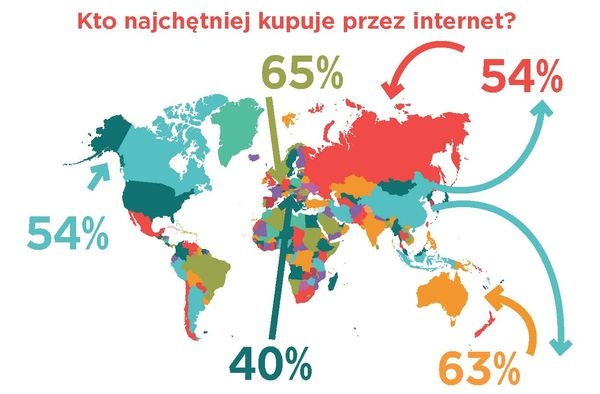
The numbers demonstrate the power of e-commerce: 2 trillion USD in global electronic trade (9% of total trade) and 30 billion shipments. E-customers are increasingly choosing to shop abroad: currently, one in every five electronic transactions crosses borders.
By 2020, the value of the e-commerce market will reach 4 trillion USD in sales, which will account for 15% of total trade. This could translate into 60 billion shipments intended to reach 2 billion e-customers. Such a large market, growing at a rate 4-5 times faster than others, presents a logistical challenge.
Challenges of cross-border e-commerce
Conducting cross-border e-commerce business is associated with significant barriers:
1) Cost of international delivery
It is sometimes several times higher than domestic delivery. Costs are influenced by distance and a lack of standardization and interoperability. There are also limitations, among others, in sending bulky shipments. Delivery cost is a significant aspect: as many as 90% of consumers may repeat purchases if the delivery cost was satisfactory.
2) Delivery time and tracking capability
It ranges from a few to even several dozen days. Often, shipments must undergo customs clearance, which extends delivery time. The ability to monitor the shipment status is also important. Nearly half of consumers do not decide to make international e-purchases due to expected delivery problems.
3) Language
The basis is communication in a language understandable to both parties on the website, in inquiries about an offer, or in handling product returns. Only 61% of e-shops in the European Union offer information in more than one language.
4) Currency
Customers prefer shops that offer their native payment currency. On average, one in three customers is willing to abandon their shopping cart if prices are only in a foreign currency, and nearly 40% of consumers declare no desire to return to such shops.
5) Payment method
Not all online shops offer generally accepted payment methods. This can contribute to abandoning purchases. In the EU, credit card payment is offered by 95% of online shops, debit card payment by 65%, online payments are handled by 51% of shops, bank transfer is available in 43% of shops, and cash on delivery is offered by 20%.
6) Law and taxes
Uncertainty regarding the total price of a product, including taxes, customs duties, or bank fees, discourages customers from buying from foreign sellers. 57% of Europeans have concerns related to product returns, product defects, and a lack of certainty regarding consumer rights in cross-border e-commerce.
7) Returns
Product returns in cross-border e-commerce are closely related to the aforementioned barriers: language – returning requires finding return instructions or establishing contact with the seller; currency and payment method – exchange rate fluctuations may cause the customer not to receive the exact amount they paid to the seller upon conversion; delivery cost – the customer must account for the need to bear the high cost of return shipping and wait for the return to be processed only after the seller receives the product. In more than half of cases in cross-border e-commerce, customers do not receive the full amount for a returned product.
Proposed logistics solutions for cross-border e-commerce
1) European Commission platform regarding cross-border delivery rates
Operators handling international shipments offer prices that are too high for e-commerce. Currently, about 55% of Europeans shop online in their own country, but only 32% place orders in shops abroad. The reason is high shipping fees from another country. A solution could be the European Commission’s electronic platform, where cross-border delivery rates of CEP operators are to be published. The platform will enable price comparison, selection of the most favorable offer, and detection of potential market irregularities. However, the new regulations will not apply to small enterprises.
2) Shipment standardization and European Committee for Standardization recommendation
The proprietary, internal solutions of CEP operators regarding shipment labeling hinder cross-border deliveries (re-labeling, limited shipment tracking capabilities). The European Committee for Standardization (CEN) has recommended one standard for labeling cross-border parcel shipments across Europe: the SSCC identifier (Serial Shipping Container Code). The SSCC identifier will now be an integral part of the standard GS1 logistics label and will allow for the unambiguous identification of a shipment, regardless of the operator. Parcel senders will be able to use the same SSCC identifier for all their shipments. Thanks to the introduction of an identifier using global standards, the previously closed operating systems of CEP operators will be able to be connected, thus creating a single, common network of independent entities.
A common identifier will facilitate tracking the route of international shipments: currently, 40% of cross-border postal shipments cannot be tracked, mainly due to different labels and a lack of system integration. The standardization of parcel labeling is primarily intended to lead to a reduction in the costs of cross-border shipments, as well as to ensure full transparency in the supply chain and shorten delivery times.
The article comes from the “Kod Eksperta” magazine, published by GS1 Poland.
