








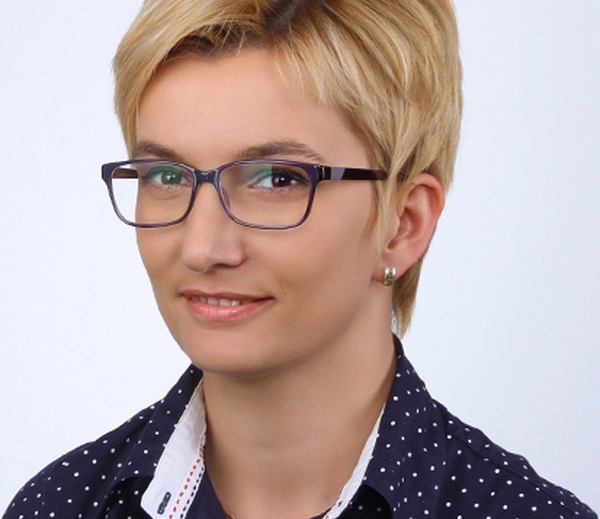
An interview with Jolanta Gałązka, Head of Logistics at Tubądzin, member of the GS1 Council.
What are the biggest challenges for logistics operators in serving the Tubądzin Group?
Jolanta Gałązka: The challenges for operators only began when we expanded our offer to include large-format tiles from the Monolith series. Previously, tiles were transported only on Euro pallets. Large-format tiles, the largest in the Monolith series, measure 120 x 240 cm – we pack them in crate-pallets, which are a huge challenge for less-than-truckload transport. Currently, none of the major logistics operators have the appropriate equipment in regional terminals to be able to handle such a carrier and effectively deliver it to the customer.
Are there solutions that streamline processes in the product group?
J. G.: The entire production process for this size of tile is completely automatic. Individual tiles are moved by robots equipped with numerous suction cups. After packing the tiles into collective packaging, the crate-pallets are then handled by internal combustion forklifts. In the picking process, where we again operate on individual pieces, we rely on the experience of production plants and move the tiles using suction cups and internal transport trucks dedicated to such dimensions. Gaining invaluable experience in handling such a demanding format, we are designing a picking line that will allow us to achieve better efficiency.
How is the supply chain organized with such large production and several production plants?
J. G.: The total production volume across all three production plants is over 1 million square meters. Since the launch of our own Logistics and Distribution Center within the Tubądzin Group, all processes have been maximally optimized and consolidated into one location. The Logistics Center acts as a Central Warehouse, to which the entire production from the three plants flows. This is also where comprehensive customer service takes place, starting from order receipt through picking and shipping of goods to the business customer’s warehouse, which is a wholesaler or a retail showroom.
How high is the level of automation in your logistics processes?
J. G.: The production process in each of the factories is highly automated, even dominated by robots, autonomous trucks, and intelligent transport and packaging systems. We have long been thinking outside the box and acting in a very non-standard way. As the first in our industry, we have been successfully cooperating with our customers, both domestically and abroad, by fulfilling orders through a B2B online purchasing platform. What used to absorb the sales team significantly has long been happening automatically in the company. We are constantly working on automating all our internal processes, while at the same time our attention is equally focused on the employee.
Why was Sieradz chosen as the location for the new production plant?
J. G.: The factory in Sieradz was located in the Łódź Special Economic Zone in the Sieradz-Zapusta subzone on an area of approximately 7 hectares. When planning investments, the central location of Sieradz, near the S8 expressway, as well as the proximity to two ceramic tile factories – in Tubądzin and Ozorków – and the distribution center in Cedrowice, were of course significant. I will add that the owners of Ceramika Tubądzin, Joanna and Andrzej Wodzyński, are residents of Sieradz and it was their dream to locate the plant in the region they come from.
What does the network of logistics partners look like and what helps to improve it?
J. G.: Cooperation with over 1,300 trading partners obliges us to be very selective in choosing logistics operators. We demand the highest quality from each of them, as customers evaluate the Tubądzin company, not the logistics operator. Without implemented GS1 standards, it would be difficult for us to manage such a dispersed sales network, or it would even be impossible. GS1 standards allow us to continuously improve logistics processes, including production intake, warehousing, quality control, inventory, and picking. We will soon begin implementing a new logistics label that combines a transport label. This will be a very important step in cooperation with logistics operators, which will significantly reduce costs and errors throughout the entire transport route to the end customer.
Is the Tubądzin Group developing a nationwide distribution network, or is it focusing on selected markets with the highest sales volume?
J. G.: The distribution network is based on a group of large ceramic tile wholesalers that serve bathroom showrooms in Poland. The company cooperates with over 1,300 trading partners, which makes Ceramika Tubądzin products available throughout the country. Year by year, we are also increasing our sales share in international markets, constantly acquiring new markets.
What are Tubądzin’s plans for 2018, and what will inspire the new tile collections?
J. G.: The Tubądzin Group is entering a new stage of its operations – among other things, the first Polish large-format slabs have hit the market, which we plan to popularize, also on building facades. We have also expanded the range of slab decoration and want to make wider use of these possibilities. Maciej Zień and Dorota Koziara are already working on the collections. We believe that tile design should reflect not only trends in construction, but above all in global fashion, and this is the direction in which we will develop them.
The article comes from the “Kod Eksperta” magazine, published by the GS1 Poland Foundation.