









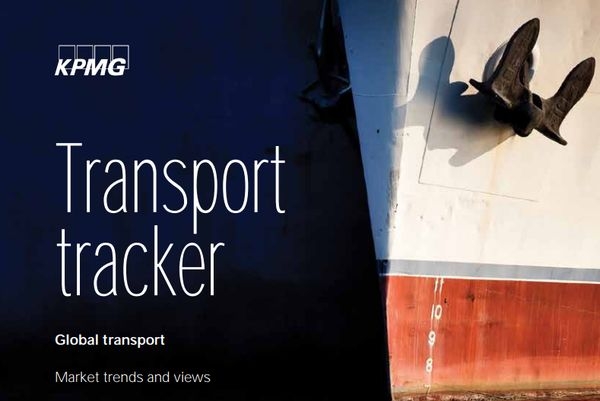
Geopolitical turmoil and the slowdown in the global economy are negatively affecting the development of the transport industry. Maritime transport stands out positively against the background of the industry. A major challenge lies ahead for companies in the logistics sector, which must respond even more to the demands of digital consumers. These are the conclusions of the KPMG International report titled “Transport tracker. Global transport – market trends and views”.
Negative effects of political changes in the world
Geopolitical turmoil has significantly affected the state of the global economy, including the transport industry. According to CPB statistics, global trade fell by 1.1% in October 2016. For many, 2016 was the year of the slowest growth in trade and production since the financial crisis in 2009. By the end of 2017, trade growth is expected to be in the range of 1.8% to 3.1% (a correction of the previous forecast by the World Trade Organization, which assumed growth of 3.6%). This deterioration is due to declines in goods sales volumes, which are the result of slowing GDP growth dynamics and trade exchange in developing economies.
– The reduction in trade growth dynamics and conservative forecasts are the result of many changes in the world, such as shorter supply chains, decreasing wage arbitrage, and the stabilization of the globalization process. Recent studies show that in times of digitalization, data and information flows bring greater economic value than the global trade in material goods. Undoubtedly, however, the transport of goods and people will remain the basis of the operations of most transport companies in the world, while the flow of data and information that transport companies manage opens up new development opportunities for them – says Wojciech Drzymała, partner in the general audit department, head of the advisory team for the transport, shipping, and logistics sector at KPMG in Poland.
Better in maritime transport
After a worrying start to 2016, the situation in the global shipping market has improved significantly. The net carrying capacity of global shipping (calculated as ship deliveries minus scrapping) showed a slight increase last year, which, combined with a decline in orders for new ships, creates good prospects for market growth. It is expected that during 2017, demand in the global shipping market will increase by about 3%, while supply will increase by about 1%, which will bridge the gap between supply and demand and influence the increase in the value of the shipping market. This trend is confirmed by the BDI (Baltic Dry Index), which reached a historical low of 290 points in February last year, and reached 1,588 points on October 24 this year.
Aviation market with a good outlook
According to IATA (International Air Transport Association) data, passenger traffic demand increased by 6.3% in 2016 compared to the previous year, which is an impressive result, considering that the lowest GDP growth (2.3%) since the beginning of the financial crisis in 2009 was recorded at that time. The IMF predicts that economic activity will increase in 2017 and 2018, especially in emerging markets and developing economies, which may positively affect the development of the aviation market. Geopolitical turmoil and rising fuel prices may negatively affect the margins realized by carriers and disrupt the development of the aviation market.
Logistics must open up to innovation
The uncertain geopolitical situation also affects logistics due to its high dependence on the growth of global trade. However, it is unlikely that this will slow down the growth of cross-border exchange in e-commerce. As the discussion on the transition to the fifth generation of mobile networks (5G) develops, online trade is becoming faster and better at responding to the impulsive needs of retail customers. As a result, logistics companies must meet high standards and the increasingly high requirements of their online customers.
– In the face of ever-increasing pressure to introduce innovation and an increasing number of companies developing new technological solutions, logistics companies must decide whether to develop technologies on their own or use ready-made solutions. Costs, speed of implementation, and usefulness must be taken into account, but the key factor is adaptation to the requirements of Millennial consumers – says Wojciech Drzymała, partner in the general audit department, head of the advisory team for the transport, shipping, and logistics sector at KPMG in Poland.
The full version of the report in electronic form can be downloaded from the website kpmg.pl